UFC front kick KO's
0
Front Kick·veronicafight
Bekijk alle front kick KO's uit de UFC, welke vond jij het mooist? VOLG Veronica Fight op social media: Facebook | http…
Translation: front kick
The Front Kick family groups all kicking techniques delivered in a forward linear trajectory, where the leg extends directly toward the opponent to strike with the ball of the foot, heel, or sole. [1] Front kicks are among the most fundamental and versatile kicks in martial arts, serving as both offensive weapons and defensive distance-management tools depending on the variation: snap front kicks deliver sharp, retractable damage while push kicks (teep) create distance by shoving the opponent backward. [1],[2] Biomechanically, the front kick uses hip flexion and knee extension along the sagittal plane, producing a direct-line force vector that is efficient and difficult to deflect laterally. [2],[3] The family is subdivided into push kick/teep variations (emphasising push-through force) and snap front kick variations (emphasising speed and retraction). [3]
The front kick is one of the most ancient and universal kicking techniques, appearing in virtually every martial art that includes leg strikes. [1] In karate, mae geri (front kick) was codified by Gichin Funakoshi as one of the fundamental kicking techniques of Shotokan. [1],[2] Muay Thai's teep (push kick) has been refined over centuries of Thai ring fighting as the primary distance-management tool. [2],[3] The front kick gained renewed attention in MMA when Anderson Silva knocked out Vitor Belfort with a front kick to the chin at UFC 126 (2011), a technique credited to his training in Steven Seagal's front kick methodology. [3]
Front kicks are used in all kickboxing, TKD, and MMA competition. [1]
No images yet for this technique.
Sign in to suggest an image.
Bekijk alle front kick KO's uit de UFC, welke vond jij het mooist? VOLG Veronica Fight op social media: Facebook | http…
Thanks for my episode partner for assisting me with muscle growth. Head over to https://bioptimizers.com/gabriel & use…
No instructional courses yet for this technique.
Sign in to suggest a course.
Risk of injury to the person this technique is applied to
Teep/push kick; primarily distance management, liver shot potential
Skill level needed to execute this technique reliably
Whether this technique is allowed under major competition rule sets
Muay Thai: The Art of Fighting (Yod Ruerngsa, Khun Kao Charuad & James Cartmell, 2002)
Alias sources — [1] Dynamic Karate (Nakayama, 1966) [2] Muay Thai: The Art of Fighting (Kraitus & Kraitus, 1988) [3] Karate-Do Kyohan (Funakoshi, 1935)
Effectiveness sources — [1] Muay Thai Unleashed (Delp, 2006) [2] Comprehensive Asian Fighting Arts (Draeger & Smith, 1969)
Official karate technique names (和語/漢語)
Established Japanese martial arts naming convention — native Japanese term (和語/漢語)
Alias sources — [1] Dynamic Karate (Nakayama, 1966) [2] Muay Thai: The Art of Fighting (Kraitus & Kraitus, 1988) [3] Karate-Do Kyohan (Funakoshi, 1935)
Effectiveness sources — [1] Muay Thai Unleashed (Delp, 2006) [2] Comprehensive Asian Fighting Arts (Draeger & Smith, 1969)
hip flexion power, knee extension speed, balance
long legs for range, hip flexibility
hip flexors, quadriceps, tibialis anterior, core
Every move, in any martial art, shares a few universal traits. Mix and match below to pinpoint the right tool — or compare equivalents across styles.
The Double Front Kick is a technique where the fighter delivers two successive front kicks without the kicking foot returning to the ground between strikes. [1] Typically, the first kick targets the midsection to lower the opponent's guard, and the second kick targets the face or neck. The technique requires excellent balance, hip flexibility, and timing to execute both kicks with speed and accuracy while maintaining combat effectiveness. [1] In Taekwon-Do, it is classified as a flying front-back kick (Twimyo Apdwi Chagi). [1]
The Drop Front Kick is a front kick delivered while the practitioner intentionally drops their body toward the ground, creating an unexpected low-angle attack that bypasses standing defences by striking from below the opponent's visual field. [1] As the kicker's body descends in a controlled fall, the kicking leg extends forward and upward, striking with the ball of the foot while the body is in mid-descent — the kick arrives from an angle that standing opponents are not conditioned to defend because conventional kicks come from an upright position. [1] The technique is classified as a 'sacrifice' kick because the practitioner deliberately abandons their standing base to execute the strike, accepting the trade-off of ending up on the ground in exchange for the element of surprise and the unique attack angle. [1] De Bremaeker and Faige categorise the Drop Front Kick alongside other drop kicks (drop side kick, drop roundhouse kick, drop back kick) as a family of techniques derived from capoeira, kung fu, and traditional martial arts systems that incorporate ground-level transitions into their fighting methodology. [1] The kick is most effective as a counter: when the opponent charges forward aggressively, the kicker drops below their attack line while simultaneously firing the front kick upward into the opponent's exposed midsection or face — the opponent's own forward momentum carries them into the ascending kick while the kicker's body drops safely below the opponent's strikes. [1] In MMA, ground-level kicks (up-kicks) from the guard position use similar mechanics, though those are delivered from an already-grounded position rather than from a deliberate drop. [2] The Drop Front Kick represents the broader martial arts principle that changing levels — moving between standing and ground-level fighting — creates confusion and openings that fixed-height fighting cannot achieve. [1]
The Drop Twin Front Kick delivers two successive front kicks while dropping to the ground — typically the first kick targeting the midsection and the second targeting the head as the opponent bends forward, or vice versa. [1] This advanced sacrifice technique exploits the body's momentum during the drop to generate power for both kicks in rapid succession. [1] The first kick creates the defensive reaction that opens the target for the second kick, making this a self-setting combination. [1] It requires exceptional body control and timing to deliver both kicks accurately during the controlled descent. [1]
The Foot Blade Front Kick strikes with the outer edge of the foot (sokuto — literally 'sword foot') rather than the ball or heel, concentrating force along a narrow blade-like surface for penetrating impact against soft tissue targets such as the ribs, abdomen, and inner thigh. [1] The sokuto is one of the classical striking surfaces documented in traditional karate: it is the lateral edge of the foot running from the base of the little toe along the outer border to the heel — the same surface used in the standard yoko geri (side kick), but here applied to a front kick trajectory. [1,2] The practitioner chambers the knee identically to a standard front kick, then rotates the ankle to present the outer edge of the foot before driving it forward into the target, creating a kick that combines the direct trajectory of a front kick with the concentrated impact of a side kick's striking surface. [1] This hybrid quality makes the Foot Blade Front Kick effective in situations where the standard ball-of-foot front kick would be absorbed by a guard or armour: the narrow profile of the sokuto can slip between defensive frames, threading through gaps between the opponent's elbows that a broader striking surface would contact. [1] De Bremaeker and Faige document the Foot Blade Front Kick as one of the 89 fundamental martial arts kicks, noting its prominence in Wado-ryu and Shotokan karate where precise foot positioning (ashi-sabaki) is emphasised as a core component of kihon training. [1] The kick appears in several traditional karate kata, including Bassai Dai and Kanku Dai, where the sokuto surface is used in both front-kick and side-kick trajectories. [2] In practical application, the Foot Blade Front Kick is particularly useful against opponents in a sideways or bladed stance (common in karate, fencing, and some kickboxing styles) where the ribs are exposed to a straight-line attack but are too narrow a target for a standard ball-of-foot kick. [1]
The Front Leg Front Kick is a fast front kick delivered with the lead leg by sliding the rear foot forward to close distance before launching the kick. [1] The rear leg slides forward without moving the upper body to avoid telegraphing, creating a momentary crossed-leg position before the formerly front leg chambers and kicks. [1] This technique emphasizes speed over power — the reduced distance traveled means less hip rotation but a faster delivery that catches opponents before they can react. [1] It can function as a stop-kick against advancing opponents or as a range-closer when combined with offensive combinations. [1]
The Hopping Front Kick combines a quick skip-step forward with a rear-leg front kick, using the hop to close distance rapidly while maintaining the full power of a rear-leg kick — solving the fundamental problem in striking arts of how to bridge the gap between standing range and kicking range without telegraphing or losing power. [1] The mechanical principle is a rapid foot replacement: the rear foot slides forward to replace the front foot's position, while the front foot — now momentarily the 'rear' foot — lifts and delivers the front kick with the full hip rotation and body weight of a standard rear-leg mae geri. [1] The skip-step occurs below the opponent's visual horizon (feet moving along the floor are harder to detect than upper body movement), and the kick that follows arrives with the forward momentum of the hop added to the kick's own power — making the Hopping Front Kick significantly more powerful than a static front kick delivered from the same starting distance. [1,2] De Bremaeker and Faige document the technique as one of the most commonly used distance-closing kicks in tournament karate and taekwondo competition, noting that the hop-and-kick should be felt as ONE movement, not two. [1] In Shotokan karate, the technique is called surikonde mae geri (sliding front kick) and is practised extensively in kumite (sparring) as the primary method of bridging distance with the front kick. [2] The Hopping Front Kick became one of the most famous techniques in MMA history when Anderson Silva used a skipping front kick to knock out Vitor Belfort at UFC 126 (February 2011) — a kick that Steven Seagal controversially claimed to have taught Silva, though the technique has existed in karate for decades. [3] Lyoto Machida used the same technique to knock out Randy Couture at UFC 129 (April 2011), cementing the Hopping Front Kick's reputation as a legitimate fight-ending weapon in MMA. [3]
The Instep Angular Front Kick (Lotus Kick) is a front kick delivered at an inward angle using the instep (top of the foot), sweeping upward in a curved lotus-petal arc to target the groin, inner thigh, or — when used as a counter — the underside of the opponent's chin. [1] Unlike a standard front kick that travels in a straight line from the chamber to the target, the Lotus Kick follows a curved inward trajectory: the foot arcs from outside the body's centreline toward the inside, scooping upward as it crosses the midline, creating a sweeping path that bypasses straight-line defences and hooks around protective frames. [1] The instep provides a broad, flexible striking surface that can wrap around the opponent's inner thigh guard or cup under the chin — contact areas that the rigid ball-of-foot cannot reach because of their concave or angled geometry. [1] The technique combines elements of both the front kick (forward trajectory) and the inside crescent kick (inward arc), creating a hybrid that is particularly effective in close-quarter exchanges where the opponent's guard blocks straight-line attacks but leaves gaps for angled entries. [1] De Bremaeker and Faige document the Lotus Kick as one of the more exotic kicks in their 89-kick compilation, noting its roots in Chinese martial arts where the lotus flower motif appears frequently as a metaphorical basis for curved kicking trajectories — the opening petals of the lotus represent the sweeping, flowing motion of the kick's arc. [1] In practical application, the Lotus Kick is used as a surprise technique when the opponent's guard is tight against straight attacks: the curved trajectory sneaks around the guard from below and inside, reaching targets that conventional kicks cannot access. [1,2]
The Inward-Tilted Front Kick is a front kick with a trajectory change at the end from outside inward, creating a hybrid between a front kick and a small roundhouse. [1] The kick starts with a regular straight high-knee chamber, then the leg tilts mildly outward while the foot turns inward, causing the ball of the foot to connect from outside in. [1] While not a powerful kick, it is effective against opponents who stand sideways and feel protected from straight kicks. [1] The overall feeling is of a front kick rather than a roundhouse, with the trajectory change adding an element of surprise. [1]
Kansetsu Geri is a stomping kick targeting the opponent's knee joint — the foot drives downward or diagonally into the front or side of the knee, hyperextending or laterally stressing the joint. [1] It is one of the most effective and most controversial kicks in martial arts — a clean kansetsu geri can tear the ACL/MCL and end a fight instantly, but it also carries a high risk of permanent knee damage. [1] Legal in MMA as the 'oblique kick' (popularized by Jon Jones), but banned in many traditional martial arts competitions. [1]
Kin Geri is the dedicated groin kick in karate — a rising snap kick targeting specifically the groin using the instep or ball of the foot. [1] While any front kick can target the groin, Kin Geri is trained specifically for this target with the appropriate trajectory (steeply upward between the legs) and striking surface (instep sweeps upward into the groin). [1] It is one of the most effective self-defense techniques but is illegal in most sport competitions. [1]
The Lift Kick is a short-range upward scooping kick delivered with minimal or no chambering, targeting the groin with a fast upward arc of the foot from the ground. [1] Unlike a standard front kick that chambers the knee before extending, the Lift Kick travels in a direct upward arc from its resting position, using the instep or top of the foot to scoop into the groin with almost no preparatory movement. [1] This absence of telegraphing makes it one of the fastest kicks in any martial art — the foot travels the shortest possible distance to the closest available target. [1,5] The technique appears across multiple martial arts traditions: in karate it is classified as kin geri (gold kick, targeting the testicles) and is taught as a specific technique separate from mae geri keage; in Jeet Kune Do, Bruce Lee considered it the ideal expression of his principle of 'longest weapon to nearest target' — the lead foot to the opponent's groin. [5] In self-defence contexts, the Lift Kick is considered one of the most effective first-response techniques because it requires no martial arts training to execute at a basic level while producing immediate incapacitation against a male attacker. [1,2] Krav Maga founder Imi Lichtenfeld incorporated the groin kick as one of the first counterattack techniques taught to beginners, recognising its universal applicability. [3]
Mae Keage is the rising/snapping front kick in karate — the leg swings upward in a pendulum motion from the floor to the target, snapping at the apex and retracting quickly. [1] Unlike the thrusting front kick (mae kekomi) which drives through the target, keage rises INTO the target from below and snaps back. [1] The striking surface is the ball of the foot (koshi) or instep (haisoku), and the target is typically the chin, groin, or solar plexus. [1] This is the most commonly practiced front kick in traditional karate. [1]
The Oblique Front Kick is a downward-angled kick directed at approximately 45 degrees into the opponent's lead knee, thigh, or shin, using a stomping or pushing motion that attacks the structural integrity of the supporting leg. [1] Unlike a standard front kick that travels horizontally toward the midsection, the oblique kick drives downward into the opponent's leg, hyperextending the knee joint or buckling the thigh, which can cause ligament damage, cartilage tears, and immediate loss of mobility. [1,2] The technique has ancient roots in French savate, where it is called the chassé bas (low push kick) and has been a fundamental technique since the art's codification in the early 19th century by Michel Casseux and Charles Lecour. [2,3] The oblique kick entered mainstream MMA awareness primarily through Jon Jones, who used it systematically to neutralise the forward movement of opponents such as Quinton Jackson, Vitor Belfort, and Glover Teixeira, and through Anderson Silva, who employed it as a range-finding tool. [4] Bruce Lee advocated a nearly identical technique in Jeet Kune Do, calling it the 'stop kick to the knee' and considering it one of the most efficient self-defence techniques due to its simplicity, speed, and the difficulty of defending against a low-line attack. [5] The kick's biomechanical efficiency — requiring minimal flexibility, telegraphing, or athletic ability while inflicting maximum structural damage — makes it one of the most practical kicks in any martial art. [1,2]
The Phantom Groin Kick is a deceptive front kick that deliberately mimics a groin strike during its initial trajectory, triggering the opponent's involuntary hands-down protective reflex, at which point the kicker redirects the kick upward to the now-exposed midsection or face. [1] The technique exploits one of the most powerful involuntary reflexes in human neurology: the protective response to perceived groin attacks. [1] When a person perceives an incoming strike to the groin, the hands instinctively drop to protect the genitals — this reflex is so deeply hardwired that even experienced fighters cannot fully suppress it, creating a guaranteed window of vulnerability at the head and body level. [1] The mechanical execution involves chambering and initiating the kick identically to a standard groin kick (upward trajectory from below), then at approximately 60-70% of the kick's extension — the moment the opponent's hands begin to drop — the kicker redirects the trajectory upward by extending the hip flexion and adjusting the knee angle, sending the foot to the solar plexus, floating ribs, or chin instead of the groin. [1] The Phantom Groin Kick shares its tactical principle with the Question Mark Kick (which feints low and arcs to the head in a roundhouse trajectory) but operates on a straight front-kick line rather than a circular one. [1] Marc De Bremaeker catalogued this as one of the 89 fundamental martial arts kicks, noting that the technique is effective because 'no man on earth is able to keep his cool with something on a direct trajectory to his groin.' [1]
The Push Kick (Teep) subfamily covers front kicks designed primarily to create distance by pushing the opponent away rather than delivering sharp impact damage. [1] The teep (Thai: ถีบ, to push) is the quintessential Muay Thai distance-management weapon, using a thrusting motion with the ball or sole of the foot to shove the opponent's hips, abdomen, or chest backward, disrupting their rhythm and preventing their forward advance. [1,2] Unlike snap kicks that retract quickly, the push kick follows through the target, extending the leg fully and driving the opponent back with sustained force. [2,3]
The Side Front Kick is a front kick performed with a hip turn so that at full extension the upper body is perpendicular to the opponent rather than facing them. [1] Practiced extensively in Wado-ryu karate, this variation allows greater penetration while presenting less target surface to the opponent's retaliation. [1] The kick can be executed as either a penetrating or upward front kick with the added hip rotation, making it effective for simultaneous attack and evasion — the perpendicular body position allows kicking while dodging incoming strikes to the centerline. [1] A variation also appears in classical tai chi chuan sequences as oblique front kicks delivered at 45 degrees. [1]
The Snap Front Kick subfamily covers front kicks delivered with a fast, whipping motion that emphasises speed and retraction over push-through force. [1] The snap kick chambers high by lifting the knee, then rapidly extends the lower leg to strike the target with the ball of the foot before immediately pulling the leg back to the chambered position. [1,2] This snapping action makes the kick fast, difficult to catch, and effective for targeting the face, chin, solar plexus, or groin with sharp, damaging impact. [2,3]
The Switch Front Kick is a front kick executed after a rapid switch of the legs, delivering what is effectively a rear-leg-power kick from the front-leg position. [1] From fighting stance, a small hop switches the lead and rear legs, then the kicking foot rebounds off the floor into a high-knee chamber and extends as a penetrating or heel front kick. [1] This technique combines the speed advantage of a front-leg kick with the power of a rear-leg kick — the switching legs baffle the opponent while the rebounding foot generates additional momentum. [1] It functions primarily as a stop-kick rather than a pursuit technique, and is extremely powerful due to the rebound effect. [1]
Tiip Trong is the straight push kick (teep) in Muay Thai, delivered directly forward to the opponent's midsection or face using the ball of the foot or flat of the foot. [1] It is the most fundamental teep in Muay Thai — a front-leg or rear-leg pushing kick used primarily for distance management, disrupting the opponent's rhythm, and scoring. [1] Unlike a snapping front kick, the tiip trong pushes through the target rather than striking and retracting, making it a controlling rather than damaging technique. [1] It is one of the most frequently used techniques in Muay Thai competition. [1]
The Tilted Heel Front Kick is a front kick delivered with the heel while tilting the foot outward at approximately 15-30 degrees from vertical, allowing the kick to penetrate at a slight angle past the opponent's standard centreline defence. [1] In a standard front kick, the foot travels directly along the centreline and impacts with the ball of the foot or heel facing straight forward — any guard positioned on the centreline blocks it cleanly. [1] The Tilted Heel variant introduces a lateral offset: by everting (tilting outward) the foot during the final phase of extension, the heel approaches the target at a slight angle from the inside, which causes the hard heel surface to scrape along the edge of a centreline guard rather than impacting it squarely. [1] This scraping, angled approach means the kick slides past defences that would cleanly stop a straight-on front kick — the guard deflects the kick's centreline component, but the lateral component carries the heel past the defensive frame and into the target behind it. [1] The heel provides the hardest natural striking surface on the foot (the calcaneus is the largest bone in the foot, designed to bear the full body weight during walking and running), making it the ideal surface for a penetrating thrust kick. [1] The tilt adds a second benefit: the angled heel contacts the target surface at a non-perpendicular angle, which distributes the initial impact across a brief scraping motion before the heel sinks into the target — this 'dig' effect is more painful and penetrating than a flat-on impact of the same force. [1] De Bremaeker and Faige document the Tilted Heel Front Kick as one of the front kick variations in their 89-kick compilation, noting that it is particularly effective against opponents who habitually protect their centreline with tight, compact guard positions. [1]
Tsumasaki Geri is a front kick delivered with the tips of the toes as the striking surface, rather than the ball of the foot (chusoku) or instep (haisoku). [1] The toes are pulled tightly together and curled slightly upward to create a compact point of impact. [1] This technique concentrates the entire force of a front kick into the small surface area of the toe tips, allowing it to penetrate between the ribs, into the solar plexus, or under the chin. [1] Common in Okinawan karate and some Kyokushin lineages, tsumasaki geri requires extensive toe conditioning — practitioners traditionally trained by kicking bundles of straw (makiwara) and sand to toughen the toes over years. [1]
The front kick (mae geri in karate, teep in Muay Thai) is the most fundamental kick in martial arts — it appears in every kicking system worldwide. Anderson Silva's front kick KO of Vitor Belfort (UFC 126, 2011) renewed interest in the technique in MMA. (De Bremaeker & Faige, Essential Book of Martial Arts Kicks)
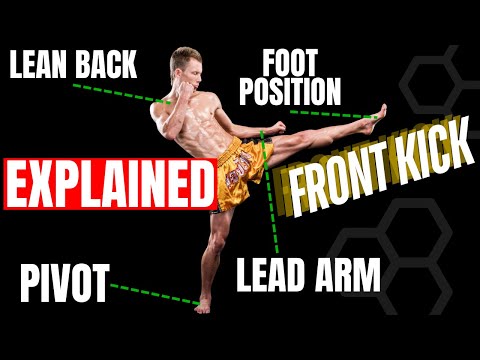
According to Gabriel Varga, a knee has the foot very tight and no pivot, with elevation happening differently. In a front kick chamber, you lift the leg and keep the heel slightly pulled in, which creates more snap and generates better distance compared to a tight knee chamber.
Gabriel Varga explains this happens because you're not lifting your knee high enough. If you extend upwards instead of outwards, your foot will jam into the target; instead, lift your leg more elevated and extend through early in the kick so you're hitting outward rather than upward.
According to Gabriel Varga, your toes should be pulled back with your foot pointed, not your toes pointed. Strike with the ball of the foot rather than the tips of your toes to get maximum range while maintaining proper form and preventing jamming.
Gabriel Varga emphasizes keeping one hand up for defense while the other swings down as you extend the kick, but not prematurely—if your opponent rushes you while your hands are down, you lose defense. Advanced practitioners can bring the swinging arm up the centerline as a block against straight punches instead.
The Front Kick family groups all kicking techniques delivered in a forward linear trajectory, where the leg extends directly toward the opponent to strike with the ball of the foot, heel, or sole. Front kicks are among the most fundamental and versatile kicks in martial arts, serving as both offensive weapons and defensive distance-management tools depending on the variation: snap front kicks deliver sharp, retractable damage while push kicks (teep) create distance by shoving the opponent backward.
The front kick is one of the most ancient and universal kicking techniques, appearing in virtually every martial art that includes leg strikes. In karate, mae geri (front kick) was codified by Gichin Funakoshi as one of the fundamental kicking techniques of Shotokan.
Unified MMA: legal — Legal striking technique; WBC/Boxing: banned — All kicks prohibited in boxing; WKF: legal — Legal, chudan (body) kick scores 2 points, jodan (head) kick scores 3 points; Kyokushin: legal — Legal at full power to body and head; WT: legal — Legal, body kick 2 points, head kick 3 points, spinning body 4 points, spinni…; WAKO: legal — Legal in Full Contact and Low Kick formats; K: legal — 1/GLORY — Legal; IFMA: legal — Legal — kicks are a core Muay Thai technique
Danger rating 5/10. High — teep/push kick; primarily distance management, liver shot potential
The standard setup chain: Stance and Range → Chamber the Leg → Execute the Kick → Recover.
Standard counters include: Check (Shin Block) — raise the shin to intercept the kick before it lands / Catch and Sweep — catch the kicking leg and sweep the standing leg / Step Inside — close distance inside the kick's effective range to smother it.
Common variants: Push kick (teep) (pushing the opponent away with the ball of the foot); Snap front kick (snapping the foot to the target and quickly retracting); Side teep (angled teep pushing the opponent laterally); Body teep (driving into the solar plexus or chest for maximum push-back).
Front kicks are used in all kickboxing, TKD, and MMA competition.
Top errors to watch for: Not chambering the knee before extending — the kick becomes a pushing leg extension without snap or power / Leaning back too far as compensation for lack of hip flexibility — keep the torso as upright as possible / Kicking with the toes instead of the ball of the foot, risking broken or jammed toes / Leaving the kicking leg extended and not retracting it, which allows the opponent to catch and sweep.
The Front Kick is also known as Mae-geri, Mae Geri, Teep, Front Thrust.