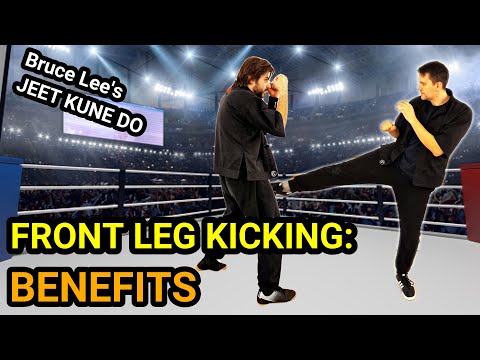
FRONT 🦵Kicking - Bruce Lee's Martial Art Jeet Kune Do
0
Oblique Front Kick·Jeet Kune Do - Way Of Intercepting Method
Why are front kicks more often used in Bruce Lee's Jeet Kune Do, than the rear kicks? In thins video we are showing some…
Translation: Diagonal front kick — oblique refers to the angled, downward trajectory of the kick
The Oblique Front Kick is a downward-angled kick directed at approximately 45 degrees into the opponent's lead knee, thigh, or shin, using a stomping or pushing motion that attacks the structural integrity of the supporting leg. [1] Unlike a standard front kick that travels horizontally toward the midsection, the oblique kick drives downward into the opponent's leg, hyperextending the knee joint or buckling the thigh, which can cause ligament damage, cartilage tears, and immediate loss of mobility. [1],[2] The technique has ancient roots in French savate, where it is called the chassé bas (low push kick) and has been a fundamental technique since the art's codification in the early 19th century by Michel Casseux and Charles Lecour. [2],[3] The oblique kick entered mainstream MMA awareness primarily through Jon Jones, who used it systematically to neutralise the forward movement of opponents such as Quinton Jackson, Vitor Belfort, and Glover Teixeira, and through Anderson Silva, who employed it as a range-finding tool. [4] Bruce Lee advocated a nearly identical technique in Jeet Kune Do, calling it the 'stop kick to the knee' and considering it one of the most efficient self-defence techniques due to its simplicity, speed, and the difficulty of defending against a low-line attack. [5] The kick's biomechanical efficiency — requiring minimal flexibility, telegraphing, or athletic ability while inflicting maximum structural damage — makes it one of the most practical kicks in any martial art. [1],[2]
The oblique kick traces its documented history to French savate, where the chassé bas (low push kick) was codified as a fundamental technique during the art's formalisation in the 1820s-1830s by Michel Casseux and Charles Lecour. [2],[3] Savate's system of four kicks (chassé, fouetté, revers, coup de pied bas) included low-line attacks to the legs as a core tactical element — the chassé bas specifically targeted the opponent's knee and shin as a distance-management and limb-destruction tool. [3] Bruce Lee incorporated a nearly identical technique into Jeet Kune Do in the 1960s and 1970s, referring to it as the 'stop kick' or 'low side kick to the knee' and considering it one of the most efficient techniques in his intercepting philosophy — he reasoned that the closest target to your front leg is the opponent's front leg, making the oblique kick the fastest possible attack. [5] The technique remained relatively obscure in mainstream MMA until Jon Jones began using it systematically from approximately 2011 onward, employing the oblique kick as his primary range-control tool against virtually every opponent. [4] Jones's success with the technique led to widespread adoption across MMA and renewed debate about whether knee-targeting kicks should be legal in professional competition. [4]
The oblique kick is arguably the most efficient kick in martial arts when measured by effort-to-damage ratio — it requires minimal flexibility, minimal telegraphing, minimal athletic ability, and minimal risk to the kicker, while targeting one of the most structurally vulnerable joints in the human body. [1],[2] In MMA competition, the oblique kick has been statistically correlated with significant reductions in opponent forward pressure and takedown attempts, as fighters become reluctant to step forward into the kick. [4] Jon Jones landed oblique kicks at a rate of approximately 8-12 per fight during his title reign, using them to systematically compromise opponents' mobility. [4] The technique is considered extremely difficult to defend because it attacks below the normal visual field and travels downward with gravity. [1],[5]
French savate (chassé bas, codified 1820s by Casseux/Lecour) → refined by Charlemont family (1899) → adopted by Bruce Lee into Jeet Kune Do as 'stop kick' (1960s-70s) → introduced to mainstream MMA by Jon Jones (c. 2011) → now a standard technique in MMA striking curricula worldwide. [2],[3],[4],[5]
Jon Jones used the oblique kick as a primary weapon throughout his UFC light heavyweight title reign (2011-2023), notably against Quinton Jackson (UFC 135), Vitor Belfort (UFC 152), Glover Teixeira (UFC 172), and Daniel Cormier (UFC 182, 214). || Anderson Silva employed oblique kicks as range-finders throughout his middleweight reign. || The technique has been used to finish or significantly impair opponents in multiple UFC, Bellator, and ONE Championship events. || Controversial moments: Yair Rodriguez's oblique kick to Jeremy Stephens's knee at UFC Fight Night 159 reignited the safety debate.
No images yet for this technique.
Sign in to suggest an image.
Why are front kicks more often used in Bruce Lee's Jeet Kune Do, than the rear kicks? In thins video we are showing some…
This is a quick video explaining the oblique/shovel kick, as it is seen in Okinawan karate. It was completely unscripted…
The Albuquerque based Jackson Wink MMA is one of the most famous and successful combat sports gyms in the world today. …
The oblique front kick is a close-range technique characterized by an angled foot position with the heel as the striking surface, targeting lower-level objectives. Illinois Practical Karate describes two primary delivery methods: an upward scooping motion used to disrupt balance and set up further techniques, and a downward stomping motion emphasizing joint damage and pain. Stuart Tomlinson and Jackson Wink MMA frame this as a strategic tool in combat sports, particularly valued for striking the knee to avoid exposing the opponent's head to injury while maintaining defensive advantages—the kick is difficult to counter mid-execution and prevents the opponent from chambering power on the targeted leg. Thomas Marx's Jeet Kune Do analysis emphasizes the lead-leg oblique kick as part of a broader offensive vocabulary, noting its efficiency in closing distance and creating openings compared to rear-leg techniques. All three instructors agree the technique operates at short to medium range and serves primarily as a setup or disruption tool rather than a finishing strike. Illinois Practical Karate warns of potential knee strain during bag work due to the cross-body positioning required, while Jackson Wink MMA emphasizes timing the kick when the opponent's leg is extended rather than bent, maximizing effectiveness and damage potential.
Synthesized from 3 instructors
No instructional courses yet for this technique.
Sign in to suggest a course.
Risk of injury to the person this technique is applied to
The oblique kick is one of the most injurious legal techniques in MMA — it directly attacks the knee joint's structural integrity and can cause ACL tears, MCL sprains, meniscus damage, patellar dislocation, and hyperextension injuries. Multiple professional fighters have suffered career-altering knee injuries from oblique kicks, leading to periodic calls for the technique to be banned (though it remains legal under all major rulesets).
Skill level needed to execute this technique reliably
Whether this technique is allowed under major competition rule sets
Essential Book of Martial Arts Kicks (De Bremaeker & Faige, 2010)
description: [1] De Bremaeker 2010 p.39, [2] Cougoul 1977, [3] Charlemont 1899, [4] UFC fight records, [5] Lee 1975
Standard katakana transliteration of Western martial arts terminology (外来語) — used in Japanese MMA, boxing, and BJJ communities
description: [1] De Bremaeker 2010 p.39, [2] Cougoul 1977, [3] Charlemont 1899, [4] UFC fight records, [5] Lee 1975
One of the most accessible kicks in martial arts — requires minimal flexibility (hip flexion of 30-60°), minimal athletic ability, and no special conditioning
hip flexors (iliopsoas, rectus femoris) for the lifting phase, quadriceps for the extension, gluteus maximus for the downward drive
Suitable for all body types and ages — the simplicity of the linear mechanic makes it effective for practitioners of any size or fitness level
No special flexibility requirements (unlike roundhouse or axe kicks)
Documented in De Bremaeker & Faige, Section 1.12. The front kick delivered at a diagonal angle — targets the knee or thigh from an oblique trajectory. In MMA, the oblique kick to the knee (used extensively by Jon Jones) is one of the most controversial legal techniques due to injury risk. (De Bremaeker & Faige, Essential Book of Martial Arts Kicks, 2010)
Thomas Marx emphasizes that the front leg oblique kick saves significant time and allows you to intercept attacks before they land, which you cannot do with the rear leg. The front leg also gives you multiple target options including the groin, body, and leg without telegraphing your movement.
According to Illinois Practical Karate, the cross-legged stance and foot angle of the oblique kick physically prevent you from lifting your leg much higher than groin level—even if you're very flexible, your bones simply won't allow it from this position.
Illinois Practical Karate recommends lifting your knee above your target before striking, just as you would with most other kicks, to generate maximum power when practicing on a bag.
According to Stuart Tomlinson in his MMA oblique kick system, when you hit the leg with an oblique front kick, your opponent has to counter after the kick lands rather than during it, making the kick very difficult to defend against.
The Oblique Front Kick is a downward-angled kick directed at approximately 45 degrees into the opponent's lead knee, thigh, or shin, using a stomping or pushing motion that attacks the structural integrity of the supporting leg. Unlike a standard front kick that travels horizontally toward the midsection, the oblique kick drives downward into the opponent's leg, hyperextending the knee joint or buckling the thigh, which can cause ligament damage, cartilage tears, and immediate loss of mobility.
The oblique kick traces its documented history to French savate, where the chassé bas (low push kick) was codified as a fundamental technique during the art's formalisation in the 1820s-1830s by Michel Casseux and Charles Lecour. Savate's system of four kicks (chassé, fouetté, revers, coup de pied bas) included low-line attacks to the legs as a core tactical element — the chassé bas specifically targeted the opponent's knee and shin as a distance-management and limb-destruction tool.
Unified MMA: legal — Legal striking technique; WBC/Boxing: banned — All kicks prohibited in boxing; WKF: legal — Legal, chudan (body) kick scores 2 points, jodan (head) kick scores 3 points; Kyokushin: legal — Legal at full power to body and head; WT: legal — Legal, body kick 2 points, head kick 3 points, spinning body 4 points, spinni…; WAKO: legal — Legal in Full Contact and Low Kick formats; K: legal — 1/GLORY — Legal; IFMA: legal — Legal — kicks are a core Muay Thai technique
Danger rating 8/10. The oblique kick is one of the most injurious legal techniques in MMA — it directly attacks the knee joint's structural integrity and can cause ACL tears, MCL sprains, meniscus damage, patellar dislocation, and hyperextension injuries. Multiple professional fighters have suffered career-altering knee injuries from oblique kicks, leading to periodic calls for the technique to be banned (though it remains legal under all major rulesets).
The standard setup chain: Establish the jab rhythm → Measure distance with 2-3 jabs → Opponent begins timing the jab and stepping forward → Fire the oblique kick to the lead knee as the opponent steps in → Opponent's forward momentum amplifies the kick's damage → Circle out to a new angle → Reset the jab rhythm → Repeat.
Standard counters include: Lift the lead leg — raising the targeted knee removes the rigid structure the oblique kick needs to damage, causing t… / Step back — retreating out of range as the kick is thrown leaves the kicker overextended and potentially off-balance / Angle off to the outside — stepping at a 45° angle takes the knee out of the kick's linear path while creating a coun… / Check the kick by turning the knee outward — rotating the knee laterally changes the angle of the joint, making it mo….
Common variants: Lead leg oblique (chassé bas) (fastest version, delivered with the front foot as a range…); Rear leg oblique (chassé bas croisé) (full power version from the rear leg, slower but capable …); Stomping oblique (heel-first variant that drives the heel downward into the…); Pushing oblique (ball-of-foot variant that pushes the knee backward in a s…); Side-angled oblique (a variant between the oblique kick and side kick, deliver…); Switch oblique (a stance-switch version where the rear foot switches forw…).
Jon Jones used the oblique kick as a primary weapon throughout his UFC light heavyweight title reign (2011-2023), notably against Quinton Jackson (UFC 135), Vitor Belfort (UFC 152), Glover Teixeira (UFC 172), and Daniel Cormier (UFC 182, 214). || Anderson Silva employed oblique kicks as range-finders throughout his middleweight reign.
Top errors to watch for: Kicking too high — the kick travels upward into a standard front kick trajectory instead of downward into the knee, l… / Not committing the hips — pulling the kick short results in a weak push rather than a structurally damaging stomp / Leaning excessively backward — while a slight lean is natural for counterbalance, excessive backward lean removes pow… / Targeting the shin instead of the knee — the shin is structurally much stronger than the knee joint and will absorb t….
The Oblique Front Kick is also known as Naname Mae Geri, Chassé Bas, Oblique Kick, Low Oblique, Chasse Bas.