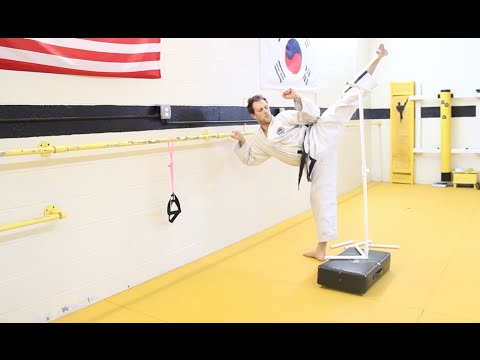
Getting Your Kicks Higher Tutorial
0
Tilted Heel Front Kick·Simon Scher
In this Tutorial, I show you the drills I use to prepare my body to utilize my flexibility to kick at a very high level.…
Translation: Tilted heel front kick — a front kick delivered with the heel while tilting the foot outward, allowing the kick to penetrate at an angle past the opponent's centreline guard
The Tilted Heel Front Kick is a front kick delivered with the heel while tilting the foot outward at approximately 15-30 degrees from vertical, allowing the kick to penetrate at a slight angle past the opponent's standard centreline defence. [1] In a standard front kick, the foot travels directly along the centreline and impacts with the ball of the foot or heel facing straight forward — any guard positioned on the centreline blocks it cleanly. [1] The Tilted Heel variant introduces a lateral offset: by everting (tilting outward) the foot during the final phase of extension, the heel approaches the target at a slight angle from the inside, which causes the hard heel surface to scrape along the edge of a centreline guard rather than impacting it squarely. [1] This scraping, angled approach means the kick slides past defences that would cleanly stop a straight-on front kick — the guard deflects the kick's centreline component, but the lateral component carries the heel past the defensive frame and into the target behind it. [1] The heel provides the hardest natural striking surface on the foot (the calcaneus is the largest bone in the foot, designed to bear the full body weight during walking and running), making it the ideal surface for a penetrating thrust kick. [1] The tilt adds a second benefit: the angled heel contacts the target surface at a non-perpendicular angle, which distributes the initial impact across a brief scraping motion before the heel sinks into the target — this 'dig' effect is more painful and penetrating than a flat-on impact of the same force. [1] De Bremaeker and Faige document the Tilted Heel Front Kick as one of the front kick variations in their 89-kick compilation, noting that it is particularly effective against opponents who habitually protect their centreline with tight, compact guard positions. [1]
Heel kick variations with angular approaches appear in multiple Asian martial arts traditions where the concept of attacking 'around' a defence rather than through it is a well-established tactical principle. [1] The Chinese martial arts concept of 'yin and yang' in fighting — using indirect angles when direct attacks are blocked — manifests in the Tilted Heel Front Kick's approach of angling past the guard rather than powering through it. [1] De Bremaeker and Faige documented the technique as Section 1.8 in their 2010 cross-style compilation, noting its utility as a refinement for fighters who face opponents with strong centreline defence. [1] The heel front kick (kakato geri) has been a standard technique in karate since Gichin Funakoshi documented it, and the tilted variant represents an evolution of the basic technique for competitive application where guards have become increasingly sophisticated. [1],[2]
The Tilted Heel Front Kick is effective as a tactical refinement against opponents with strong centreline guards — it solves the specific problem of 'my front kick keeps getting blocked by their forearms' by angling the approach past the defence. [1] Its effectiveness scales with the opponent's defensive discipline: against a fighter with a tight, well-maintained guard, the tilted approach consistently penetrates where the straight approach is consistently blocked; against a sloppy or open guard, the tilt is unnecessary. [1] The heel's concentrated impact surface produces a digging, penetrating quality that makes the tilted variant more painful than a ball-of-foot kick at the same force level. [1] The technique represents the broader principle that small angular adjustments to basic techniques can produce disproportionate tactical advantages against experienced defenders. [1]
The Tilted Heel Front Kick is used in competition as a variation of the standard front kick, primarily in point karate and full-contact karate where opponents maintain tight centreline guards. The technique's subtle angular adjustment makes it difficult for referees to distinguish from a standard front kick, which is advantageous in point competition.
No images yet for this technique.
Sign in to suggest an image.
In this Tutorial, I show you the drills I use to prepare my body to utilize my flexibility to kick at a very high level.…
Although there are many similarities between modern and ancient Muay Thai kicking, there are also differences, especiall…
The tilted heel front kick represents a conceptual approach within Muay Thai kicking methodology that emphasizes deceptive, non-telegraphed execution over raw power generation. Muay Boran Academy describes this technique within the broader framework of modern Muay Thai's preference for sneaky, fast kicks that minimize opponent reaction time and defensive opportunity. Rather than employing a pronounced wind-up characteristic of power kicks—which telegraph intent and invite leg checks or body blocks—the tilted heel front kick is thrown with minimal preparation, often immediately following opponent strikes or as a counter, making it difficult to defend. This approach prioritizes placement accuracy and timing over destructive force. Simon Scher's tutorial on high-section kicking complements this methodology by emphasizing technical precision regardless of target height: proper body alignment, maintained balance, controlled leg retraction, and hip rotation are essential regardless of whether the kick is delivered low, mid, or high. Both instructors stress that effective kicking requires repetitive drilling to develop control and strength, whether through bar work, resistance training, or partner drills. The synthesis of these approaches suggests the tilted heel front kick functions as a tactical tool for breaking down an opponent through accurate, swift strikes rather than as a power-generating technique.
Synthesized from 2 instructors
No instructional courses yet for this technique.
Sign in to suggest a course.
Risk of injury to the person this technique is applied to
The heel is the hardest natural striking surface on the foot, and the angled approach produces a digging, scraping impact that is more painful than a flat-on heel strike. When targeting the solar plexus, the kick can cause winding and diaphragm spasm. When targeting the floating ribs, the concentrated heel pressure can cause rib fractures. The primary danger is the penetrating quality of the angled impact.
Skill level needed to execute this technique reliably
Whether this technique is allowed under major competition rule sets
Essential Book of Martial Arts Kicks (De Bremaeker & Faige, 2010)
description: [1] De Bremaeker 2010 pp.31-32
Standard katakana transliteration of Western martial arts terminology (外来語) — used in Japanese MMA, boxing, and BJJ communities
description: [1] De Bremaeker 2010 pp.31-32
Requires good ankle mobility for eversion (tilting the foot outward)
Strong peroneal muscles to maintain the tilt under impact
Standard front kick hip strength and flexibility
Accessible to most body types once the ankle eversion is mastered
Practitioners with naturally mobile ankles find the technique easier
Documented in De Bremaeker & Faige, Section 1.9. A front kick tilted to use the heel as the striking surface — the hardest part of the foot. Delivers concentrated force to a small area. (De Bremaeker & Faige, Essential Book of Martial Arts Kicks, 2010)
Sneaky kicks are harder for your opponent to see and defend against because they have minimal wind-up, whereas power kicks telegraph the movement and give your opponent time to react. According to Muay Boran Academy, the goal is to apply kicks in a non-telegraphed way to set up your opponent or break them down gradually rather than just relying on power.
Keep your wind-up quick and tight so your opponent won't see the kick coming. Muay Boran Academy emphasizes reducing the setup motion—throw the kick with just enough momentum to be effective but without the exaggerated chambering that makes the technique visible.
Use sneaky kicks to set up your opponent, counter strikes when they commit (like after they throw a jab), or gradually wear down their defense. Muay Boran Academy notes that while power kicks can be used, the emphasis in Muay Boran is on the deceptive kicks rather than relying heavily on raw power.
The Tilted Heel Front Kick is a front kick delivered with the heel while tilting the foot outward at approximately 15-30 degrees from vertical, allowing the kick to penetrate at a slight angle past the opponent's standard centreline defence. In a standard front kick, the foot travels directly along the centreline and impacts with the ball of the foot or heel facing straight forward — any guard positioned on the centreline blocks it cleanly.
Heel kick variations with angular approaches appear in multiple Asian martial arts traditions where the concept of attacking 'around' a defence rather than through it is a well-established tactical principle. The Chinese martial arts concept of 'yin and yang' in fighting — using indirect angles when direct attacks are blocked — manifests in the Tilted Heel Front Kick's approach of angling past the guard rather than powering through it.
Unified MMA: legal — Legal striking technique; WBC/Boxing: banned — All kicks prohibited in boxing; WKF: legal — Legal, chudan (body) kick scores 2 points, jodan (head) kick scores 3 points; Kyokushin: legal — Legal at full power to body and head; WT: legal — Legal, body kick 2 points, head kick 3 points, spinning body 4 points, spinni…; WAKO: legal — Legal in Full Contact and Low Kick formats; K: legal — 1/GLORY — Legal; IFMA: legal — Legal — kicks are a core Muay Thai technique
Danger rating 6/10. The heel is the hardest natural striking surface on the foot, and the angled approach produces a digging, scraping impact that is more painful than a flat-on heel strike. When targeting the solar plexus, the kick can cause winding and diaphragm spasm. When targeting the floating ribs, the concentrated heel pressure can cause rib fractures. The primary danger is the penetrating quality of the angled impact.
The standard setup chain: Establish the standard front kick (straight, untilted) → Opponent calibrates their centreline guard to block the straight approach → Fire 2-3 standard front kicks that the opponent successfully blocks → On the next kick, add the subtle outward tilt in the final 2-3 inches of extension → The heel scrapes past the edge of the opponent's guard → Heel contacts the exposed ribs or solar plexus behind the defence → Follow up with a cross or hook while the opponent adjusts their guard to cover the new angle.
Standard counters include: Widen the guard — spreading the defensive frame outward covers the angled approach as well as the centreline / Read the ankle — an experienced fighter can detect the ankle tilt during the kick's extension and adjust guard positi… / Step offline — lateral movement takes the target out of the kick's adjusted trajectory / Catch the heel — if the tilt is anticipated, catching the heel (which is exposed during the tilt) can lead to a takedown.
Common variants: Outward-tilted heel (the standard version, tilting the foot laterally outward …); Inward-tilted heel (tilting the foot inward (inversion) to approach from the …); Heavy tilt (30°+) (maximum angle for maximum guard bypass, but with reduced …); Light tilt (10-15°) (subtle angle that is harder for the opponent to detect bu…); Tilted heel teep (applying the tilt to a push kick for penetrating distance…); Tilted heel to the thigh (using the angled heel against the inner or outer thigh fo…).
The Tilted Heel Front Kick is used in competition as a variation of the standard front kick, primarily in point karate and full-contact karate where opponents maintain tight centreline guards. The technique's subtle angular adjustment makes it difficult for referees to distinguish from a standard front kick, which is advantageous in point competition.
Top errors to watch for: Over-tilting the foot — tilting more than 30° converts the kick into a side kick variant and loses the forward penetr… / Tilting too early — rotating the ankle during the chamber (visible phase) rather than during the final extension (hid… / Losing power by focusing on angle — the tilt should be a minor adjustment to a POWERFUL front kick, not a replacement… / Weak ankle collapsing on contact — if the ankle eversion is not maintained by strong peroneal muscles, the foot colla….
The Tilted Heel Front Kick is also known as Tiruteddo Hīru Furonto Kikku, Angled Heel Kick, Tilted Kakato Geri, Offset Heel Front Kick, Lateral Heel Thrust.