How To Throw A Front Kick | Striking Basics Series | Kickboxing
0
Hopping Front Kick·Hayabusa
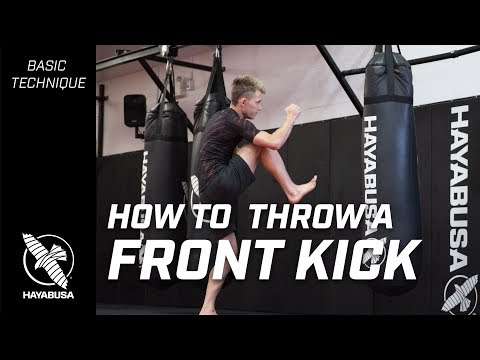
The Striking Basics series is all about the fundamentals for kickboxing beginners. Gabriel Varga and Hayabusa develope…
跳び前蹴り(Tobi Mae Geri)
HybridTranslation: Tobi (跳び) = jumping/hopping, Mae Geri (前蹴り) = front kick — a front kick preceded by a quick skip-step (hop) to close distance while maintaining kicking power
The Hopping Front Kick combines a quick skip-step forward with a rear-leg front kick, using the hop to close distance rapidly while maintaining the full power of a rear-leg kick — solving the fundamental problem in striking arts of how to bridge the gap between standing range and kicking range without telegraphing or losing power. [1] The mechanical principle is a rapid foot replacement: the rear foot slides forward to replace the front foot's position, while the front foot — now momentarily the 'rear' foot — lifts and delivers the front kick with the full hip rotation and body weight of a standard rear-leg mae geri. [1] The skip-step occurs below the opponent's visual horizon (feet moving along the floor are harder to detect than upper body movement), and the kick that follows arrives with the forward momentum of the hop added to the kick's own power — making the Hopping Front Kick significantly more powerful than a static front kick delivered from the same starting distance. [1],[2] De Bremaeker and Faige document the technique as one of the most commonly used distance-closing kicks in tournament karate and taekwondo competition, noting that the hop-and-kick should be felt as ONE movement, not two. [1] In Shotokan karate, the technique is called surikonde mae geri (sliding front kick) and is practised extensively in kumite (sparring) as the primary method of bridging distance with the front kick. [2] The Hopping Front Kick became one of the most famous techniques in MMA history when Anderson Silva used a skipping front kick to knock out Vitor Belfort at UFC 126 (February 2011) — a kick that Steven Seagal controversially claimed to have taught Silva, though the technique has existed in karate for decades. [3] Lyoto Machida used the same technique to knock out Randy Couture at UFC 129 (April 2011), cementing the Hopping Front Kick's reputation as a legitimate fight-ending weapon in MMA. [3]
The hopping or sliding front kick has been a fundamental technique in competitive karate and taekwondo since the early tournament era of the 1960s and 1970s, developed as a solution to the universal problem of closing distance while maintaining kicking power. [1],[2] In Shotokan karate, the technique is called surikonde mae geri and was popularised by competition fighters who needed to bridge the gap against opponents maintaining long-range defensive stances. [2] The technique achieved its greatest fame in MMA through two back-to-back UFC knockouts in 2011: Anderson Silva knocked out Vitor Belfort at UFC 126 (February 5, 2011) with a hopping front kick to the chin, and Lyoto Machida (a Shotokan karate black belt) knocked out Randy Couture at UFC 129 (April 30, 2011) with essentially the same technique. [3] These two knockouts, occurring less than three months apart, revolutionised MMA's perception of the front kick — previously considered a basic distance-management tool, the Hopping Front Kick was suddenly recognised as a legitimate knockout weapon at the highest level. [3] De Bremaeker and Faige documented the technique in their 2010 cross-style kick compilation, noting its universality across karate, taekwondo, and kickboxing. [1]
The Hopping Front Kick is one of the most effective distance-closing kicks in martial arts competition because it adds forward momentum to a powerful rear-leg kick without the telegraphing associated with stepping forward or lunging. [1] In tournament karate, the technique accounts for a significant percentage of front-kick scores because it bridges the gap that static front kicks cannot reach. [2] In MMA, the Anderson Silva and Lyoto Machida knockouts demonstrated that the technique can produce fight-ending power even against world-class opponents, particularly when targeting the chin with a snap kick trajectory. [3] The perceptual advantage (the skip-step is difficult to detect because it occurs at foot level, below the typical visual focus) makes it consistently effective even against experienced opponents. [1]
Anderson Silva vs Vitor Belfort, UFC 126 (Feb 5, 2011) — hopping front kick to the chin, KO in Round 1 (one of the most famous knockouts in UFC history) || Lyoto Machida vs Randy Couture, UFC 129 (Apr 30, 2011) — hopping front kick to the face, KO in Round 2 || These two knockouts, weeks apart, transformed MMA's perception of the front kick as a fight-ending weapon || The technique is a standard scoring technique in WKF karate and WT taekwondo competition at all levels.
No images yet for this technique.
Sign in to suggest an image.
The Striking Basics series is all about the fundamentals for kickboxing beginners. Gabriel Varga and Hayabusa develope…
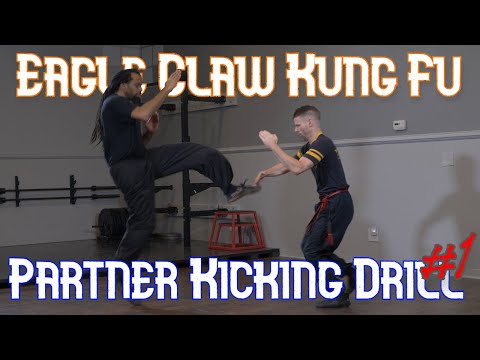
this partner striking drill develops the front kick and the jump front kick on the attacking side while the cat stance t…
The hopping front kick, also called the jump front kick or double front kick, represents an advanced progression of the standard front kick that incorporates explosive footwork and distance-closing mechanics. Hayabusa emphasizes foundational elements applicable to hopping variants: establishing proper distance just outside jab range, chambering with a high knee raise, pivoting on the standing foot's ball, and striking with the foot's ball rather than the heel while leaning back slightly for power and range. For techniques requiring forward momentum, Hayabusa describes a shuffle step where the back foot closes the gap to the front foot, enabling the kick to land from the lead leg. Six Harmonies United provides contextual instruction on partner-drilled hopping front kicks, specifically within Eagle Claw Kung Fu's partner training system, where the technique transitions from a slow, controlled single kick to a fast double-kick combination executed in cat stance. The progression involves kicking once with balance, then performing a hopping/jumping second kick before landing back into cat stance. Six Harmonies United stresses maintaining proper stance positioning after each kick iteration and emphasizes kicking "inward with the direction of energy" rather than swinging upward, distinguishing combat application from flexibility-focused practice. Akiko Yoshii-Johnson addresses chambering precision, noting that knee height determines kick height and cautioning against lazy knee positioning or balletic forms. All three instructors converge on the importance of proper chamber position and controlled, repeatable footwork as prerequisites for executing effective hopping front kicks.
Synthesized from 3 instructors
No instructional courses yet for this technique.
Sign in to suggest a course.
Risk of injury to the person this technique is applied to
The forward momentum of the skip-step adds significant force to the kick. When targeting the chin (as in the Anderson Silva and Lyoto Machida UFC knockouts), the Hopping Front Kick can produce spectacular knockout-of-the-year impacts. To the solar plexus, it produces winding and doubling-over. The surprise factor (the distance closure is difficult to perceive) means the kick often lands flush on undefended targets.
Skill level needed to execute this technique reliably
Whether this technique is allowed under major competition rule sets
Essential Book of Martial Arts Kicks (De Bremaeker & Faige, 2010)
description: [1] De Bremaeker 2010 pp.29-30, [2] Nakayama 1966
Mixed Japanese-Western terminology — combines traditional Japanese terms with katakana loanwords
description: [1] De Bremaeker 2010 pp.29-30, [2] Nakayama 1966
Requires good footwork coordination (the skip-step must be fluid, not mechanical)
Explosive calves and quadriceps for the rapid slide forward
Good balance — the fighter must maintain stability during the transition from skip to kick
Standard front kick flexibility and hip strength
Accessible to all body types — the technique compensates for short legs by adding forward distance
Documented in De Bremaeker & Faige, Section 1.15. A front kick delivered with a forward hop — the hopping step closes distance while the rear leg chambers and kicks. Adds forward momentum to the kick. (De Bremaeker & Faige, Essential Book of Martial Arts Kicks, 2010)
According to Hayabusa, you want to position yourself just outside punch range, where you can land the kick but aren't too close. This distance allows you to decide whether to extend the kick or re-chamber and retreat if your opponent moves away.
Always strike with the ball of your foot, never the heel. Hayabusa emphasizes that leaning back slightly as you extend will give you extra distance and power while keeping your hands out of punch range.
Lift your knee higher and make the line from your hip to your knee arc upward to head level, then add more head fade (lean back) with your body. Hayabusa notes that doing these two things together allows you to reach head level effectively.
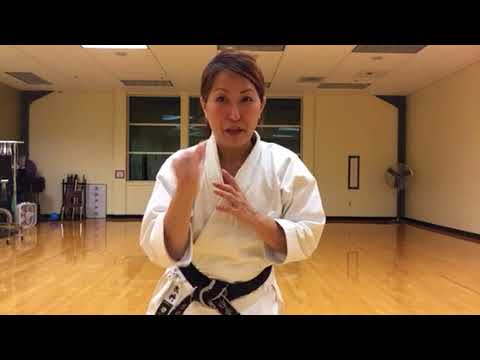
Mastering the chamber is essential. Akiko Yoshii-Johnson emphasizes practicing the chambered position repeatedly—keeping your heel close to your butt and your foot flexed—as the foundation for effective kicks.
The Hopping Front Kick combines a quick skip-step forward with a rear-leg front kick, using the hop to close distance rapidly while maintaining the full power of a rear-leg kick — solving the fundamental problem in striking arts of how to bridge the gap between standing range and kicking range without telegraphing or losing power. The mechanical principle is a rapid foot replacement: the rear foot slides forward to replace the front foot's position, while the front foot — now momentarily the 'rear' foot — lifts and delivers the front kick with the full hip rotation and body weight of a standard rear-leg mae geri.
The hopping or sliding front kick has been a fundamental technique in competitive karate and taekwondo since the early tournament era of the 1960s and 1970s, developed as a solution to the universal problem of closing distance while maintaining kicking power. In Shotokan karate, the technique is called surikonde mae geri and was popularised by competition fighters who needed to bridge the gap against opponents maintaining long-range defensive stances.
Unified MMA: legal — Legal striking technique; WBC/Boxing: banned — All kicks prohibited in boxing; WKF: legal — Legal, chudan (body) kick scores 2 points, jodan (head) kick scores 3 points; Kyokushin: legal — Legal at full power to body and head; WT: legal — Legal, body kick 2 points, head kick 3 points, spinning body 4 points, spinni…; WAKO: legal — Legal in Full Contact and Low Kick formats; K: legal — 1/GLORY — Legal; IFMA: legal — Legal — kicks are a core Muay Thai technique
Danger rating 7/10. The forward momentum of the skip-step adds significant force to the kick. When targeting the chin (as in the Anderson Silva and Lyoto Machida UFC knockouts), the Hopping Front Kick can produce spectacular knockout-of-the-year impacts. To the solar plexus, it produces winding and doubling-over. The surprise factor (the distance closure is difficult to perceive) means the kick often lands flush on undefended targets.
The standard setup chain: Establish jab rhythm at long range (2-3 jabs to draw the opponent's attention to their hands) → Opponent adjusts to the jab rhythm and prepares counters → Skip: rear foot slides forward to replace front foot (below the opponent's visual focus) → Front foot immediately lifts and chambers → Front kick fires at the instant the skip is complete → Ball of foot strikes the opponent's chin (snap) or solar plexus (thrust) → The forward momentum of the skip adds power to the kick → Opponent absorbs a full-power rear-leg kick from a distance they thought was safe → Retract and follow up with hands → Alternative: feint the skip-kick, opponent flinches → throw the jab they're no longer prepared for.
Standard counters include: Side step — moving laterally as the opponent initiates the skip takes the target off the kick's linear path / Stop kick to the body — firing a front kick of your own into the skipping opponent's midsection during their forward … / Rear straight counter — timing a straight punch to arrive as the opponent's kick is in flight (the opponent cannot ch… / Clinch — if the kick is anticipated, closing to clinch range before the kick can extend neutralises it.
Common variants: Short hop (minimal skip-step for close range adjustments, sacrificin…); Long hop (extended skip covering 24-36 inches, sacrificing speed fo…); Hopping penetrating front kick (the skip-step version of mae geri kekomi, driving the bal…); Hopping snap front kick (the skip-step version of mae geri keage, snapping upward …); Hopping teep (the Muay Thai version, using the skip to close distance f…); Switch hop (switching stance (rear foot comes ALL THE WAY past front …).
Anderson Silva vs Vitor Belfort, UFC 126 (Feb 5, 2011) — hopping front kick to the chin, KO in Round 1 (one of the most famous knockouts in UFC history) || Lyoto Machida vs Randy Couture, UFC 129 (Apr 30, 2011) — hopping front kick to the face, KO in Round 2 || These two knockouts, weeks apart, transformed MMA's perception of the front kick as a fight-ending weapon || The technique is a standard scoring technique in WKF karate and WT taekwondo competition at all levels.
Top errors to watch for: Telegraphing the skip by rising upward — the most critical error: any upward movement of the head or body during the … / Pausing between the skip and the kick — a visible pause between planting the sliding foot and launching the kick give… / Hopping too high — the feet should slide along the floor, not jump into the air. A visible hop is slow, telegraphed, … / Breaking the rhythm — many fighters develop a recognisable pre-skip rhythm (weight shift, small step, then skip). Exp….
The Hopping Front Kick is also known as Tobi Mae Geri, Skip Front Kick, Skipping Mae Geri, Hop Step Front Kick, Sliding Front Kick.