3 USELESS Karate Techniques (+ Kick)
0
Kick·Jesse Enkamp
Karate is a practical martial art from Okinawa. But its roots can be traced back to ancient China. That's why many of it…
蹴り技(Keri-waza)
TraditionalTranslation: kicking technique
The Kick group encompasses all striking techniques delivered with the leg — using the foot, shin, heel, or knee of the extended leg — to attack an opponent at various ranges and heights. [1] Kicks are biomechanically the most powerful strikes in a fighter's arsenal, with studies showing that elite practitioners can generate peak impact forces exceeding 9,000 newtons in roundhouse kicks, substantially greater than the forces produced by punches, due to the longer lever arm and greater muscle mass of the lower extremities. [1],[2] The group is organised by the kick's trajectory and mechanics: roundhouse kicks (circular), front kicks (linear push or snap), side kicks (lateral thrust), axe kicks (downward), crescent kicks (arcing), back kicks (rearward), hook kicks (hooking path), and flying kicks (airborne delivery), each presenting distinct biomechanical and tactical profiles. [2],[3] Kicks are central to numerous martial arts traditions worldwide: Muay Thai's devastating shin kicks, taekwondo's acrobatic spinning and jumping kicks, karate's front kick (mae geri) and side kick (yoko geri), savate's precise foot-delivered techniques (chassé, fouetté), and capoeira's flowing, acrobatic kick vocabulary. [3],[4] In modern competition, kick selection is heavily influenced by rule set — taekwondo's point system rewards head kicks, Muay Thai scoring favours powerful round kicks to the body, and MMA fighters must balance kick offence against takedown vulnerability. [4],[5]
Kicking techniques are attested in the earliest martial arts records, with Chinese kung fu traditions dating the development of systematic kick methods to the Shaolin Temple and northern Chinese styles more than a thousand years ago. [1] The French art of savate, formalised in the early 19th century by Michel Casseux and Charles Lecour, was one of the first Western systems to systematise kicking within a sporting framework. [1],[2] In Korea, taekwondo emerged in the mid-20th century with an emphasis on high, fast kicks, drawing on indigenous kicking traditions and Japanese karate influences, achieving Olympic sport status in 2000. [2],[3] Muay Thai's development of the shin-delivered roundhouse kick — emphasising the shin rather than the foot as the primary impact surface — created perhaps the most powerful kicking methodology in combat sports, refined through centuries of Thai ring fighting. [3],[4] The global dissemination of kicking techniques accelerated in the 1960s-1980s through the rise of full-contact karate and American kickboxing, and was further catalysed by MMA's integration of kicking arts from the 1990s onward. [4],[5]
Kicks are a primary scoring action in taekwondo, kickboxing, and Muay Thai, and a significant source of knockouts in MMA. [1]
No images yet for this technique.
Sign in to suggest an image.
Karate is a practical martial art from Okinawa. But its roots can be traced back to ancient China. That's why many of it…
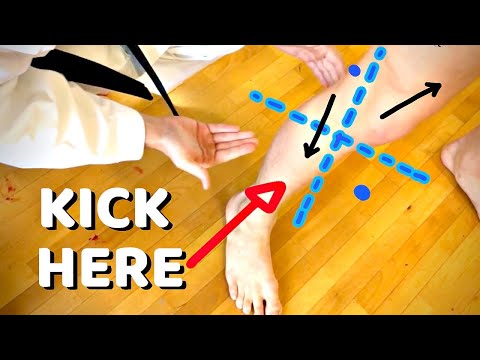
Conor McGregor was defeated by this simple kick at UFC 257! Learn the low calf kick as performed by MMA fighters and UFC…
No instructional courses yet for this technique.
Sign in to suggest a course.
Risk of injury to the person this technique is applied to
Kicks generate 2-3x more force than punches; KO and fracture risk (Falco et al. 2009)
Skill level needed to execute this technique reliably
Whether this technique is allowed under major competition rule sets
Muay Thai: The Art of Fighting (Yod Ruerngsa, Khun Kao Charuad & James Cartmell, 2002)
Alias sources — [1] Dynamic Karate (Nakayama, 1966) [2] Karate-Do Kyohan (Funakoshi, 1935)
Effectiveness sources — [1] Muay Thai Unleashed (Delp, 2006) [2] Comprehensive Asian Fighting Arts (Draeger & Smith, 1969)
Official karate technique names (和語/漢語)
Established Japanese martial arts naming convention — native Japanese term (和語/漢語)
Alias sources — [1] Dynamic Karate (Nakayama, 1966) [2] Karate-Do Kyohan (Funakoshi, 1935)
Effectiveness sources — [1] Muay Thai Unleashed (Delp, 2006) [2] Comprehensive Asian Fighting Arts (Draeger & Smith, 1969)
hip rotation, horizontal arm acceleration, tight elbow angle
compact build for short-range hooks, strong core
obliques, hip rotators, pectorals, biceps, forearms
The Axe Kick family groups kicking techniques in which the leg is raised high — often above the opponent's head — and then brought straight down onto the target in a chopping motion, using the heel or sole of the foot as the impact surface. [1] The axe kick generates force through the combination of gravitational acceleration and the active hip flexor contraction that pulls the leg downward, creating a hammering effect capable of striking the collarbone, shoulder, top of the head, or face of an opponent. [1,2] Axe kicks are most closely associated with taekwondo, where they are a competition staple scoring technique, but they also appear in karate (kakato geri) and MMA. [2,3] The technique requires exceptional hip flexibility and hamstring length to raise the leg above head height before executing the downward chop. [3]
The Back Kick family groups kicking techniques where the striker turns away from the opponent and thrusts the heel of the foot directly backward in a linear trajectory, impacting with the heel or sole. [1] The back kick is one of the most powerful kicks in martial arts because it combines the thrust of the entire leg with the rotational momentum of the body turn, directed through the hardest part of the foot. [1,2] Biomechanical studies have measured back kicks among the highest force-producing kicks, comparable to or exceeding the roundhouse kick, due to the full leg extension and hip drive along the kick's linear path. [2,3] The technique is used extensively in taekwondo, karate, and MMA as both an offensive and counter-attacking weapon. [3]
The Crescent Kick family groups kicking techniques that follow a wide, sweeping arc — rising from low to high in a curved crescent-shaped path — using the sole, instep, or blade of the foot to strike or deflect. [1] Unlike linear kicks, crescent kicks travel in a large semicircular trajectory that can be directed either inward (medial to lateral) or outward (lateral to medial), giving them the ability to bypass straight-line defences and attack from unexpected angles. [1,2] Crescent kicks are used both offensively to strike the head or body and defensively to parry or deflect an opponent's guard, and they feature prominently in taekwondo, karate, and kung fu. [2,3]
The Flying Kick family encompasses all kicking techniques delivered while the attacker is airborne, having leapt off the ground before executing the kick in midair. [1] Flying kicks sacrifice the stable base of grounded techniques in exchange for added height, distance, and dramatic momentum, using the forward and upward energy of the jump to amplify the force of the kick. [1,2] These techniques are high-risk, high-reward attacks — a well-timed flying kick can cover significant distance and deliver devastating force, but a missed flying kick leaves the attacker airborne and unable to change direction, vulnerable to counters and takedowns. [2,3] Flying kicks are prominent in taekwondo, kung fu, and karate, and they occasionally produce spectacular knockouts in MMA and kickboxing. [3]
The Front Kick family groups all kicking techniques delivered in a forward linear trajectory, where the leg extends directly toward the opponent to strike with the ball of the foot, heel, or sole. [1] Front kicks are among the most fundamental and versatile kicks in martial arts, serving as both offensive weapons and defensive distance-management tools depending on the variation: snap front kicks deliver sharp, retractable damage while push kicks (teep) create distance by shoving the opponent backward. [1,2] Biomechanically, the front kick uses hip flexion and knee extension along the sagittal plane, producing a direct-line force vector that is efficient and difficult to deflect laterally. [2,3] The family is subdivided into push kick/teep variations (emphasising push-through force) and snap front kick variations (emphasising speed and retraction). [3]
The Fundamental Kick family covers core kicking techniques across martial arts — the most powerful strikes in combat, delivering force through the shin, foot, or knee using the largest muscle groups in the body. [1] Kicking generates significantly more force than punching because the legs are both longer (more leverage) and powered by larger muscles (glutes, quadriceps, hamstrings), making kicks the dominant power weapon in Muay Thai, Taekwondo, kickboxing, and karate. [1,2] This family covers the universal kicking archetypes: front kick (teep/mae geri), roundhouse kick (the most versatile and commonly used kick), side kick, back kick, and their variations across martial arts traditions. [2,3] In MMA, the low kick (targeting the opponent's lead leg) has become one of the most tactically important techniques, while head kicks produce the most spectacular knockouts. [3]
The Hook Kick family groups kicking techniques where the leg extends past the target and then hooks back inward, striking with the heel or sole of the foot as the leg retracts in a hooking arc. [1] The hook kick's deceptive trajectory — extending as if for a side kick before curving back to strike from an unexpected angle — makes it one of the most difficult kicks to defend against, as the impact comes from behind the opponent's guard. [1,2] Hook kicks are prominent in taekwondo (huryeo chagi), karate (ura mawashi geri), and kickboxing, where they are used to attack the opponent's head from an angle that bypasses conventional blocking. [2,3]
The Roundhouse Kick family is the most widely used and tactically versatile kick family in combat sports, encompassing all circular kicks where the leg swings in a horizontal or slightly upward arc to strike the opponent with the shin or instep. [1] Biomechanical studies have consistently identified the roundhouse kick as one of the most powerful strikes in martial arts, with elite Thai boxers generating peak forces of 9,000+ newtons — roughly equivalent to being struck by a baseball bat. [1,2] The roundhouse kick's power derives from the whipping action of the hip, the rotational torque of the trunk, and the centripetal acceleration of the extended leg, all concentrated into the dense tibial bone of the shin. [2,3] The family is subdivided by target height — low kicks attacking the legs, body kicks targeting the torso, and head kicks aimed above the shoulders — and by delivery method, including switch-stance variants and spinning/turning kicks that add rotational momentum. [3,4]
The Side Kick family groups kicking techniques delivered laterally, where the kicker turns the hip over and thrusts the foot (heel or blade) sideways into the target in a linear trajectory perpendicular to the body's frontal plane. [1] The side kick is one of the most powerful linear kicks in martial arts, as it uses the full extension of the leg in combination with hip thrust to drive the heel into the opponent's midsection, ribcage, or knee with penetrating force. [1,2] Side kicks are classified by their execution speed and intent: snapping side kicks prioritise speed and retraction, while thrusting side kicks emphasise power and follow-through. [2,3] The technique is fundamental to karate (yoko geri), taekwondo (yeop chagi), and plays an important role in MMA as a range-management and counter-attacking tool. [3]
The kick group is the most extensively documented striking category — 'kick' appears in tens of thousands of passages across our corpus. De Bremaeker & Faige alone document 89 distinct kicks. The kick generates more force than any punch due to the mass and length of the leg. (200+ books; De Bremaeker & Faige, Essential Book of Martial Arts Kicks; Delp, Muay Thai Unleashed)
Aim straight for the root of the calf—the lower portion of the calf muscle. When you connect properly, your opponent will make a distinctive sound and feel a jolt, according to Jesse Enkamp.
Use feints and combinations to force your opponent to step and commit their weight to their front leg. Jesse Enkamp recommends circling, throwing shots to make them react and move in a direction, then on the third or fourth shot, feint and throw the low calf kick as they move back into range.
In modern times, kicking with the ball of the foot is preferred because it's safer for both you and your opponent, according to Jesse Enkamp.
The Kick group encompasses all striking techniques delivered with the leg — using the foot, shin, heel, or knee of the extended leg — to attack an opponent at various ranges and heights. Kicks are biomechanically the most powerful strikes in a fighter's arsenal, with studies showing that elite practitioners can generate peak impact forces exceeding 9,000 newtons in roundhouse kicks, substantially greater than the forces produced by punches, due to the longer lever arm and greater muscle mass of the lower extremities.
Kicking techniques are attested in the earliest martial arts records, with Chinese kung fu traditions dating the development of systematic kick methods to the Shaolin Temple and northern Chinese styles more than a thousand years ago. The French art of savate, formalised in the early 19th century by Michel Casseux and Charles Lecour, was one of the first Western systems to systematise kicking within a sporting framework.
Unified MMA: legal — Legal striking technique; WBC/Boxing: banned — All kicks prohibited in boxing; WKF: legal — Legal, chudan (body) kick scores 2 points, jodan (head) kick scores 3 points; Kyokushin: legal — Legal at full power to body and head; WT: legal — Legal, body kick 2 points, head kick 3 points, spinning body 4 points, spinni…; WAKO: legal — Legal in Full Contact and Low Kick formats; K: legal — 1/GLORY — Legal; IFMA: legal — Legal — kicks are a core Muay Thai technique
Danger rating 6/10. High — kicks generate 2-3x more force than punches; KO and fracture risk (Falco et al. 2009)
The standard setup chain: Stance and Range → Chamber the Leg → Execute the Kick → Recover.
Standard counters include: Check (Shin Block) — raise the shin to intercept the kick before it lands / Catch and Sweep — catch the kicking leg and sweep the standing leg / Step Inside — close distance inside the kick's effective range to smother it.
Common variants: Standard hook (horizontal-arc punch targeting the jaw or temple); Tight hook (compact, short-range hook for close-quarters fighting); Body hook (targeting the ribs or liver with a downward-angled hook); Check hook (pivoting on the lead foot while throwing the hook as a co…).
Kicks are a primary scoring action in taekwondo, kickboxing, and Muay Thai, and a significant source of knockouts in MMA.
Top errors to watch for: Dropping the hands when kicking — exposes the head to counter punches and is the most common KO setup in kickboxing / Not pivoting the support foot, which limits hip rotation and puts lateral stress on the knee / Leaning too far back to gain height instead of lifting through the hip — sacrifices power and balance / Kicking with the toes instead of the ball of the foot or shin, risking broken toes.
The Kick is also known as Keri-waza, Leg Strike, Foot Strike.