How to practice inside block martial arts for beginners part 2
0
Inward-Tilted Front Kick·Fitness Karate Academy
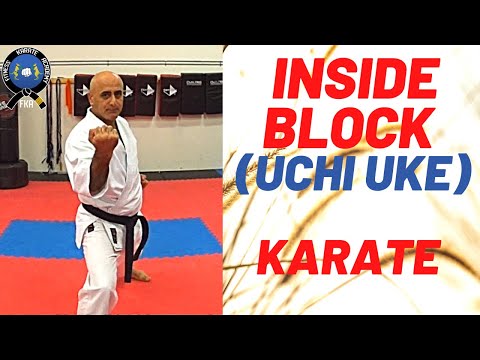
Learn inside block martial arts step by step in natural pose and in front stance or zenkutso dachi with Sensei James G…
Translation: inward-tilted front kick
The Inward-Tilted Front Kick is a front kick with a trajectory change at the end from outside inward, creating a hybrid between a front kick and a small roundhouse. [1] The kick starts with a regular straight high-knee chamber, then the leg tilts mildly outward while the foot turns inward, causing the ball of the foot to connect from outside in. [1] While not a powerful kick, it is effective against opponents who stand sideways and feel protected from straight kicks. [1] The overall feeling is of a front kick rather than a roundhouse, with the trajectory change adding an element of surprise. [1]
A hybrid technique in the space between front kicks and roundhouse kicks, practiced in various karate styles and kickboxing as a deception tool. [1]
Not a powerful kick, but effective as a surprise technique against opponents who stand sideways and feel protected from straight kicks. [1]
Documented in De Bremaeker & Faige, Essential Book of Martial Arts Kicks (2010). Practiced across multiple kicking arts. [1]
Primarily a training, demonstration, and point-fighting technique. Rarely seen in full-contact MMA or kickboxing due to acrobatic risk and telegraphing. Appears occasionally in TKD and point-fighting karate tournaments. [1]
No images yet for this technique.
Sign in to suggest an image.
Learn inside block martial arts step by step in natural pose and in front stance or zenkutso dachi with Sensei James G…
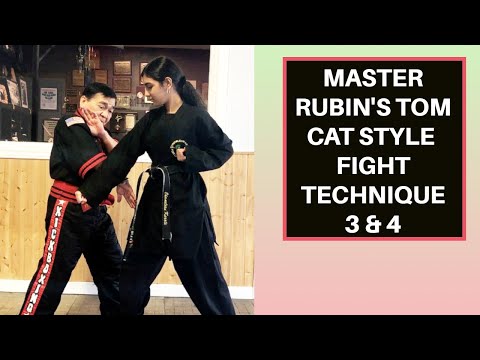
Master Rubin's Tom Cat Style Fight Technique 3 & 4 - Learn Street Fighting/ Anti Bullying/ MMA Style Fighting Techniques…
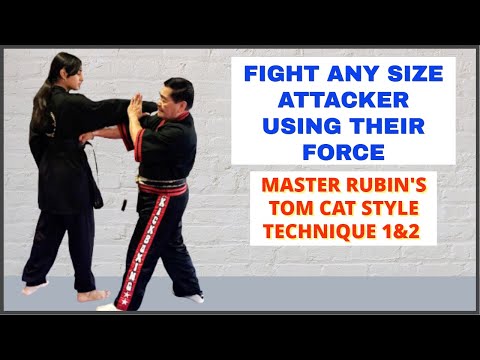
Face Any Size Attacker & Fight Like a Pro - Learn Street Fighting/ Anti Bullying/ MMA Style Fighting Techniques CAUTION…
The inward-tilted front kick is primarily addressed through the Tom Cat style teachings of Master Rubin at PG-2-GP Fitness, though the technique name does not appear explicitly in the provided transcripts. Instead, the instructors focus on defensive hand techniques called 'thumb-cut' movements that employ similar biomechanical principles of angled deflection and forward momentum. Master Rubin emphasizes using the opponent's force against them rather than meeting power with power, a principle applicable to both striking and defensive techniques. The instructional approach involves four sequential movements (numbered 1-4) that combine blocking, striking, and control elements in flowing combinations. PG-2-GP Fitness instructors stress the importance of relaxation over tension, forward movement into attacks rather than backward retreat, and maintaining leg proximity for follow-up control techniques such as knee targeting. The technique is presented as practical self-defense applicable across age ranges and skill levels, with emphasis on timing, hand positioning, and seamless transitions between defensive and offensive actions. Fitness Karate Academy's contribution addresses 45-degree angular body motion, suggesting the body angle plays a crucial role in executing angled defensive techniques, though detail is limited in the available transcript.
Synthesized from 3 instructors
No instructional courses yet for this technique.
Sign in to suggest a course.
Risk of injury to the person this technique is applied to
Moderate — limited power due to angle change. Surprise value is the primary weapon.
Skill level needed to execute this technique reliably
Whether this technique is allowed under major competition rule sets
De Bremaeker, M. & Faige, R. (2010). Essential Book of Martial Arts Kicks. Tuttle Publishing.
[1] De Bremaeker & Faige, Essential Book of Martial Arts Kicks (2010), Section 1.10, pp. 35-36
[1] De Bremaeker & Faige, Essential Book of Martial Arts Kicks (2010), Section 1.10, pp. 35-36
hip flexibility, fine motor control of kicking trajectory
hip flexors, quadriceps, hip adductors
Master Rubin emphasizes that backing up gives momentum to your opponent, allowing them to hit you more effectively. Instead, move forward and to the side to take them off balance.
Master Rubin teaches practicing the kick in a numbered sequence (one through four), then bringing it back, repeating the pattern to build muscle memory and proper form.
According to Master Rubin, Tom Cat style uses relaxation and forward movement to redirect an attacker's force against them, rather than meeting power with power like in karate tournaments.
The Inward-Tilted Front Kick is a front kick with a trajectory change at the end from outside inward, creating a hybrid between a front kick and a small roundhouse. The kick starts with a regular straight high-knee chamber, then the leg tilts mildly outward while the foot turns inward, causing the ball of the foot to connect from outside in.
A hybrid technique in the space between front kicks and roundhouse kicks, practiced in various karate styles and kickboxing as a deception tool.
Unified MMA: Legal: legal — standard striking technique; WKF Karate: Legal: legal — controlled contact required; WT Taekwondo: Legal: legal — kicks are primary scoring technique; WAKO Kickboxing: Legal: legal — full contact permitted
Danger rating 3/10. Low-Moderate — limited power due to angle change. Surprise value is the primary weapon.
The standard setup chain: Jab-cross to occupy hands → inward-tilted front kick to exposed ribs → Feint straight front kick → change angle at the last moment.
Standard counters include: Step back out of range / Block with rear elbow / Inside parry to redirect.
Common variants: From outside 45-degree angle (wider arc for more surprise); Combined with hand feint (jab-kick combo).
Primarily a training, demonstration, and point-fighting technique. Rarely seen in full-contact MMA or kickboxing due to acrobatic risk and telegraphing.
Top errors to watch for: Starting the tilt too early — makes it look like a roundhouse / Tilting too aggressively / Telegraphing by pre-rotating the hip / Not returning to guard quickly.
The Inward-Tilted Front Kick is also known as Uchikei Mae Geri, Inside Tilted Front Kick, Inward Angle Front Kick.