Translation: Renge (蓮華) = lotus flower — the kick's curved upward arc from inside to target resembles the sweeping petals of a lotus blossom opening
Range & classification
Category
Strike & defenceLocksClose rangeFighting multiple people
Distance
CloseMiddleLong
Limb angle
Zero180–135°135–90°90–45°45–0°
Overview
The Instep Angular Front Kick (Lotus Kick) is a front kick delivered at an inward angle using the instep (top of the foot), sweeping upward in a curved lotus-petal arc to target the groin, inner thigh, or — when used as a counter — the underside of the opponent's chin. [1] Unlike a standard front kick that travels in a straight line from the chamber to the target, the Lotus Kick follows a curved inward trajectory: the foot arcs from outside the body's centreline toward the inside, scooping upward as it crosses the midline, creating a sweeping path that bypasses straight-line defences and hooks around protective frames. [1] The instep provides a broad, flexible striking surface that can wrap around the opponent's inner thigh guard or cup under the chin — contact areas that the rigid ball-of-foot cannot reach because of their concave or angled geometry. [1] The technique combines elements of both the front kick (forward trajectory) and the inside crescent kick (inward arc), creating a hybrid that is particularly effective in close-quarter exchanges where the opponent's guard blocks straight-line attacks but leaves gaps for angled entries. [1] De Bremaeker and Faige document the Lotus Kick as one of the more exotic kicks in their 89-kick compilation, noting its roots in Chinese martial arts where the lotus flower motif appears frequently as a metaphorical basis for curved kicking trajectories — the opening petals of the lotus represent the sweeping, flowing motion of the kick's arc. [1] In practical application, the Lotus Kick is used as a surprise technique when the opponent's guard is tight against straight attacks: the curved trajectory sneaks around the guard from below and inside, reaching targets that conventional kicks cannot access. [1],[2]
Also known as
Lotus KickAngular Front KickRenge GeriJPCurved Front KickInward Arc KickInside Crescent Front Kick
Angular kicks using the instep have been documented in Chinese martial arts for centuries, where the lotus flower (蓮華, lianhua) served as both a Buddhist religious symbol and a metaphorical basis for the flowing, circular motion patterns found throughout kung fu. [1] The lotus metaphor appears across multiple Chinese martial arts systems — in Tai Chi Chuan, the 'Fen Jiao' (split kick) sequence includes similar angled kicks; in Northern Shaolin, sweeping crescent-family kicks share the inward-arcing trajectory. [1] De Bremaeker and Faige documented the Instep Angular Front Kick (Lotus Kick) in their 2010 cross-style compilation, identifying it as a technique that bridges the gap between the front kick family and the crescent kick family. [1] The technique's practical value was historically in close-quarters scenarios — market fights, tavern brawls, and military close combat — where space did not permit full-arc kicks and the curved trajectory could reach targets behind improvised guards (raised arms, shields, furniture). [1]
Country of origin· shown in random order
🇯🇵Japan蓮華蹴り(Renge Geri)Karate
🇨🇳ChinaKung Fu, Wushu, Sanda
🇰🇷KoreaTaekwondo
🇮🇩IndonesiaPencak Silat
🇲🇾MalaysiaPencak Silat
🇧🇷BrazilCapoeira (a similar curving kick exists as meia lua de compasso)
Effectiveness
The Lotus Kick is a specialist technique whose value lies in its ability to reach targets that straight-line kicks cannot access — specifically, targets protected by tight guards with elbows close to the body. [1] Its curved trajectory exploits a defensive blind spot: most fighters train to defend against attacks coming from directly in front, above, or to the sides, but not from BELOW AND INSIDE simultaneously. [1] The technique is most effective as a surprise: used once or twice per fight to catch the opponent off-guard, its angular approach produces clean hits on well-guarded targets. Overuse allows the opponent to adapt their guard to cover the angular entry. [1] In practical self-defence, the Lotus Kick to the groin is effective because its curved approach bypasses the instinctive hand-drop defence that blocks straight-line groin kicks. [1]
Lineage
Chinese martial arts (lotus motif across kung fu systems) → hybrid technique bridging front kick and crescent kick families → documented as cross-style kick by De Bremaeker & Faige (2010). [1]
Competition Record
The Lotus Kick is primarily used in traditional martial arts training and self-defence rather than modern competition. Its curved trajectory makes it difficult for referees to score in point karate (the arc is often mistaken for a poorly aimed crescent kick). In full-contact competition, variants of the angular front kick are used as surprise attacks to the body.
Images
No images yet for this technique.
Sign in to suggest an image.
Biomechanical Mechanism
Primary Action — Hip flexion combined with hip adduction, creating an inward-arcing trajectory — the foot travels upward from outside the body's centreline to inside, sweeping across the midline in a curved path
Joints Involved — Hip (flexion for the upward component + adduction for the inward curve — the combination of these two movements creates the lotus-petal arc), knee (partial extension — less full extension than a standard front kick, maintaining the curve), ankle (plantarflexion to present the instep/dorsum of the foot as the striking surface)
Force Vector — Upward and inward — the kick travels approximately 30-45° from the vertical plane, curving from the attacker's outside toward the opponent's centreline. This contrasts with a standard front kick's purely forward vector.
Leverage Principle — The curved trajectory bypasses straight-line defences because defensive frames (forearms held vertically in front of the body) are optimised to block attacks traveling on a straight horizontal or vertical path. The Lotus Kick's diagonal curve approaches from below and inside, reaching the target through the angular gap between the defender's elbows and body. The instep surface, being flexible and broad, conforms to curved target surfaces (inner thigh, underside of chin) better than the rigid ball of the foot.
Position & Entry
From fighting stance against a tight guard — When the opponent maintains a tight guard with elbows close to the body, chamber the front kick normally, then arc the foot inward on an upward curve — the kick threads under the elbows and scoops into the groin or inner thigh
As a counter to a straight punch — When the opponent extends a jab or cross, the Lotus Kick can arc under their extended arm, scooping upward into the exposed armpit or ribs from below
From clinch range — At close range where standard kicks cannot develop, the short-arc Lotus Kick can scoop upward between the bodies into the opponent's groin or chin
As a setup for other attacks — The Lotus Kick's unusual trajectory forces the opponent to adjust their guard inward to defend, which opens the outside line for a follow-up roundhouse kick or hook punch
Variants
Standard Lotus Kick to groin — the primary version, arcing upward with the instep into the groin from below
High Lotus Kick to chin — extending the arc upward to reach the underside of the chin (requires more flexibility and a wider arc)
Low Lotus Kick to inner thigh — a shorter arc targeting the inner thigh adductors, useful as a leg-weakening technique
Rear leg Lotus — full power from the rear leg with complete hip rotation
Lead leg Lotus — faster but weaker, used as a quick strike from the front foot
Double Lotus — two successive Lotus Kicks from alternating legs, each arcing from a different angle
Learn some drills to sharpen your front kick from a master of the kicking arts, 7th degree black belt Peter Miles.
KICK…
2 videos
What Instructors Say
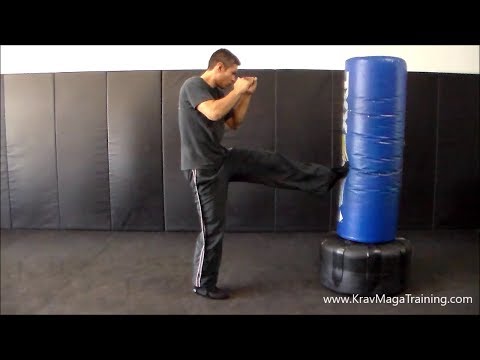
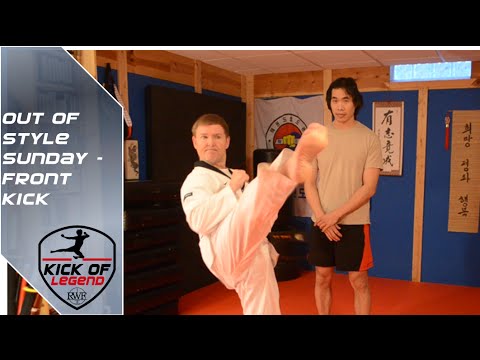
The instep angular front kick is a versatile striking technique employed across Taekwondo and Krav Maga traditions. According to KickofLegend, the instep contact point is primarily used when striking softer targets such as the groin, throat, or face, particularly when an opponent has been knocked down or is in a horizontal position. This contrasts with the ball-of-foot strike, which targets more vertical surfaces like boards or a standing opponent's torso. KickofLegend emphasizes that the kick should travel straight and level rather than rising like a football punt, ensuring proper power delivery. Training methodology differs between instructors: KickofLegend recommends focus mitt drills (kicking between targets to develop accuracy), single-leg repetitive drills for speed and endurance, and power-development exercises using body weight and stance transitions. Krav Maga Worldwide addresses a critical execution error—the forward-leg variant's tendency to incorporate an unintended advance step. The instructor stresses that the base foot must remain stationary while the hip shifts backward to maintain balance, and recommends practicing closer to the target, breaking the kick into four distinct phases (chamber, extension, reach-and-recoil, retraction), and using mirror work or partner feedback to eliminate unnecessary movement. Both sources agree on eliminating wasted motion and developing the technique through focused, methodical drilling.
Synthesized from 2 instructors
KickofLegend — TAEKWONDO: Front Kick drills: Defined instep as primary contact point for softer targets (groin, throat, face); emphasized straight horizontal trajectory; provided three drilling progressions: focus mitt accuracy drills, single-leg speed/endurance repetitions, and power development through stance explosions.
Krav Maga Worldwide - Fort Lauderdale, Florida — Krav Maga - Forward Leg Front Kick in Place (Most Common Mistake to Avoid): Identified the common error of base-foot advancement; explained balance mechanics and hip-shift mechanics; prescribed corrections including closer target distance, heel-planting with hip shift, four-phase breakdown drills, mirror work, and partner monitoring.
Learn This Technique
No instructional courses yet for this technique.
Sign in to suggest a course.
Ratings
Danger Rating
Risk of injury to the person this technique is applied to
6
High6/10
The Lotus Kick to the groin produces the same incapacitating effect as any groin kick. To the inner thigh, it can cause deep adductor muscle bruising. The power is moderate (the curved trajectory reduces the forward force component compared to a straight kick), but the technique compensates by reaching targets that are normally protected. To the chin from below, it can cause a snapping head rotation. [1]
Difficulty
Skill level needed to execute this technique reliably
Advanced
Competition Legality
Whether this technique is allowed under major competition rule sets
Illegal
WBC/Boxing — All kicks prohibited in boxing {src— WBC Rules of Boxing}
✓Practise the inward arc on a hanging bag to develop the curved trajectory — the foot should contact the bag from the side and below, not from the front. If the kick is hitting the bag square-on, it has become a standard front kick and lost the angular component (De Bremaeker & Faige, 2010). [1] Use a focus mitt held at groin height by a partner: the partner holds the mitt between their legs (with a protective cup), and the kicker must arc the instep into the mitt from below and inside. This develops the specific targeting accuracy needed for the curved trajectory. [1] The hip adduction component (the inward movement) must be trained in isolation: from a standing position, practise swinging the kicking leg inward across the body in a scooping arc, without the forward component. Then combine the inward arc with the upward front kick movement. [1] Flexibility for the Lotus Kick is primarily in the hip adductors (inner thigh) — stretching the adductor muscles improves the range of the inward arc. Standard groin stretches (butterfly stretch, side splits progression) directly benefit this technique. [1] In sparring, the Lotus Kick works best when preceded by straight-line attacks that condition the opponent to defend the centreline — the curved arc then exploits the tunnel vision created by straight-line defensive patterns. [1] The instep surface must make contact — if the kick connects with the toes (which can break) or the shin (which converts it into a different technique), the Lotus Kick's wrapping quality is lost. Train contact awareness on the heavy bag. [1]
Common Mistakes
!Making the arc too wide — a wide, looping arc telegraphs the kick and allows the opponent to see it coming and adjust. The arc should be tight and subtle, with the inward curve occurring during the final phase of the kick, not throughout.
!Kicking with the toes instead of the instep — the toes are fragile and will break against a hard target. The instep (dorsum of the foot) provides a broad, padded surface for safe contact.
!Losing the curve — many practitioners start with the correct intention but straighten the kick under pressure, converting it into a standard front kick. Maintain the inward adduction throughout the movement.
!Not scooping upward — the kick must travel UPWARD on its arc, not just inward. A purely horizontal inward movement is an inside crescent kick, not a Lotus Kick. The upward component is what reaches targets below the guard.
!Attempting against an open guard — the Lotus Kick's value is in circumventing a TIGHT guard through angular approach. Against an opponent with a loose, open guard, a standard front kick is more direct and powerful.
1Establish straight-line attacks (jab, front kick) to condition the opponent to defend the centreline → Opponent tightens guard with elbows close to body → Chamber the front kick normally (opponent expects a standard front kick) → During extension, add the inward adduction to create the lotus arc → Foot sweeps upward on a curved path, threading under the opponent's elbows → Instep contacts the groin, inner thigh, or chin from below and inside → Opponent reacts to the unexpected angle → Follow with a straight technique (cross or standard front kick) to the opening created by the guard adjustment
Sources & References
Primary Source
Essential Book of Martial Arts Kicks (De Bremaeker & Faige, 2010)
1Book[1] De Bremaeker, M. and Faige, R. (2010). Essential Book of Martial Arts Kicks. Tuttle Publishing. ISBN 978-1-4629-0558-4. Section 1.13 'The Instep Angular Front (Lotus) Kick'. [2] Yang, J.M. (1990). Tai Chi Chuan Martial Applications. YMAA Publication Center. Fen Jiao technique.pp. De Bremaeker pp.41-42 (Section 1.13)
description: [1] De Bremaeker 2010 pp.41-42
2OtherJapanese Martial Arts Hybrid Terminology
Mixed Japanese-Western terminology — combines traditional Japanese terms with katakana loanwords
3Citation[1] De Bremaeker, M. and Faige, R. (2010). Essential Book of Martial Arts Kicks. Tuttle Publishing. ISBN 978-1-4629-0558-4. Section 1.13 'The Instep Angular Front (Lotus) Kick'. [2] Yang, J.M. (1990). Tai Chi Chuan Martial Applications. YMAA Publication Center. Fen Jiao technique.pp. De Bremaeker pp.41-42 (Section 1.13)
description: [1] De Bremaeker 2010 pp.41-42
Community
Athletics
Requires good hip adductor flexibility for the inward arcing motion
Above-average hip flexor control to maintain the curve during delivery
Good ankle flexibility for plantarflexion (presenting the instep)
Practitioners with naturally flexible hips find the technique easier
Not suitable for practitioners with tight adductors until flexibility is developed
Notes
Documented in De Bremaeker & Faige, Section 1.13 (Instep Angular/Lotus Kick). A front kick using the instep at an angular trajectory — the foot sweeps inward at the end of the extension. Named 'Lotus Kick' in some traditions. (De Bremaeker & Faige, Essential Book of Martial Arts Kicks, 2010)
Frequently Asked Questions
What's the most common mistake people make with the instep angular front kick?
The most common mistake is moving your base foot forward instead of keeping it planted in place. Krav Maga Worldwide emphasizes that when doing a front kick in place, your back foot should not move at all—instead, you should shift your hip back to generate power, not step forward.
How should my foot travel when I throw a front kick—what's the correct path?
Your foot should come straight forward, not up like a football punt, because that's how you deliver power. KickofLegend recommends pointing your knee and shooting straight to ensure proper power transfer.
How can I practice the front kick to make sure I'm doing it correctly?
Practice in front of a mirror to keep your base foot planted and ensure it doesn't creep forward. You can also train with a partner holding a pad and ask them to watch your base foot—if you're cheating with that advanced step, they'll notice it immediately.
Why do I need to be closer to my target for a forward leg front kick?
The forward leg has less reach than a back leg kick, so you generally need to be at least a foot closer to your target. Starting closer forces you to execute the technique correctly and prevents you from compensating with an unwanted forward step.
How does the Instep Angular Front Kick work?
The Instep Angular Front Kick (Lotus Kick) is a front kick delivered at an inward angle using the instep (top of the foot), sweeping upward in a curved lotus-petal arc to target the groin, inner thigh, or — when used as a counter — the underside of the opponent's chin. Unlike a standard front kick that travels in a straight line from the chamber to the target, the Lotus Kick follows a curved inward trajectory: the foot arcs from outside the body's centreline toward the inside, scooping upward as it crosses the midline, creating a sweeping path that bypasses straight-line defences and hooks around protective frames.
Where does the Instep Angular Front Kick come from?
Angular kicks using the instep have been documented in Chinese martial arts for centuries, where the lotus flower (蓮華, lianhua) served as both a Buddhist religious symbol and a metaphorical basis for the flowing, circular motion patterns found throughout kung fu. The lotus metaphor appears across multiple Chinese martial arts systems — in Tai Chi Chuan, the 'Fen Jiao' (split kick) sequence includes similar angled kicks; in Northern Shaolin, sweeping crescent-family kicks share the inward-arcing trajectory.
Is the Instep Angular Front Kick legal in competition?
Unified MMA: legal — Legal striking technique; WBC/Boxing: banned — All kicks prohibited in boxing; WKF: legal — Legal, chudan (body) kick scores 2 points, jodan (head) kick scores 3 points; Kyokushin: legal — Legal at full power to body and head; WT: legal — Legal, body kick 2 points, head kick 3 points, spinning body 4 points, spinni…; WAKO: legal — Legal in Full Contact and Low Kick formats; K: legal — 1/GLORY — Legal; IFMA: legal — Legal — kicks are a core Muay Thai technique
How dangerous is the Instep Angular Front Kick?
Danger rating 6/10. The Lotus Kick to the groin produces the same incapacitating effect as any groin kick. To the inner thigh, it can cause deep adductor muscle bruising. The power is moderate (the curved trajectory reduces the forward force component compared to a straight kick), but the technique compensates by reaching targets that are normally protected. To the chin from below, it can cause a snapping head rotation.
How do I set up the Instep Angular Front Kick?
The standard setup chain: Establish straight-line attacks (jab, front kick) to condition the opponent to defend the centreline → Opponent tightens guard with elbows close to body → Chamber the front kick normally (opponent expects a standard front kick) → During extension, add the inward adduction to create the lotus arc → Foot sweeps upward on a curved path, threading under the opponent's elbows → Instep contacts the groin, inner thigh, or chin from below and inside → Opponent reacts to the unexpected angle → Follow with a straight technique (cross or standard front kick) to the opening created by the guard adjustment.
How do I defend against the Instep Angular Front Kick?
Standard counters include: Widen the guard — spreading the elbows outward removes the gap the Lotus Kick targets / Low block (gedan barai) — a standard downward sweeping block intercepts the kick's upward arc / Step back — the Lotus Kick has slightly less range than a standard front kick due to the curved path; one step back t… / Side step outward — moving to the outside of the curved arc avoids the kick entirely.
What are the variants of the Instep Angular Front Kick?
Common variants: Standard Lotus Kick to groin (the primary version, arcing upward with the instep into t…); High Lotus Kick to chin (extending the arc upward to reach the underside of the ch…); Low Lotus Kick to inner thigh (a shorter arc targeting the inner thigh adductors, useful…); Rear leg Lotus (full power from the rear leg with complete hip rotation); Lead leg Lotus (faster but weaker, used as a quick strike from the front …); Double Lotus (two successive Lotus Kicks from alternating legs, each ar…).
How effective is the Instep Angular Front Kick in competition?
The Lotus Kick is primarily used in traditional martial arts training and self-defence rather than modern competition. Its curved trajectory makes it difficult for referees to score in point karate (the arc is often mistaken for a poorly aimed crescent kick).
What are common mistakes when doing the Instep Angular Front Kick?
Top errors to watch for: Making the arc too wide — a wide, looping arc telegraphs the kick and allows the opponent to see it coming and adjust… / Kicking with the toes instead of the instep — the toes are fragile and will break against a hard target. The instep (… / Losing the curve — many practitioners start with the correct intention but straighten the kick under pressure, conver… / Not scooping upward — the kick must travel UPWARD on its arc, not just inward. A purely horizontal inward movement is….
What are other names for the Instep Angular Front Kick?
The Instep Angular Front Kick is also known as Lotus Kick, Angular Front Kick, Renge Geri, Curved Front Kick, Inward Arc Kick.