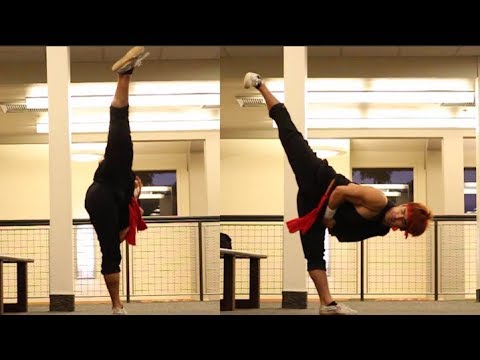
Muay Thai Kick LIKE A PRO! step-by-step guide
0
Lift Kick·Paul Banasiak @MuayThaiTechnician
How to Muay Thai Kick like a pro. Full Course FREE for a Limited Time: https://OnlineStrikingAcademy.com/kickchecklist …
Translation: Scooping kick — sukui (すくい) means to scoop, referring to the upward scooping trajectory of the foot
The Lift Kick is a short-range upward scooping kick delivered with minimal or no chambering, targeting the groin with a fast upward arc of the foot from the ground. [1] Unlike a standard front kick that chambers the knee before extending, the Lift Kick travels in a direct upward arc from its resting position, using the instep or top of the foot to scoop into the groin with almost no preparatory movement. [1] This absence of telegraphing makes it one of the fastest kicks in any martial art — the foot travels the shortest possible distance to the closest available target. [1],[5] The technique appears across multiple martial arts traditions: in karate it is classified as kin geri (gold kick, targeting the testicles) and is taught as a specific technique separate from mae geri keage; in Jeet Kune Do, Bruce Lee considered it the ideal expression of his principle of 'longest weapon to nearest target' — the lead foot to the opponent's groin. [5] In self-defence contexts, the Lift Kick is considered one of the most effective first-response techniques because it requires no martial arts training to execute at a basic level while producing immediate incapacitation against a male attacker. [1],[2] Krav Maga founder Imi Lichtenfeld incorporated the groin kick as one of the first counterattack techniques taught to beginners, recognising its universal applicability. [3]
The groin kick is one of the oldest documented fighting techniques in human history, appearing in ancient Greek pankration illustrations and Egyptian wrestling depictions dating to 2000 BCE. [2] As a codified martial arts technique, the scooping groin kick appears in classical karate as kin geri (金蹴り, gold kick) — the name reflects the value placed on protecting this target — and is taught as a distinct technique from white belt level in most traditional schools. [1] Bruce Lee elevated the technique to a central principle in Jeet Kune Do, arguing that the fastest path to incapacitation is the shortest weapon (the lead foot) to the nearest vulnerable target (the opponent's groin), and that any other initial attack is biomechanically suboptimal for self-defence. [5] Imi Lichtenfeld incorporated the groin kick as a foundational counterattack in Krav Maga during its development for the Israeli Defence Forces in the 1940s-1960s, recognising that groin kicks are effective regardless of the defender's size, strength, or training level. [3]
In self-defence contexts, the Lift Kick to the groin is considered one of the highest-percentage techniques available — it requires minimal training, works against larger opponents, and produces immediate incapacitation. [1],[3],[5] Its primary limitation is that it is ineffective against female attackers (who lack the external vulnerability) and can be partially defended by an attacker who keeps their legs together or wears a protective cup. [3] In the context of this encyclopedia, the Lift Kick represents a technique whose simplicity IS its effectiveness — it is the martial arts equivalent of a fire extinguisher: simple, reliable, and devastating when applied correctly.
Illegal in virtually all combat sports competitions (groin strikes prohibited). Primary application is self-defence. Notable exception: early UFC events (UFC 1-5, 1993-1995) before the Unified Rules, where groin strikes were legal and the technique was used multiple times.
No images yet for this technique.
Sign in to suggest an image.
How to Muay Thai Kick like a pro. Full Course FREE for a Limited Time: https://OnlineStrikingAcademy.com/kickchecklist …
IN THIS EPISODE, ANDY LE REVEALS SOME OF HIS SECRET KICK TECHNIQUES!!! THE ROAD TO THE BEST KICKS IN THE WORLD IS A LONG…
The lift kick, while not explicitly named in these transcripts, relates to the foundational kicking mechanics both instructors emphasize. MartialClub's Andy Lee focuses on the aesthetic and stability aspects of kicks, introducing the concept of 'sticky kicks'—holding a chambered kick position against resistance to develop control and muscular endurance. Lee stresses the importance of flexibility as a prerequisite and demonstrates body alignment (shoulders, hips, knee, ankle, and toes in one line) to achieve a sharp, extended look. His drill involves holding a kick position for 10 seconds with multiple repetitions to build stability and mental fortitude. Conversely, Paul Banasiak from MuayThaiTechnician approaches kicking with emphasis on functional entry and exit mechanics, centering on centreline alignment, knee-driven drive (rather than wide arcing), and hip engagement. Banasiak's checklist prioritizes the entry step (45-degree angle, ankle opening, arm positioning), the pulling of hips across the target via rear arm swing, and controlled retreat. While Lee prioritizes the static hold and aesthetic extension, Banasiak prioritizes dynamic power transfer and range management. Both instructors agree on body awareness, controlled positioning, and deliberate practice, though their pedagogical approaches differ: Lee's is anatomically aesthetic and stability-focused, while Banasiak's is biomechanically efficient and combat-practical.
Synthesized from 2 instructors
No instructional courses yet for this technique.
Sign in to suggest a course.
Risk of injury to the person this technique is applied to
A full-force Lift Kick to the groin can cause testicular rupture, severe nausea and vomiting, temporary paralysis from vasovagal syncope (groin nerve stimulation causing blood pressure drop and fainting), and in extreme cases, internal hemorrhaging. Even a moderate-force Lift Kick causes immediate doubling-over and incapacitation in male recipients.
Skill level needed to execute this technique reliably
Whether this technique is allowed under major competition rule sets
Essential Book of Martial Arts Kicks (De Bremaeker & Faige, 2010)
description: [1] De Bremaeker 2010 pp.44-46, [5] Lee 1975 pp.156-158, [3] Lichtenfeld 2001, [4] Funakoshi 1973
Official karate technique names (和語/漢語)
Established Japanese martial arts naming convention — native Japanese term (和語/漢語)
description: [1] De Bremaeker 2010 pp.44-46, [5] Lee 1975 pp.156-158, [3] Lichtenfeld 2001, [4] Funakoshi 1973
One of the most accessible techniques in martial arts — requires zero flexibility, zero conditioning, and minimal coordination
Effective regardless of the practitioner's size, age, or fitness level
hip flexors (iliopsoas) for the lifting motion — these are muscles used in walking, so no special training is needed
The technique can be executed in any footwear including heels, sandals, or boots
Documented in De Bremaeker & Faige, Section 1.16. A rising front kick that lifts the target upward rather than pushing it backward — the foot scoops under the chin or groin. Used in Muay Thai as a body-lifting teep variation. (De Bremaeker & Faige, Essential Book of Martial Arts Kicks, 2010)
According to MartialClub, flexibility is a prerequisite for good kicking ability—there's no secret to it, just consistent stretching. Beyond that, you need to know exactly what aesthetic and dynamic you want in your kick and be very detailed about body positioning.
MartialClub recommends training your stability muscles by holding your kick against a wall for 10 seconds, delivering 10 slow and controlled kicks to really stick them, then gradually practicing without the wall once you improve. This teaches you to hold your leg extended and stable.
Get your shoulders, hips, knee, ankle, and toes all in one line when you extend, which gives you that nice extended pointed look and maximizes the effectiveness of the technique.
Paul Banasiak emphasizes that you should step forward to enter your kick and then pull yourself back out afterward—this prevents you from landing in front of your target where your opponent can counter with a kick or punch.
The Lift Kick is a short-range upward scooping kick delivered with minimal or no chambering, targeting the groin with a fast upward arc of the foot from the ground. Unlike a standard front kick that chambers the knee before extending, the Lift Kick travels in a direct upward arc from its resting position, using the instep or top of the foot to scoop into the groin with almost no preparatory movement.
The groin kick is one of the oldest documented fighting techniques in human history, appearing in ancient Greek pankration illustrations and Egyptian wrestling depictions dating to 2000 BCE. As a codified martial arts technique, the scooping groin kick appears in classical karate as kin geri (金蹴り, gold kick) — the name reflects the value placed on protecting this target — and is taught as a distinct technique from white belt level in most traditional schools.
Unified MMA: legal — Legal striking technique; WBC/Boxing: banned — All kicks prohibited in boxing; WKF: legal — Legal, chudan (body) kick scores 2 points, jodan (head) kick scores 3 points; Kyokushin: legal — Legal at full power to body and head; WT: legal — Legal, body kick 2 points, head kick 3 points, spinning body 4 points, spinni…; WAKO: legal — Legal in Full Contact and Low Kick formats; K: legal — 1/GLORY — Legal; IFMA: legal — Legal — kicks are a core Muay Thai technique
Danger rating 9/10. A full-force Lift Kick to the groin can cause testicular rupture, severe nausea and vomiting, temporary paralysis from vasovagal syncope (groin nerve stimulation causing blood pressure drop and fainting), and in extreme cases, internal hemorrhaging. Even a moderate-force Lift Kick causes immediate doubling-over and incapacitation in male recipients.
The standard setup chain: For self-defence: Verbal de-escalation fails → Attacker closes distance → Lift Kick to groin with zero telegraphing → Attacker doubles over → Follow up with knee to face or palm strike to back of head → Disengage and escape → For martial arts combination: Feint jab to face → Opponent raises guard → Lift Kick to exposed groin → Opponent doubles over → Downward elbow or knee.
Standard counters include: Protective cup — the most reliable defence in training (eliminates the groin vulnerability) / Close the stance — keeping the legs together or blading the body removes the direct line to the groin / Drop the hands to block — lowering the hands to cup-block protects the groin but exposes the head to strikes / Angle off — stepping at a 45° angle takes the groin out of the kick's vertical path.
Common variants: Lead leg lift (the fastest variant, using the front foot for maximum spe…); Rear leg lift (more powerful but slightly slower, using the rear foot wi…); Walking lift (delivered while walking forward naturally, disguised with…); Instep lift (scoops with the top of the foot for a broader impact surface); Toe lift (drives the point of the toes upward for concentrated impa…); Double lift (two rapid successive lift kicks to the same target, with …).
Illegal in virtually all combat sports competitions (groin strikes prohibited). Primary application is self-defence.
Top errors to watch for: Chambering the knee before kicking — this defeats the entire purpose of the Lift Kick, which is the absence of chambe… / Looking down at the target — the eyes dropping to the groin telegraph the intention as clearly as pointing / Shifting weight backward before kicking — any backward lean signals an incoming kick and gives the opponent time to p… / Kicking with too much power at the expense of speed — the Lift Kick's effectiveness comes from speed and surprise, no….
The Lift Kick is also known as Scoop Kick, Scooping Front Kick, Sukui Geri, Groin Scoop, Snap Groin Kick.