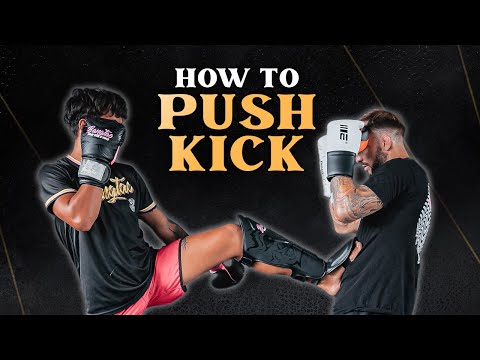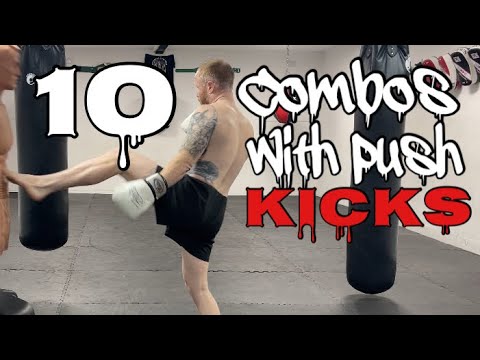
10 Combos with a PUSH KICK or TEEP #pushkick #teep
0
Push Kick-Teep·The Will To Fight
In this video i show 10 different combinations ending with a push kick. #pushkick #teep If you wish to purchase a sma…
Translation: push kick / teep
The Push Kick (Teep) subfamily covers front kicks designed primarily to create distance by pushing the opponent away rather than delivering sharp impact damage. [1] The teep (Thai: ถีบ, to push) is the quintessential Muay Thai distance-management weapon, using a thrusting motion with the ball or sole of the foot to shove the opponent's hips, abdomen, or chest backward, disrupting their rhythm and preventing their forward advance. [1],[2] Unlike snap kicks that retract quickly, the push kick follows through the target, extending the leg fully and driving the opponent back with sustained force. [2],[3]
The teep is one of Muay Thai's most fundamental techniques, equivalent in importance to the jab in boxing as the primary tool for controlling range and setting tempo. [1] Thai fighters have refined the teep over centuries of ring competition, and it is one of the first techniques taught to beginners at Thai camps. [1],[2] The push kick also appears in karate as mae geri kekomi (front thrust kick) and in savate as the chassé frontal. [2],[3]
The teep is one of the most frequently used kicks in Muay Thai competition. [1]
No images yet for this technique.
Sign in to suggest an image.
In this video i show 10 different combinations ending with a push kick. #pushkick #teep If you wish to purchase a sma…
Thai fighters are renowned and famous for their skill and ability to throw and time push kicks(teep). I held some pads f…
No instructional courses yet for this technique.
Sign in to suggest a course.
Risk of injury to the person this technique is applied to
Teep/push kick; primarily distance management, liver shot potential
Skill level needed to execute this technique reliably
Whether this technique is allowed under major competition rule sets
Muay Thai: The Art of Fighting (Yod Ruerngsa, Khun Kao Charuad & James Cartmell, 2002)
Alias sources — [1] Muay Thai: The Art of Fighting (Kraitus & Kraitus, 1988) [2] Muay Thai Unleashed (Delp, 2006)
Effectiveness sources — [1] Muay Thai Unleashed (Delp, 2006) [2] Muay Thai: The Art of Fighting (Kraitus & Rennehan, 2002)
Mixed Japanese-Western terminology — combines traditional Japanese terms with katakana loanwords
Alias sources — [1] Muay Thai: The Art of Fighting (Kraitus & Kraitus, 1988) [2] Muay Thai Unleashed (Delp, 2006)
Effectiveness sources — [1] Muay Thai Unleashed (Delp, 2006) [2] Muay Thai: The Art of Fighting (Kraitus & Rennehan, 2002)
hip flexion power, knee extension speed, balance
long legs for range, hip flexibility
hip flexors, quadriceps, tibialis anterior, core
Every move, in any martial art, shares a few universal traits. Mix and match below to pinpoint the right tool — or compare equivalents across styles.
The Side Teep is a push kick variation delivered from a sideways stance, using the lead or rear leg to push the opponent away at an angle rather than straight ahead. [1] The side teep combines elements of the traditional teep with lateral body positioning, allowing the kicker to maintain distance while presenting a narrower profile to the opponent. [1,2] This technique is used to manage distance against aggressive opponents approaching from an angle or to push an opponent off the centreline. [2,3]
The Snap Teep is a push kick variation that emphasises speed and retraction over push-through force, delivered with a quick snapping motion that contacts the target and retracts immediately. [1] Unlike the standard teep, which follows through to shove the opponent, the snap teep strikes and returns, making it harder to catch and providing a faster return to guard position. [1,2] The snap teep targets the face, solar plexus, or body with a stinging impact rather than a sustained push. [2,3]
The Standard Teep is the fundamental Muay Thai push kick, executed by lifting the knee to chamber position and extending the leg to push the ball or sole of the foot into the opponent's torso, driving them backward. [1] The technique uses full hip extension to deliver sustained pushing force through the target, and the arms are typically thrown back during execution to counterbalance the forward leg extension. [1,2] The standard teep is the most commonly used teep variation and serves as Muay Thai's primary range-control weapon. [2,3]
The push kick (teep) appears in 494 passages across 26 books under 'push kick' and 232 references across our corpus under 'teep'. De Bremaeker & Faige (2010) document it as the most fundamental distance-management kick in Muay Thai. The lead teep to the body is the most frequently used technique for maintaining range in professional Muay Thai. (26 books; De Bremaeker & Faige, Essential Book of Martial Arts Kicks)
According to Brad Riddell, you want to hit with the ball of your foot using a stabbing motion, as this is the most effective striking surface for a teep.
Brad Riddell emphasizes using an A-frame stance where your weight is forward and your kicking leg angles slightly backward, keeping you grounded and stable throughout the technique.
Brad Riddell stresses that your leg should snap back immediately without falling forward—if your kick is knocked away, you want to retract your knee and maintain control of your limb rather than overcommitting into your opponent.
Brad Riddell recommends practicing on a heavy bag as an effective solo training method to improve your push kick technique.
The Push Kick (Teep) subfamily covers front kicks designed primarily to create distance by pushing the opponent away rather than delivering sharp impact damage. The teep (Thai: ถีบ, to push) is the quintessential Muay Thai distance-management weapon, using a thrusting motion with the ball or sole of the foot to shove the opponent's hips, abdomen, or chest backward, disrupting their rhythm and preventing their forward advance.
The teep is one of Muay Thai's most fundamental techniques, equivalent in importance to the jab in boxing as the primary tool for controlling range and setting tempo. Thai fighters have refined the teep over centuries of ring competition, and it is one of the first techniques taught to beginners at Thai camps.
Unified MMA: legal — Legal striking technique; WBC/Boxing: banned — All kicks prohibited in boxing; WKF: legal — Legal, chudan (body) kick scores 2 points, jodan (head) kick scores 3 points; Kyokushin: legal — Legal at full power to body and head; WT: legal — Legal, body kick 2 points, head kick 3 points, spinning body 4 points, spinni…; WAKO: legal — Legal in Full Contact and Low Kick formats; K: legal — 1/GLORY — Legal; IFMA: legal — Legal — kicks are a core Muay Thai technique
Danger rating 5/10. High — teep/push kick; primarily distance management, liver shot potential
The standard setup chain: Stance and Range → Chamber the Leg → Execute the Kick → Recover.
Standard counters include: Check (Shin Block) — raise the shin to intercept the kick before it lands / Catch and Sweep — catch the kicking leg and sweep the standing leg / Step Inside — close distance inside the kick's effective range to smother it.
Common variants: Push kick (teep) (pushing the opponent away with the ball of the foot); Snap front kick (snapping the foot to the target and quickly retracting); Side teep (angled teep pushing the opponent laterally); Body teep (driving into the solar plexus or chest for maximum push-back).
The teep is one of the most frequently used kicks in Muay Thai competition.
Top errors to watch for: Flicking the teep with the foot only instead of driving through the hip — the push comes from the hip extension / Leaning back too far, which takes weight off the kick and makes you vulnerable to sweeps / Not chambering the knee first, turning the teep into a stomping leg extension / Leaving the foot out after the push, allowing the opponent to grab the ankle and dump you.
The Push Kick-Teep is also known as Mae-geri / Tīpu, Teep, Push Kick.