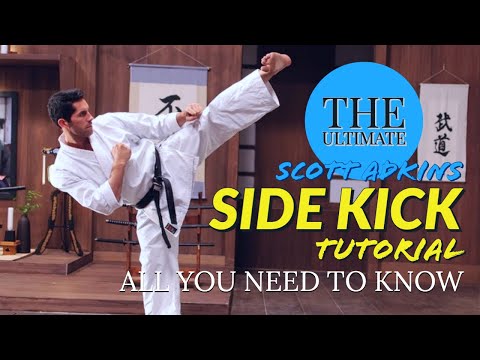
Scott Adkins Side Kick Tutorial
0
Side Front Kick·Scott Adkins
This Side Kick Tutorial is brought to you by World renowned martial artist Scott Adkins. This kick is a staple of martia…
Translation: side front kick
The Side Front Kick is a front kick performed with a hip turn so that at full extension the upper body is perpendicular to the opponent rather than facing them. [1] Practiced extensively in Wado-ryu karate, this variation allows greater penetration while presenting less target surface to the opponent's retaliation. [1] The kick can be executed as either a penetrating or upward front kick with the added hip rotation, making it effective for simultaneous attack and evasion — the perpendicular body position allows kicking while dodging incoming strikes to the centerline. [1] A variation also appears in classical tai chi chuan sequences as oblique front kicks delivered at 45 degrees. [1]
Effective for simultaneous attack and evasion — perpendicular body presents a smaller target while maintaining forward striking power. [1]
Documented in De Bremaeker & Faige, Essential Book of Martial Arts Kicks (2010). A hybrid trajectory combining front and side kick elements. [1]
Primarily a training, demonstration, and point-fighting technique. Rarely seen in full-contact MMA or kickboxing due to acrobatic risk and telegraphing. Appears occasionally in TKD and point-fighting karate tournaments. [1]
No images yet for this technique.
Sign in to suggest an image.
This Side Kick Tutorial is brought to you by World renowned martial artist Scott Adkins. This kick is a staple of martia…
No instructional courses yet for this technique.
Sign in to suggest a course.
Risk of injury to the person this technique is applied to
Standard striking force with added penetration from hip rotation.
Skill level needed to execute this technique reliably
Whether this technique is allowed under major competition rule sets
De Bremaeker, M. & Faige, R. (2010). Essential Book of Martial Arts Kicks. Tuttle Publishing.
[1] De Bremaeker & Faige, Essential Book of Martial Arts Kicks (2010), Section 1.5, pp. 23-25
Official karate technique names (和語/漢語)
Established Japanese martial arts naming convention — native Japanese term (和語/漢語)
[1] De Bremaeker & Faige, Essential Book of Martial Arts Kicks (2010), Section 1.5, pp. 23-25
hip flexibility for rotation, good balance
hip rotators, quadriceps, core obliques
Documented in De Bremaeker & Faige, Section 1.8. A hybrid between a front kick and a side kick — the trajectory splits the difference between the two. Useful against opponents who defend one angle but not the other. (De Bremaeker & Faige, Essential Book of Martial Arts Kicks, 2010)
What matters most is what you do with your hips before you throw the side kick. Scott Adkins emphasizes turning your back foot out so your toes point one direction and your heel points the opposite way, which sets up proper hip rotation for the kick.
According to Scott Adkins, knowing the proper end position makes it easier to transition to that position from whatever stance you're in—if you know where you're supposed to end up, you'll get there more efficiently and with better technique.
Scott Adkins recommends hitting with the heel and the ridge of the foot (the knife's edge), not the flat of the foot or toes, because a smaller contact area concentrates force more effectively—think of a stiletto heel versus a flat shoe striking the same target.
Your toes should be lower than your heel; if your toes are pointing upward, you're probably hitting with your toes or flat foot instead of the heel. Scott Adkins stresses that pulling your toes back and keeping them down is essential for proper technique.
The Side Front Kick is a front kick performed with a hip turn so that at full extension the upper body is perpendicular to the opponent rather than facing them. Practiced extensively in Wado-ryu karate, this variation allows greater penetration while presenting less target surface to the opponent's retaliation.
A signature technique of Wado-ryu karate, a style founded by Hironori Otsuka that emphasizes hip movements, evasions, and body shifting. A variation appears in classical tai chi chuan as oblique front kicks at 45 degrees.
Unified MMA: Legal: legal — standard striking technique; WKF Karate: Legal: legal — controlled contact required; WT Taekwondo: Legal: legal — kicks are primary scoring technique; WAKO Kickboxing: Legal: legal — full contact permitted
Danger rating 4/10. Moderate — standard striking force with added penetration from hip rotation.
The standard setup chain: Jab to draw counter → side front kick while evading → Step to outside angle → side front kick to ribs.
Standard counters include: Angle off laterally / Low kick to standing leg during hip rotation / Close distance quickly.
Common variants: Penetrating version (ball of foot driven through target); Upward version (instep snaps upward); 45-degree version (tai chi variation).
Primarily a training, demonstration, and point-fighting technique. Rarely seen in full-contact MMA or kickboxing due to acrobatic risk and telegraphing.
Top errors to watch for: Turning the hips too early, telegraphing the angle / Not committing to the perpendicular position / Confusing this with a standard side kick — the chamber is frontal / Losing balance from rotational momentum.
The Side Front Kick is also known as Yoko Geri, Yoko Sokugyaku Geri Kekomi, Side-Angled Front Kick.