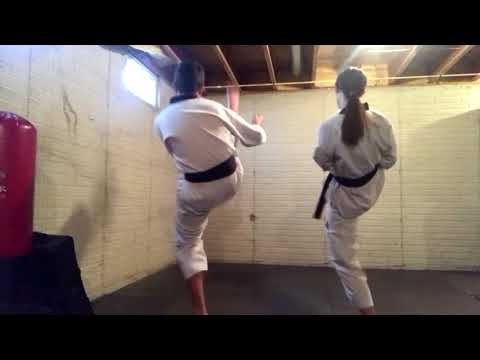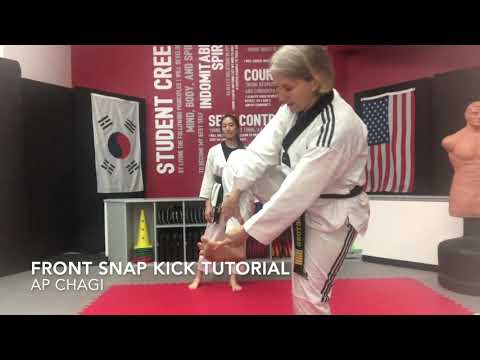
Front Snap Kick Tutorial
0
Snap Front Kick·Beyond Taekwondo
This video is a Fronst Snap Kick Tutorial. Master Sorenson & Suzie break down the parts of a front Snap kick and practi…
Translation: snap front kick
The Snap Front Kick subfamily covers front kicks delivered with a fast, whipping motion that emphasises speed and retraction over push-through force. [1] The snap kick chambers high by lifting the knee, then rapidly extends the lower leg to strike the target with the ball of the foot before immediately pulling the leg back to the chambered position. [1],[2] This snapping action makes the kick fast, difficult to catch, and effective for targeting the face, chin, solar plexus, or groin with sharp, damaging impact. [2],[3]
Snap front kicks are most closely associated with Japanese and Okinawan karate, where mae geri keage (snapping front kick) is distinguished from mae geri kekomi (thrusting front kick) as one of the two primary front kick types. [1] The distinction between snap and thrust variations was formalised in Shotokan karate by Gichin Funakoshi and his students. [1],[2] Taekwondo also employs the snap front kick (ap chagi) as a fundamental technique. [2],[3]
The snap front kick uses a snapping motion for speed and accuracy to the head or body. [1]
From karate and TKD. [1]
Used in karate, TKD, and MMA competition. [1]
No images yet for this technique.
Sign in to suggest an image.
This video is a Fronst Snap Kick Tutorial. Master Sorenson & Suzie break down the parts of a front Snap kick and practi…
Created with Movie Studio Platinum
No instructional courses yet for this technique.
Sign in to suggest a course.
Risk of injury to the person this technique is applied to
Teep/push kick; primarily distance management, liver shot potential
Skill level needed to execute this technique reliably
Whether this technique is allowed under major competition rule sets
Muay Thai: The Art of Fighting (Yod Ruerngsa, Khun Kao Charuad & James Cartmell, 2002)
Alias sources — [1] Karate-Do Kyohan (Funakoshi, 1935) [2] Kukkiwon Taekwondo Textbook (Kukkiwon, 2006) [3] Dynamic Karate (Nakayama, 1966)
Effectiveness sources — [1] Comprehensive Asian Fighting Arts (Draeger & Smith, 1969)
Official karate technique names (和語/漢語)
Established Japanese martial arts naming convention — native Japanese term (和語/漢語)
Alias sources — [1] Karate-Do Kyohan (Funakoshi, 1935) [2] Kukkiwon Taekwondo Textbook (Kukkiwon, 2006) [3] Dynamic Karate (Nakayama, 1966)
Effectiveness sources — [1] Comprehensive Asian Fighting Arts (Draeger & Smith, 1969)
hip flexion power, knee extension speed, balance
long legs for range, hip flexibility
hip flexors, quadriceps, tibialis anterior, core
Every move, in any martial art, shares a few universal traits. Mix and match below to pinpoint the right tool — or compare equivalents across styles.
Mae Geri Keage is the Japanese karate term for the snapping front kick, in which the leg is chambered by raising the knee and then snapped forward rapidly using the knee joint as a hinge, striking with the ball of the foot (koshi) before immediately retracting. [1] The 'keage' designation (meaning 'rising' or 'snapping upward') indicates that the kick follows a slightly upward trajectory at the end of extension, creating a flicking impact that is fast and sharp. [1,2] Mae Geri Keage is one of the most fundamental kicks in Shotokan, Shito-Ryu, and Wado-Ryu karate, practised extensively in kihon (basics) and kata. [2,3]
Mae Geri Kekomi is the Japanese karate term for the thrusting front kick, in which the leg is chambered and then driven forward in a straight penetrating line, striking with the heel or ball of the foot and pushing through the target with full hip extension. [1] The 'kekomi' designation (meaning 'thrusting' or 'pushing in') indicates a forceful, penetrating kick that prioritises power and displacement over speed and retraction. [1,2] Mae Geri Kekomi functions similarly to the Muay Thai teep but is typically aimed higher, targeting the solar plexus or chest. [2,3]
You should be up on the balls of your feet, which concentrates all your energy and momentum through that small contact point. Make sure your arch is extended while your toes are pulled back during the kick.
According to Beyond Taekwondo, instructors pay close attention to the chamber, execute, chamber, and back sequence when scoring students for testing, as it makes the technique look clean and controlled.
Keep your hands up throughout the entire kick—never drop your hands—and tighten your back with firm tension as you execute the kick. Everything in Taekwondo is about balance, with your head over shoulder, shoulders over hips.
The Snap Front Kick subfamily covers front kicks delivered with a fast, whipping motion that emphasises speed and retraction over push-through force. The snap kick chambers high by lifting the knee, then rapidly extends the lower leg to strike the target with the ball of the foot before immediately pulling the leg back to the chambered position.
Snap front kicks are most closely associated with Japanese and Okinawan karate, where mae geri keage (snapping front kick) is distinguished from mae geri kekomi (thrusting front kick) as one of the two primary front kick types. The distinction between snap and thrust variations was formalised in Shotokan karate by Gichin Funakoshi and his students.
Unified MMA: legal — Legal striking technique; WBC/Boxing: banned — All kicks prohibited in boxing; WKF: legal — Legal, chudan (body) kick scores 2 points, jodan (head) kick scores 3 points; Kyokushin: legal — Legal at full power to body and head; WT: legal — Legal, body kick 2 points, head kick 3 points, spinning body 4 points, spinni…; WAKO: legal — Legal in Full Contact and Low Kick formats; K: legal — 1/GLORY — Legal; IFMA: legal — Legal — kicks are a core Muay Thai technique
Danger rating 5/10. High — teep/push kick; primarily distance management, liver shot potential
The standard setup chain: Stance and Range → Chamber the Leg → Execute the Kick → Recover.
Standard counters include: Check (Shin Block) — raise the shin to intercept the kick before it lands / Catch and Sweep — catch the kicking leg and sweep the standing leg / Step Inside — close distance inside the kick's effective range to smother it.
Common variants: Push kick (teep) (pushing the opponent away with the ball of the foot); Snap front kick (snapping the foot to the target and quickly retracting); Side teep (angled teep pushing the opponent laterally); Body teep (driving into the solar plexus or chest for maximum push-back).
Used in karate, TKD, and MMA competition.
Top errors to watch for: Kicking with the toes instead of pulling them back to present the ball of the foot — toe injuries are common / Not chambering the knee high enough, which reduces the snap angle and the kick's penetrating power / Pushing through the target instead of snapping back — a front kick is not a teep / Leaning the upper body back excessively, which disconnects the hip from the kick.
The Snap Front Kick is also known as Mae-geri Keage, Mae Geri Keage, Ap Chagi, Snap Kick.