Taekwondo Fundamentals: Double Front Kick
0
Double Front Kick·TaekwondoShawn
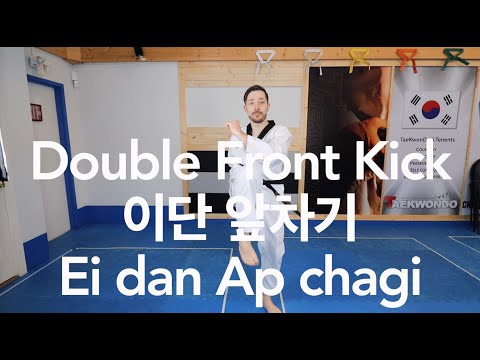
Double Front Kick 이단 앞차기 Ei Dan Ap Chagi Double front kick can be found in Taegeuk 8 Jang, and is spectacular to watch i…
Translation: double front kick
The Double Front Kick is a technique where the fighter delivers two successive front kicks without the kicking foot returning to the ground between strikes. [1] Typically, the first kick targets the midsection to lower the opponent's guard, and the second kick targets the face or neck. The technique requires excellent balance, hip flexibility, and timing to execute both kicks with speed and accuracy while maintaining combat effectiveness. [1] In Taekwon-Do, it is classified as a flying front-back kick (Twimyo Apdwi Chagi). [1]
The first kick forces a defensive reaction, and the second kick exploits the opening. [1] Most effective when the first kick targets the body (drawing the guard down) and the second targets the head. In competition, the speed of the double kick often catches defenders mid-reaction.
Practiced in karate (nidan mae geri) and Taekwondo. Japanese karate lineage: Okinawan te → Shotokan/Kyokushin systems. [1]
Commonly used in WT Taekwondo Olympic competition and ITF tournament sparring. Also appears in WKF karate kumite and kickboxing. [1]
No images yet for this technique.
Sign in to suggest an image.
Double Front Kick 이단 앞차기 Ei Dan Ap Chagi Double front kick can be found in Taegeuk 8 Jang, and is spectacular to watch i…
Tutorial by Master Paul Rana of Prana Martial Arts on how to properly perform a Jumping Double Front Snap Kick in 3 form…
The double front kick, known in Taekwondo as Idan Ap Chagi, is executed by driving both knees upward during a jump and then snapping both legs out explosively at the peak of the jump. Both TaekwondoShawn and Prana Master's Academy emphasize that despite its name, the technique involves simultaneous kicking motions rather than sequential strikes. TaekwondoShawn stresses the importance of knee chamber before extension, explaining that bringing a smaller package (bent knees) upward and then unloading is faster than swinging straight legs. Prana Master's Academy reinforces this point, noting that common mistakes include failing to chamber knees properly and instead performing rising kicks without power. Both instructors agree on fundamental prerequisites: practitioners must first master the stationary front snap kick, then practice jumping mechanics independently before combining them. TaekwondoShawn provides detailed progression using chair assistance, while Prana Master's Academy outlines three leg configurations: 45-degree angles, feet together, and full 180-degree splits. Both emphasize pulling toes back and driving the ball of the foot straight during the snap. Upper body mechanics differ slightly: TaekwondoShawn compares arm motion to Mario's jumping technique for counterbalance and power generation, while Prana Master's Academy prescribes bringing both hands downward toward the center to prevent backward rotation and maintain forward weight distribution. Both recommend maintaining vertical positioning without traveling forward significantly.
Synthesized from 2 instructors
No instructional courses yet for this technique.
Sign in to suggest a course.
Risk of injury to the person this technique is applied to
Individual kicks are standard front kick power. The surprise of the second kick is the weapon.
Skill level needed to execute this technique reliably
Whether this technique is allowed under major competition rule sets
Choi, H.H. (1999). Condensed Encyclopedia of Taekwon-Do. International Taekwon-Do Federation.
[1] Choi, Condensed Encyclopedia of Taekwon-Do (1999), Combination Kicks section
[1] Choi, Condensed Encyclopedia of Taekwon-Do (1999), Combination Kicks section
excellent hip flexibility for rapid re-chambering, balance on one leg, cardio for sustained kicking
hip flexors (rapid chamber), quadriceps, core (balance between kicks)
TaekwondoShawn emphasizes driving your knee up first before extending the kick, keeping your hands up for balance assistance, and staying in the same spot—you're only allowed to move forward about one body length. Focus on landing soft to reduce impact and protect your joints.
TaekwondoShawn recommends emulating the video game character Mario: swing your arms up powerfully as you jump, similar to how Mario uses his arms to propel himself upward. This arm motion is very important for generating momentum and control.
Make sure your toes are down and your foot is straight all the way from your knee to your toes when executing the kick. Master Paul Rana advises pulling your knees up tight and shooting both feet out together in the jumping double front snap kick variation.
The Double Front Kick is a technique where the fighter delivers two successive front kicks without the kicking foot returning to the ground between strikes. Typically, the first kick targets the midsection to lower the opponent's guard, and the second kick targets the face or neck.
The Double Front Kick is documented in Taekwon-Do as Twimyo Apdwi Chagi (flying front-back kick) and in karate as nidan mae geri (two-level front kick). It represents the martial arts principle of using combination attacks to overcome static defenses.
Unified MMA: Legal: legal — standard striking technique; WKF Karate: Legal: legal — controlled contact required; WT Taekwondo: Legal: legal — kicks are primary scoring technique; WAKO Kickboxing: Legal: legal — full contact permitted; IFMA Muay Thai: Legal: legal — all strikes permitted
Danger rating 5/10. Moderate — individual kicks are standard front kick power. The surprise of the second kick is the weapon.
The standard setup chain: Jab to face → double front kick (body then head) → First kick blocked → second kick goes around the block → Feint the first kick → opponent doesn't react → commit both kicks.
Standard counters include: Step back after the first kick — creates distance for both kicks to miss / Clinch after the first kick — prevents the second / Side step — exit the kicking line entirely.
Common variants: Same leg double (both kicks from the same leg); Alternating legs (left then right (requires a hop-switch)); Same target double (both kicks to the same target for maximum damage); Split level (first low, second high).
Commonly used in WT Taekwondo Olympic competition and ITF tournament sparring. Also appears in WKF karate kumite and kickboxing.
Top errors to watch for: Telegraphing the second kick by pausing after the first / Not retracting the first kick fast enough — delays the second / Losing balance after the first kick — base leg must be solid / Aiming both kicks at the same height — no tactical advantage.
The Double Front Kick is also known as Nidan Mae Geri, Twimyo Apdwi Chagi, Flying Front-Back Kick, Double Snap Kick, Successive Front Kicks.