How to Roundhouse Kick | Martial Arts for Beginners
0
Roundhouse Kick·Black Belt Samery
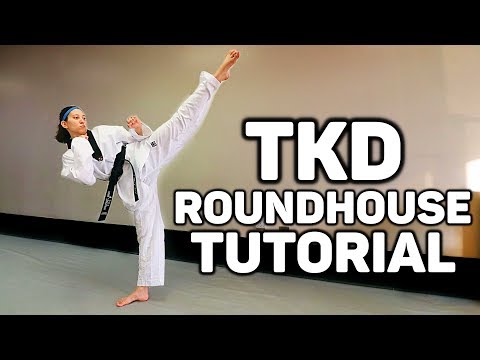
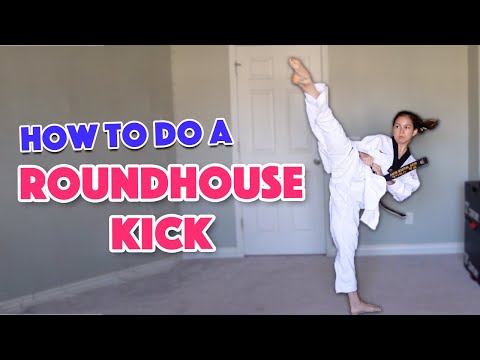
How to Do one of the most used kicks in Taekwondo - the Roundhouse Kick 🔥 Get my Free 30-min Intro to Taekwondo class: …
回し蹴り(Mawashi-geri)
TraditionalTranslation: roundhouse kick
The Roundhouse Kick family is the most widely used and tactically versatile kick family in combat sports, encompassing all circular kicks where the leg swings in a horizontal or slightly upward arc to strike the opponent with the shin or instep. [1] Biomechanical studies have consistently identified the roundhouse kick as one of the most powerful strikes in martial arts, with elite Thai boxers generating peak forces of 9,000+ newtons — roughly equivalent to being struck by a baseball bat. [1],[2] The roundhouse kick's power derives from the whipping action of the hip, the rotational torque of the trunk, and the centripetal acceleration of the extended leg, all concentrated into the dense tibial bone of the shin. [2],[3] The family is subdivided by target height — low kicks attacking the legs, body kicks targeting the torso, and head kicks aimed above the shoulders — and by delivery method, including switch-stance variants and spinning/turning kicks that add rotational momentum. [3],[4]
The roundhouse kick exists in virtually every kicking art worldwide, but its modern competitive form was most profoundly shaped by Muay Thai, which refined the shin-delivered, full-hip-rotation roundhouse into the most powerful kicking method in combat sports. [1] Thai fighters developed the technique by kicking banana trees and heavy bags thousands of times, hardening the shin through repetitive micro-fracture conditioning. [1],[2] Karate's mawashi geri uses the instep or ball of the foot and a more chambered trajectory, while taekwondo's dollyo chagi emphasises speed and height for head scoring. [2],[3] The Dutch kickboxing school — founded by pioneers like Jan Plas and refined by fighters like Ramon Dekkers and Ernesto Hoost — blended Muay Thai's round kick power with Western boxing combinations, creating the modern kickboxing style that dominates European and international competition. [3],[4]
The roundhouse kick is the most commonly thrown kick in MMA and accounts for a significant percentage of kick knockouts. [1]
No images yet for this technique.
Sign in to suggest an image.
How to Do one of the most used kicks in Taekwondo - the Roundhouse Kick 🔥 Get my Free 30-min Intro to Taekwondo class: …
Follow me on Social Media! VIDEOS - http://www.AlexWongTKD.com FACEBOOK - http://www.FB.com/AlexWongTKD INSTAGRAM - htt…
No instructional courses yet for this technique.
Sign in to suggest a course.
Risk of injury to the person this technique is applied to
Most common KO kick; generates ~1,000N force to head (Falco et al. 2009)
Skill level needed to execute this technique reliably
Whether this technique is allowed under major competition rule sets
Karate-Do Kyohan: The Master Text (Gichin Funakoshi, 1935)
Alias sources — [1] Dynamic Karate (Nakayama, 1966) [2] Kukkiwon Textbook (2006) [3] Dynamic Karate (Nakayama, 1966) [4] Muay Thai: The Art of Fighting (Kraitus & Kraitus, 1988)
Effectiveness sources — [1] Muay Thai Unleashed (Delp, 2006) [2] Comprehensive Asian Fighting Arts (Draeger & Smith, 1969)
Official karate technique names (和語/漢語)
Established Japanese martial arts naming convention — native Japanese term (和語/漢語)
Alias sources — [1] Dynamic Karate (Nakayama, 1966) [2] Kukkiwon Textbook (2006) [3] Dynamic Karate (Nakayama, 1966) [4] Muay Thai: The Art of Fighting (Kraitus & Kraitus, 1988)
Effectiveness sources — [1] Muay Thai Unleashed (Delp, 2006) [2] Comprehensive Asian Fighting Arts (Draeger & Smith, 1969)
hip flexibility, rotational hip power, balance on support leg
long legs for reach, flexible hips for high kicks
hip flexors, glutes, quadriceps, obliques, calves
The 360 Spin-Back Roundhouse Kick is an advanced variation of the spin-back roundhouse that incorporates a full 360-degree rotation before the kick lands. [1] Unlike the standard spin-back which uses a 180-degree turn, this technique begins with a forward step that initiates a complete revolution, building maximum rotational momentum. [1] The extended wind-up makes it slower and more telegraphed but generates extraordinary power when it connects. [1] This kick is primarily used in competitive point-fighting and demonstrations rather than full-contact combat due to its high risk and telegraph. [1]
The Bent-Body Long Roundhouse Kick uses extreme lateral body lean to maximise reach at the cost of balance. [1] By bending the torso away from the kicking leg, the practitioner extends the effective range significantly, reaching targets that would be impossible with standard posture. [1] This variant is common in Thai boxing where clinch-range body kicks require maximum extension. [1]
Bituro Chagi (twisting kick) is a Taekwon-Do kicking technique that follows an outcurved line to the target, creating a twisting trajectory. [1] Unlike the straight-line front kick or the circular roundhouse, the twisting kick travels in a curved path that deceives the opponent about the final point of impact. [1] It is divided into low, middle, and high variations, with the ball of the foot as the primary striking surface for low and middle versions. [1] Classified as a smashing kick in General Choi's Taekwon-Do encyclopedia, it is designed for attacking the front of the opponent with a deceptive trajectory. [1]
The Body Kick subfamily covers roundhouse kicks targeting the opponent's torso, including the ribs, liver, spleen area, and floating ribs, delivered at midsection height. [1] Body kicks are among the most tactically effective strikes in Muay Thai and kickboxing because they accumulate damage over rounds, degrading the opponent's endurance and willingness to engage, while individual clean body kicks can produce instant stoppages by impacting the liver or solar plexus. [1,2] The body kick is scored highly in Muay Thai judging, where heavy body kicks are considered indicators of dominance and ring control. [2,3]
The Downward Roundhouse Kick is a roundhouse kick that travels in a high-to-low descending arc, striking the target from above. [1] The leg chambers high and the shin or instep drops downward onto the target — typically the collarbone, shoulder, or side of the neck. [1] This trajectory reverses the typical roundhouse path and catches defenders who expect horizontal attacks, making it effective against opponents with high guard positions. [1]
The Drop Roundhouse Kick is a roundhouse delivered while intentionally dropping the body, attacking from an unexpected low angle. [1] The dropping motion creates a unique circular trajectory that comes from below the opponent's visual field. [1] It can be used both offensively and as a surprise counter. [1]
The Drop Twin Roundhouse Kick delivers two successive roundhouse kicks during a single controlled drop to the ground, attacking with rapid alternating legs. [1] The momentum of the first kick helps power the chamber of the second, creating a rapid two-kick combination from an unusual angle. [1]
The Front Leg Roundhouse Kick is a roundhouse kick delivered with the lead leg, trading power for speed and reduced telegraphing. [1] The rear foot slides forward to close distance while the former front leg swings in a circular arc toward the target. [1] While generating less rotational force than the rear-leg roundhouse, the front leg version is significantly faster and harder to anticipate, making it one of the most frequently used kicks in competitive striking sports. [1]
Haisoku Geri is a kick delivered using the instep (top of the foot) as the striking surface, typically in a roundhouse or snapping trajectory. [1] The instep provides a larger contact area than the ball of the foot, making it easier to land but distributing force over a wider surface. [1] In Muay Thai, the instep/shin is the primary roundhouse striking surface, while in traditional karate the ball of the foot is more common — Haisoku Geri represents the instep-contact approach. [1]
The Head Kick subfamily covers roundhouse kicks aimed above the shoulders, targeting the opponent's jaw, temple, or neck — areas where impact produces the highest probability of knockout due to the rotational forces applied to the skull and brain. [1] Head kicks require greater flexibility and hip range of motion than body or low kicks, as the leg must travel a higher arc while maintaining speed and power. [1,2] A clean head kick delivers massive rotational acceleration to the skull, frequently producing immediate unconsciousness, making it one of the most dramatic and decisive techniques in combat sports. [2,3]
The Heel Roundhouse Kick is a roundhouse kick variant that strikes with the heel instead of the shin or instep, concentrating the kick's circular force onto a small, hard, bony surface for maximum penetrating impact. [1] In the standard roundhouse kick, the striking surface is either the instep (top of the foot, common in karate and taekwondo) or the shin (tibial bone, standard in Muay Thai) — both relatively broad surfaces that distribute impact over a wide area. [1] The Heel Roundhouse changes the striking surface to the calcaneus (heel bone), which is the largest, densest bone in the foot and presents a concentrated impact area of approximately 3-4 cm² — roughly half the surface area of the instep and one-quarter the surface area of the shin. [1] This concentration of force produces a penetrating, drilling impact that is particularly effective against the solar plexus and liver, where the narrow heel can dig deeper into the body cavity than the broader shin or instep. [1] The heel is presented by pulling the toes back (dorsiflexion) and driving the heel through the target in a circular trajectory — the mechanical execution is identical to a standard roundhouse in terms of hip rotation, chambering, and leg extension, but the ankle position at the moment of impact is dorsiflexed rather than plantarflexed. [1] De Bremaeker and Faige document the Heel Roundhouse as a specialised variant for targeting the solar plexus and liver, noting that the heel's concentrated surface area produces a qualitatively different impact sensation: recipients describe it as a 'stabbing' or 'drilling' feeling rather than the broad 'slapping' impact of a shin roundhouse. [1] The technique requires careful ankle positioning — the dorsiflexion must be aggressive enough to present the heel as the primary contact point, but not so extreme that the ankle buckles under the rotational force of the kick. [1]
The Hopping Roundhouse Kick combines a quick skip-step forward with a rear-leg roundhouse kick, using the hop to close distance rapidly while maintaining the full power and circular trajectory of the rear leg's roundhouse. [1] The technique uses the same foot-replacement principle as the Hopping Front Kick: the rear foot slides forward to replace the front foot's position, and the front foot — now momentarily in the rear position — delivers the roundhouse kick with full hip rotation, adding the forward momentum of the skip to the kick's rotational force. [1] The skip-step occurs below the opponent's primary visual focus (feet moving along the floor are less detectable than upper body movement), and the roundhouse that follows arrives with both the circular rotational force of the hip rotation AND the linear forward momentum of the hop — producing a kick approximately 20-30% more powerful than a static roundhouse from the same distance. [1,2] De Bremaeker and Faige document the Hopping Roundhouse as one of the most commonly used distance-closing kicks in competitive martial arts, used across karate, taekwondo, Muay Thai, and kickboxing. [1] The technique is ubiquitous in UFC striking: fighters regularly use the skip-step to close distance for body kicks and head kicks, often disguised within punching combinations where the forward footwork appears to be part of the boxing. [3] The Hopping Roundhouse to the body (especially the liver on the right side) is one of the highest-percentage finishing techniques in professional kickboxing, with fighters like Giorgio Petrosyan, Buakaw Banchamek, and Saenchai using it as a primary weapon. [2,3]
The Kneeling Up Roundhouse Kick is delivered while rising from a kneeling position, using the upward momentum to power the circular kick. [1] The rising motion adds vertical force to the horizontal arc of the roundhouse, creating a spiralling trajectory. [1] It is an effective recovery technique when knocked to the ground. [1]
The Low Kick subfamily covers roundhouse kicks targeting the opponent's legs, primarily the outer thigh (quadriceps), inner thigh (adductors), and calf, delivered below the waistline. [1] Low kicks are the workhorse of Muay Thai and kickboxing, used to degrade the opponent's mobility, punish forward movement, and accumulate damage that compounds over rounds as the targeted leg muscles bruise and lose function. [1,2] While individual low kicks rarely end fights immediately, their cumulative effect can render an opponent unable to stand, move, or generate power in their own techniques, as famously demonstrated in the decline of opponents' mobility in extended kickboxing bouts. [2,3]
The Oblique Roundhouse Kick is delivered at a non-standard angle, typically 45 degrees downward or upward from the standard horizontal arc. [1] The angled trajectory bypasses defences calibrated for standard-arc roundhouses and can target unusual areas like the top of the shoulder or the back of the head. [1] It requires precise hip control to maintain power through the non-standard arc. [1]
The Rear Leg Drop Roundhouse Kick is a drop roundhouse specifically initiated from the rear leg, combining the greater power of a rear-leg kick with the surprise element of the drop. [1] The rear leg generates more rotational force during the drop, making this the more powerful variant of the drop roundhouse. [1]
The Small Roundhouse Kick is a tight, compact variant of the roundhouse kick that uses a shortened circular arc and minimal hip rotation, optimised for close range where a full roundhouse kick would be too wide to execute effectively. [1] At standard or long range, the full roundhouse kick (mawashi geri) uses complete hip rotation and a wide circular arc to generate maximum centrifugal force — but at close range, there is insufficient space for this wide arc, and the full hip rotation would turn the body past the target before the kick lands. [1] The Small Roundhouse solves this by keeping the arc tight (approximately 45-60° of hip rotation versus the full roundhouse's 90-120°) and using the knee extension (snap) as the primary power source rather than the hip rotation. [1] The result is a faster, more compact kick that sacrifices raw power for speed and close-range applicability. [1] De Bremaeker and Faige document the Small Roundhouse as one of the roundhouse kick variants in their 89-kick compilation, noting that it fills the tactical gap between the hook kick (which arcs from behind) and the front kick (which travels straight) at close range — the Small Roundhouse provides a mid-angle option at distances where neither a full roundhouse nor a front kick is optimal. [1] In Muay Thai, the equivalent technique is the short Thai kick delivered with the shin at close quarters — Thai fighters naturally shorten the roundhouse arc when fighting in close, using the knee's snap rather than the hip's rotation as the primary power mechanism. [2] The Small Roundhouse is particularly effective when combined with boxing combinations: after a jab-cross at punching range, the Small Roundhouse to the body or head arrives from an angle that straight punches cannot — without requiring the fighter to step back to roundhouse range. [1]
The Spin-Back Roundhouse Kick is a roundhouse kick executed by spinning the body 180 degrees backward before delivering the kick, using the rotational momentum to generate devastating power. [1] The fighter pivots on the front foot, turns the back toward the opponent, and launches the rear leg in a circular arc that connects with the heel or the back of the foot. [1] This is one of the most powerful kicks in martial arts — the full body rotation adds significant force — but it requires precise timing and carries the risk of exposing the back to the opponent during the spin. [1]
The Spinning/Turning Kick subfamily covers roundhouse kick variations that incorporate a full rotational turn of the body (180-360 degrees) before delivering the kick, adding centripetal force and angular momentum to the strike. [1] Spinning kicks are among the most powerful techniques in a fighter's arsenal, as the full-body rotation multiplies the force available at the moment of impact, but they also carry significant risk because the rotation turns the kicker's back to the opponent mid-execution. [1,2] This subfamily includes the spinning back kick, spinning hook kick, and tornado kick, each combining rotation with a different kicking trajectory. [2,3]
The Straight Leg Roundhouse Kick is delivered with the kicking leg kept straight (or nearly straight) throughout the entire circular arc, relying entirely on hip rotation for power rather than the typical snap from knee extension that characterises the standard roundhouse kick. [1] In a standard roundhouse (mawashi geri), the knee chambers first, then the lower leg snaps out at the apex of the rotation — a two-phase mechanism that produces a whip-like acceleration. [1] The Straight Leg variant eliminates the chamber-and-snap sequence: the entire leg swings as a single rigid unit from the hip, like a baseball bat swinging in a horizontal arc. [1] This produces a fundamentally different impact characteristic: the standard roundhouse delivers a concentrated, fast-onset impact (whip effect from the snap), while the Straight Leg version delivers a heavier, wider-arc impact with more follow-through (bat effect from the rigid swing). [1] The wider arc means the Straight Leg Roundhouse has greater reach than the standard version (the foot travels a longer radius from the hip) and different timing (the kick arrives slightly later because the leg must travel a longer path, but with a different rhythm that can catch opponents calibrated to defend the standard roundhouse's timing). [1] De Bremaeker and Faige document the technique as one of the roundhouse variants that challenges defenders because its timing differs from the standard roundhouse — fighters who have trained thousands of defensive responses against the snap-style roundhouse find the Straight Leg's different arrival time disrupts their defensive rhythm. [1] The technique appears in capoeira (as meia lua de frente — front half-moon), in some Okinawan karate styles, and in certain kung fu systems where sweeping circular leg movements are favoured. [1,2] In Muay Thai, the standard roundhouse already uses a relatively straight leg (the Thai kick minimises knee snap in favour of hip rotation through a heavy shin), making the Thai kick a near-relative of the Straight Leg Roundhouse. [3]
The Universal Chamber Roundhouse Kick starts from a neutral chamber position that can transition into any kick type, committing to the roundhouse trajectory only at the last moment. [1] This delayed commitment creates a powerful deception, as the opponent cannot predict the kick type during the chamber phase. [1] It is one of the most tactically sophisticated kicking approaches. [1]
The roundhouse kick is the single most commonly used kick in professional MMA and Muay Thai competition. In Muay Thai, it is delivered with the shin; in karate, with the ball of the foot or instep. (Delp, Muay Thai Unleashed; De Bremaeker & Faige, Essential Book of Martial Arts Kicks)
You should hit with the top of your foot or the instep. Make sure your toes are pulled back and pointed so you don't risk injuring them on impact.
Hip rotation is critical—you need to pivot your hips and standing foot completely over toward the side rather than kicking upward. Your back shoulder should come forward toward the target, and your knee should point toward where you're kicking.
Start in a fighting stance, bring your knee up with toes pointed down, pivot your standing foot and rotate your hips over, extend the kick straight out sideways toward your target, re-chamber the leg, and land back down in a fighting stance.
It takes considerable practice to get the technique smooth, achieve the right height, and develop proper power—so don't get frustrated with the learning process.
The Roundhouse Kick family is the most widely used and tactically versatile kick family in combat sports, encompassing all circular kicks where the leg swings in a horizontal or slightly upward arc to strike the opponent with the shin or instep. Biomechanical studies have consistently identified the roundhouse kick as one of the most powerful strikes in martial arts, with elite Thai boxers generating peak forces of 9,000+ newtons — roughly equivalent to being struck by a baseball bat.
The roundhouse kick exists in virtually every kicking art worldwide, but its modern competitive form was most profoundly shaped by Muay Thai, which refined the shin-delivered, full-hip-rotation roundhouse into the most powerful kicking method in combat sports. Thai fighters developed the technique by kicking banana trees and heavy bags thousands of times, hardening the shin through repetitive micro-fracture conditioning.
Unified MMA: legal — Legal striking technique; WBC/Boxing: banned — All kicks prohibited in boxing; WKF: legal — Legal, chudan (body) kick scores 2 points, jodan (head) kick scores 3 points; Kyokushin: legal — Legal at full power to body and head; WT: legal — Legal, body kick 2 points, head kick 3 points, spinning body 4 points, spinni…; WAKO: legal — Legal in Full Contact and Low Kick formats; K: legal — 1/GLORY — Legal; IFMA: legal — Legal — kicks are a core Muay Thai technique
Danger rating 6/10. High — most common KO kick; generates ~1,000N force to head (Falco et al. 2009)
The standard setup chain: Stance and Range → Chamber the Leg → Execute the Kick → Recover.
Standard counters include: Check (Shin Block) — raise the shin to intercept the kick before it lands / Catch and Sweep — catch the kicking leg and sweep the standing leg / Step Inside — close distance inside the kick's effective range to smother it.
Common variants: Standard roundhouse (rear leg) (full hip rotation, shin strikes the target); Lead leg roundhouse (switch kick) (switch-step to generate power from the lead side); Low roundhouse (leg kick) (targeting the thigh to damage the opponent's base); Head kick (high roundhouse targeting the temple or jaw).
The roundhouse kick is the most commonly thrown kick in MMA and accounts for a significant percentage of kick knockouts.
Top errors to watch for: Not pivoting the support foot, which limits hip rotation and puts dangerous torque on the knee / Kicking with the foot instead of the shin — higher risk of foot fracture and less impact force / Leaning back excessively to gain height, sacrificing power and balance / Dropping both hands during the kick, especially the rear hand — the head becomes an open target.
The Roundhouse Kick is also known as Mawashi-geri, Mawashi Geri, Turning Kick, Round Kick, Tiip Tae.