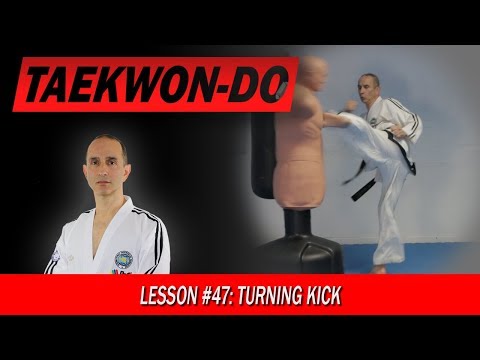
Turning Kick - Taekwon-Do Lesson #47
0
Spinning-Turning Kick·Donato Nardizzi
In this video I show you how to perform a Turning Kick (Dollyo Chagi) I explain the application of the technique and s…
Translation: spinning/turning kick
The Spinning/Turning Kick subfamily covers roundhouse kick variations that incorporate a full rotational turn of the body (180-360 degrees) before delivering the kick, adding centripetal force and angular momentum to the strike. [1] Spinning kicks are among the most powerful techniques in a fighter's arsenal, as the full-body rotation multiplies the force available at the moment of impact, but they also carry significant risk because the rotation turns the kicker's back to the opponent mid-execution. [1],[2] This subfamily includes the spinning back kick, spinning hook kick, and tornado kick, each combining rotation with a different kicking trajectory. [2],[3]
Spinning kick techniques have deep roots in Korean and Chinese martial arts, with taekwondo developing an extensive repertoire of spinning and turning kicks as signature techniques of the art. [1] The spinning back kick and spinning hook kick became competition staples in taekwondo and full-contact karate in the 1970s and 1980s. [1],[2] In MMA and kickboxing, spinning kicks have produced some of the most spectacular knockouts in combat sports history. [2],[3]
Spinning kicks are found in TKD, karate, and have been adopted into MMA. [1]
Spinning kicks have produced spectacular knockouts in MMA. [1]
No images yet for this technique.
Sign in to suggest an image.
In this video I show you how to perform a Turning Kick (Dollyo Chagi) I explain the application of the technique and s…
No instructional courses yet for this technique.
Sign in to suggest a course.
Risk of injury to the person this technique is applied to
Most common KO kick; generates ~1,000N force to head (Falco et al. 2009)
Skill level needed to execute this technique reliably
Whether this technique is allowed under major competition rule sets
Karate-Do Kyohan: The Master Text (Gichin Funakoshi, 1935)
Alias sources — [1] Kukkiwon Textbook (2006) [2] Kukkiwon Textbook (2006)
Effectiveness sources — [1] Comprehensive Asian Fighting Arts (Draeger & Smith, 1969) [2] Muay Thai Unleashed (Delp, 2006)
Official karate technique names (和語/漢語)
Established Japanese martial arts naming convention — native Japanese term (和語/漢語)
Alias sources — [1] Kukkiwon Textbook (2006) [2] Kukkiwon Textbook (2006)
Effectiveness sources — [1] Comprehensive Asian Fighting Arts (Draeger & Smith, 1969) [2] Muay Thai Unleashed (Delp, 2006)
hip rotation, horizontal arm acceleration, tight elbow angle
compact build for short-range hooks, strong core
obliques, hip rotators, pectorals, biceps, forearms
Every move, in any martial art, shares a few universal traits. Mix and match below to pinpoint the right tool — or compare equivalents across styles.
The Spinning Back Kick is a powerful spinning technique where the fighter rotates 180 degrees and delivers a linear back kick with the heel, combining the rotational momentum of the spin with the thrusting power of the back kick. [1] The spinning back kick generates enormous force due to the full-body rotation preceding the linear thrust, and it targets the midsection, solar plexus, or face with the hardest part of the foot. [1,2] This technique requires precise distance management and timing, as the rotation creates a brief blind spot before the kicker acquires the target visually. [2,3]
The Spinning Hook Kick is a rotational kick where the fighter spins 180 degrees or more and delivers a hooking kick to the opponent's head, striking with the heel as the leg retracts through a curved arc. [1] The spinning hook kick combines the deceptive hooking trajectory with the power of a full-body spin, creating a technique that is extremely difficult to defend because the angle and timing of impact are nearly impossible to predict. [1,2] This technique primarily targets the jaw or temple and has produced numerous highlight-reel knockouts across combat sports. [2,3]
The Tornado Kick is a dramatic spinning kick where the fighter uses a full 360-degree rotation with a jumping component, chambering the non-kicking leg in a sweeping motion to build rotational momentum before delivering a roundhouse kick at the apex of the spin. [1] The tornado kick combines the elements of a spin, jump, and roundhouse kick into a single explosive technique that generates exceptional power through angular momentum. [1,2] Due to its complexity and the time required to complete the full rotation, the tornado kick is considered a high-risk, high-reward technique primarily seen in taekwondo competition and MMA highlight finishes. [2,3]
Your stationary foot should point about 45 degrees outward, and at the moment of impact your foot should be positioned so the kick travels perpendicular to the target—not at an angle. Donato Nardizzi emphasizes that your shoulders should be parallel to your opponent's when you complete the technique.
Ideally, aim for a side-front target position, which means you should face slightly behind your opponent so the target ends up on your side-front. This positioning exposes the target area and allows you to generate proper hip rotation into the kick.
Think of the kick in two phases: first, rotate and pivot your body while chambering the leg, then extend the leg at the end. The kick moves in an arc, and incorporating forward motion will add power to your technique.
A traditional turning kick isn't ideal for front targets, but you can use a side turning kick with the instep instead, which is why it's popular in competition and allows you to hit from a greater distance.
The Spinning/Turning Kick subfamily covers roundhouse kick variations that incorporate a full rotational turn of the body (180-360 degrees) before delivering the kick, adding centripetal force and angular momentum to the strike. Spinning kicks are among the most powerful techniques in a fighter's arsenal, as the full-body rotation multiplies the force available at the moment of impact, but they also carry significant risk because the rotation turns the kicker's back to the opponent mid-execution.
Spinning kick techniques have deep roots in Korean and Chinese martial arts, with taekwondo developing an extensive repertoire of spinning and turning kicks as signature techniques of the art. The spinning back kick and spinning hook kick became competition staples in taekwondo and full-contact karate in the 1970s and 1980s.
Unified MMA: legal — Legal striking technique; WBC/Boxing: banned — All kicks prohibited in boxing; WKF: legal — Legal, chudan (body) kick scores 2 points, jodan (head) kick scores 3 points; Kyokushin: legal — Legal at full power to body and head; WT: legal — Legal, body kick 2 points, head kick 3 points, spinning body 4 points, spinni…; WAKO: legal — Legal in Full Contact and Low Kick formats; K: legal — 1/GLORY — Legal; IFMA: legal — Legal — kicks are a core Muay Thai technique
Danger rating 6/10. High — most common KO kick; generates ~1,000N force to head (Falco et al. 2009)
The standard setup chain: Stance and Range → Chamber the Leg → Execute the Kick → Recover.
Standard counters include: Check (Shin Block) — raise the shin to intercept the kick before it lands / Catch and Sweep — catch the kicking leg and sweep the standing leg / Step Inside — close distance inside the kick's effective range to smother it.
Common variants: Standard hook (horizontal-arc punch targeting the jaw or temple); Tight hook (compact, short-range hook for close-quarters fighting); Body hook (targeting the ribs or liver with a downward-angled hook); Check hook (pivoting on the lead foot while throwing the hook as a co…).
Spinning kicks have produced spectacular knockouts in MMA.
Top errors to watch for: Spinning without spotting the target, which makes you dizzy and inaccurate / Initiating the spin with the shoulders instead of the hips, which is slower and telegraphs the rotation / Spinning too slowly, giving the opponent time to step in and counter while your back is turned / Throwing spinning kicks when fatigued — they require coordination and balance that deteriorate rapidly with exhaustion.
The Spinning-Turning Kick is also known as Kaiten-geri, Spinning Kick, Rotational Kick.