TAEKWONDO ROUND HOUSE KICK TUTORIAL (POWER) (SPEED) (ACCURACY)
0
Small Roundhouse Kick·SKY Life
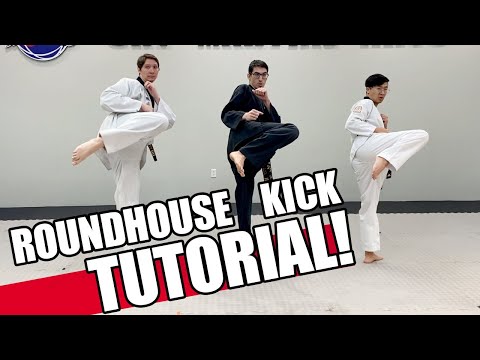
Do YOU know how to throw a proper TaeKwonDo roundhouse kick? With this tutorial, you’ll find out! Whether you’re brand n…
Translation: Ko (小) = small/short, Mawashi (回し) = turning/round, Geri (蹴り) = kick — a compact, short-arc roundhouse kick optimised for close range
The Small Roundhouse Kick is a tight, compact variant of the roundhouse kick that uses a shortened circular arc and minimal hip rotation, optimised for close range where a full roundhouse kick would be too wide to execute effectively. [1] At standard or long range, the full roundhouse kick (mawashi geri) uses complete hip rotation and a wide circular arc to generate maximum centrifugal force — but at close range, there is insufficient space for this wide arc, and the full hip rotation would turn the body past the target before the kick lands. [1] The Small Roundhouse solves this by keeping the arc tight (approximately 45-60° of hip rotation versus the full roundhouse's 90-120°) and using the knee extension (snap) as the primary power source rather than the hip rotation. [1] The result is a faster, more compact kick that sacrifices raw power for speed and close-range applicability. [1] De Bremaeker and Faige document the Small Roundhouse as one of the roundhouse kick variants in their 89-kick compilation, noting that it fills the tactical gap between the hook kick (which arcs from behind) and the front kick (which travels straight) at close range — the Small Roundhouse provides a mid-angle option at distances where neither a full roundhouse nor a front kick is optimal. [1] In Muay Thai, the equivalent technique is the short Thai kick delivered with the shin at close quarters — Thai fighters naturally shorten the roundhouse arc when fighting in close, using the knee's snap rather than the hip's rotation as the primary power mechanism. [2] The Small Roundhouse is particularly effective when combined with boxing combinations: after a jab-cross at punching range, the Small Roundhouse to the body or head arrives from an angle that straight punches cannot — without requiring the fighter to step back to roundhouse range. [1]
The Small Roundhouse developed naturally in competitive martial arts as fighters encountered the close-range tactical gap between boxing punches and full roundhouse kicks. [1] In Muay Thai, the abbreviated roundhouse at close range has been used for centuries — Thai fighters naturally shorten the kick's arc when fighting inside, using the knee snap to deliver rapid shin kicks to the ribs and arms at clinch-adjacent range. [2] In sport karate, the Small Roundhouse evolved as competitors sought ways to score kicks at ranges traditionally dominated by punches — the tight arc and fast delivery allow the kick to function at punching range without the wide commitment of a full roundhouse. [1] De Bremaeker and Faige documented the technique as Section 3.2 in their 2010 compilation, distinguishing it from the full roundhouse based on its reduced arc, altered power mechanism (knee snap vs hip rotation), and close-range tactical application. [1]
The Small Roundhouse fills a tactical gap that no other technique addresses: at punching range (18-24 inches), full roundhouse kicks are too wide, front kicks may be too linear, and hooks come from a different angle — the Small Roundhouse provides a compact circular attack from an angle that punches cannot replicate. [1] Its rapid delivery speed makes it effective as a combination finisher: after jab-cross exchanges that occupy the opponent's frontal defence, the Small Roundhouse arrives from the side before the guard can adjust. [1] In MMA and Muay Thai, the short Thai kick to the body (a close cousin of the Small Roundhouse) is one of the highest-volume weapons at close range, accumulating damage through repeated impacts rather than single devastating strikes. [2]
The Small Roundhouse is used extensively in MMA and Muay Thai competition as a close-range body kick. In sport karate (WKF), the compact roundhouse is a common scoring technique at ranges where a full roundhouse would be too slow. The short Thai kick to the body is one of the highest-volume weapons in Muay Thai stadium competition.
No images yet for this technique.
Sign in to suggest an image.
Do YOU know how to throw a proper TaeKwonDo roundhouse kick? With this tutorial, you’ll find out! Whether you’re brand n…
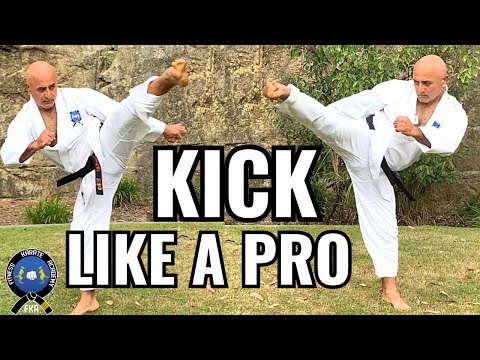
Here is Martial arts roundhouse kick tutorial for beginners Learn how to kick like a pro in karate, this lesson is abou…
The small roundhouse kick (mawashi giri in karate terminology, or 'Rana's kick' in taekwondo parlance) is a fundamental striking technique taught across multiple martial arts disciplines. Fitness Karate Academy emphasizes the basic mechanics: establishing a solid stance with hands raised and eyes focused, then executing the kick by lifting the knee, rotating the standing leg's hip inward, and extending the leg in a circular arc while maintaining upper body control. SKY Life provides more granular progression and biomechanical detail, breaking the technique into four sequential phases: knee lift (driven straight forward rather than around), hip rotation with proper pivot of the supporting foot, combination of these elements, and finally adding speed to the extension. Both instructors stress hip rotation as central to the technique's execution. SKY Life additionally emphasizes that leading with a forward knee chambering—rather than circling the knee outward—generates superior speed and power, and that knee height and position should be adjusted based on target level (face, body, or lower). SKY Life demonstrates the technique in combination forms and at varying distances, illustrating practical application in sparring scenarios. The instructors agree on fundamental mechanics while SKY Life provides greater analytical depth regarding speed, power generation, and accuracy variables.
Synthesized from 2 instructors
No instructional courses yet for this technique.
Sign in to suggest a course.
Risk of injury to the person this technique is applied to
The Small Roundhouse sacrifices power for speed and close-range applicability. It delivers less force than a full roundhouse but arrives significantly faster. When targeting the liver (right side of the body), even the reduced power can produce the characteristic liver-shot incapacitation. To the head at close range, the snap kick mechanism can produce a concussive whip effect. The primary value is cumulative: rapid, repeated Small Roundhouses to the body accumulate damage over time.
Skill level needed to execute this technique reliably
Whether this technique is allowed under major competition rule sets
Essential Book of Martial Arts Kicks (De Bremaeker & Faige, 2010)
description: [1] De Bremaeker 2010 pp.97-99, [2] Krauss 2006
Mixed Japanese-Western terminology — combines traditional Japanese terms with katakana loanwords
description: [1] De Bremaeker 2010 pp.97-99, [2] Krauss 2006
Requires less hip flexibility than a full roundhouse (the reduced arc demands less range of motion)
Good knee-snap speed (fast-twitch quadriceps for the snapping mechanism)
Balance on the standing leg at close range
Accessible to all body types — the compact nature makes it suitable even for practitioners who lack the flexibility for full roundhouse kicks
Good integration with boxing (practitioners with boxing backgrounds adapt quickly)
According to SKY Life's roundhouse kick tutorial, keep your knee positioned inside rather than outside, as starting with the knee outside limits your power output. Additionally, when you knee up, always land in front—pulling it back causes you to lose power.
Make sure your bottom foot pivots as you turn, and keep your hips rotating throughout the kick. SKY Life emphasizes that proper hip rotation combined with foot pivot is essential for executing the technique correctly.
Bring your knee up forward in one smooth motion and execute the kick in a single flowing movement rather than separating the steps. SKY Life notes that Taekwondo features some of the best speed and power kicks when performed with this combined motion.
The Small Roundhouse Kick is a tight, compact variant of the roundhouse kick that uses a shortened circular arc and minimal hip rotation, optimised for close range where a full roundhouse kick would be too wide to execute effectively. At standard or long range, the full roundhouse kick (mawashi geri) uses complete hip rotation and a wide circular arc to generate maximum centrifugal force — but at close range, there is insufficient space for this wide arc, and the full hip rotation would turn the body past the target before the kick lands.
The Small Roundhouse developed naturally in competitive martial arts as fighters encountered the close-range tactical gap between boxing punches and full roundhouse kicks. In Muay Thai, the abbreviated roundhouse at close range has been used for centuries — Thai fighters naturally shorten the kick's arc when fighting inside, using the knee snap to deliver rapid shin kicks to the ribs and arms at clinch-adjacent range.
Unified MMA: legal — Legal striking technique; WBC/Boxing: banned — All kicks prohibited in boxing; WKF: legal — Legal, chudan (body) kick scores 2 points, jodan (head) kick scores 3 points; Kyokushin: legal — Legal at full power to body and head; WT: legal — Legal, body kick 2 points, head kick 3 points, spinning body 4 points, spinni…; WAKO: legal — Legal in Full Contact and Low Kick formats; K: legal — 1/GLORY — Legal; IFMA: legal — Legal — kicks are a core Muay Thai technique
Danger rating 5/10. The Small Roundhouse sacrifices power for speed and close-range applicability. It delivers less force than a full roundhouse but arrives significantly faster. When targeting the liver (right side of the body), even the reduced power can produce the characteristic liver-shot incapacitation. To the head at close range, the snap kick mechanism can produce a concussive whip effect. The primary value is cumulative: rapid, repeated Small Roundhouses to the body accumulate damage over time.
The standard setup chain: Establish the jab-cross at punching range → Opponent calibrates defence for straight punches (hands high, elbows tight) → After the next jab-cross: instead of resetting, chamber the rear knee → Snap the Small Roundhouse to the opponent's exposed ribs/liver from the same close range → The kick arrives from an angle (the side) that the opponent's centreline defence does not cover → Retract immediately → Follow with a straight punch to capitalise on the opponent adjusting their guard to cover the side.
Standard counters include: Check by raising the knee — lifting the lead knee intercepts the kick's compact arc at its midpoint / Elbow block — dropping the elbow to the ribs covers the primary target (Muay Thai standard defence against short body… / Step back — one step backward takes the target beyond the Small Roundhouse's limited range / Jab counter — the Small Roundhouse's abbreviated arc creates a brief window where the kicker's guard drops; a fast ja….
Common variants: Lead leg Small Roundhouse (the fastest version, delivered with the front leg for jab…); Rear leg Small Roundhouse (slightly more powerful, using the rear leg's rotational a…); Small Roundhouse to the body (targeting the ribs, liver, or solar plexus at close range…); Small Roundhouse to the head (elevating the compact kick to head level (requires good h…); Small Roundhouse with shin (using the shin as the striking surface for additional imp…); Chopping Small Roundhouse (angling the kick slightly downward for a chopping effect …).
The Small Roundhouse is used extensively in MMA and Muay Thai competition as a close-range body kick. In sport karate (WKF), the compact roundhouse is a common scoring technique at ranges where a full roundhouse would be too slow.
Top errors to watch for: Allowing full hip rotation — if the hip rotates beyond 45-60°, the kick widens into a standard roundhouse that is too… / Stepping back to create room for a full kick — the Small Roundhouse is designed for close range; stepping back to kic… / Using the hip for power instead of the knee — at close range, the hip cannot generate full rotational force; trying t… / Kicking too high with the compact arc — the Small Roundhouse is optimised for body-level targets at close range; elev….
The Small Roundhouse Kick is also known as Ko Mawashi Geri, Short Roundhouse, Compact Mawashi Geri, Tight Roundhouse, Close-Range Round Kick.