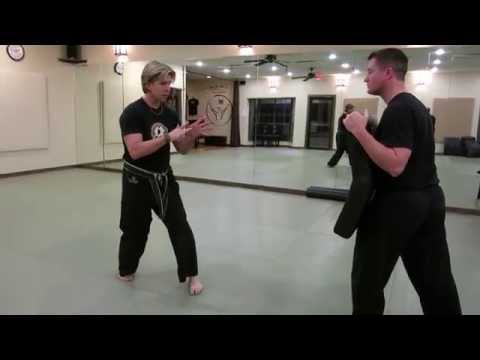
The Hidden Power of The Spinning Back Kick!
0
Spin-Back Roundhouse Kick·Satori Method
Hey Martial Arts friends! Here's a quick 5-minute video on how to improve the power and accuracy of your spinning back k…
Translation: reverse roundhouse kick
The Spin-Back Roundhouse Kick is a roundhouse kick executed by spinning the body 180 degrees backward before delivering the kick, using the rotational momentum to generate devastating power. [1] The fighter pivots on the front foot, turns the back toward the opponent, and launches the rear leg in a circular arc that connects with the heel or the back of the foot. [1] This is one of the most powerful kicks in martial arts — the full body rotation adds significant force — but it requires precise timing and carries the risk of exposing the back to the opponent during the spin. [1]
Practiced in taekwondo, karate, kickboxing, and capoeira. [1] In taekwondo, it is one of the highest-scoring techniques. In MMA, fighters like Mirko Cro Cop made it famous with knockout victories.
Practiced across Taekwondo, karate, and kickboxing. The spinning back roundhouse (ushiro mawashi geri in karate, dwi dollyo chagi in TKD) is a staple of tournament competition. [1]
High-risk, high-reward technique seen in MMA, kickboxing, and TKD competition. Multiple notable KOs in UFC and GLORY kickboxing. Less common than standard kicks but spectacular when it lands. [1]
No images yet for this technique.
Sign in to suggest an image.
Hey Martial Arts friends! Here's a quick 5-minute video on how to improve the power and accuracy of your spinning back k…
No instructional courses yet for this technique.
Sign in to suggest a course.
Risk of injury to the person this technique is applied to
Full body rotation through heel can cause knockouts, concussions, jaw fractures.
Skill level needed to execute this technique reliably
Whether this technique is allowed under major competition rule sets
De Bremaeker, M. & Faige, R. (2010). Essential Book of Martial Arts Kicks. Tuttle Publishing.
[1] De Bremaeker & Faige, Essential Book of Martial Arts Kicks (2010), Section 3.10, pp. 121-123
Official karate technique names (和語/漢語)
Established Japanese martial arts naming convention — native Japanese term (和語/漢語)
[1] De Bremaeker & Faige, Essential Book of Martial Arts Kicks (2010), Section 3.10, pp. 121-123
excellent balance, hip flexibility, timing
core obliques, hip rotators, gluteus maximus, calves
Documented in De Bremaeker & Faige, Section 3.8. A 180-degree spinning entry into a roundhouse kick — the heel or instep connects after a full turn. One of the most spectacular head-kick knockouts in competition when it lands. (De Bremaeker & Faige, Essential Book of Martial Arts Kicks, 2010)
According to Satori Method, the key issue is likely that you're not lining up your heel with exactly where you want to kick—if you don't turn your foot enough, you'll be off target and have to track the kick in, which doesn't work. Additionally, keep your upper body upright and engaged with your arms tight (like an ice skater pulling in), rather than letting them drop and float, to avoid splitting your force.
Satori Method explains that you should keep your back upright as much as possible and bring your arms in tight to your center—similar to how an ice skater pulls their arms in tighter when spinning. Your upper body should be engaged throughout to help generate power, not floating out to the side.
Satori Method emphasizes that you should follow through and move towards your target after the kick—'kick and move towards your target' rather than stopping or running away. The motion should be continuous: move in, spin, and through.
The Spin-Back Roundhouse Kick is a roundhouse kick executed by spinning the body 180 degrees backward before delivering the kick, using the rotational momentum to generate devastating power. The fighter pivots on the front foot, turns the back toward the opponent, and launches the rear leg in a circular arc that connects with the heel or the back of the foot.
Practiced in taekwondo, karate, kickboxing, and capoeira. In taekwondo, it is one of the highest-scoring techniques.
Unified MMA: Legal: legal — standard striking technique; WKF Karate: Legal: legal — controlled contact required; WT Taekwondo: Legal: legal — kicks are primary scoring technique; WAKO Kickboxing: Legal: legal — full contact permitted
Danger rating 9/10. Extreme — full body rotation through heel can cause knockouts, concussions, jaw fractures.
The standard setup chain: Jab-cross to occupy guard → spinning heel kick to head → Low roundhouse feint → spin high → Counter.
Standard counters include: Step forward and push during spin / Duck under the high arc / Counter-punch as they turn — back is exposed.
Common variants: To the head (knockout weapon); To the body (less risk, still powerful); Jumping version (added height but more risk).
High-risk, high-reward technique seen in MMA, kickboxing, and TKD competition. Multiple notable KOs in UFC and GLORY kickboxing.
Top errors to watch for: Not looking at target — kicking blind / Spinning too wide / Not committing — stopping mid-spin exposes back / Dropping hands during spin.
The Spin-Back Roundhouse Kick is also known as Ushiro Mawashi Geri, Spinning Heel Kick, Reverse Roundhouse, Dwi Huryeo Chagi, Back Spinning Kick.