Instep Conditioning: haisoku-kitai
0
Haisoku Geri·Chip Quimby & Authentic Karate Training Center
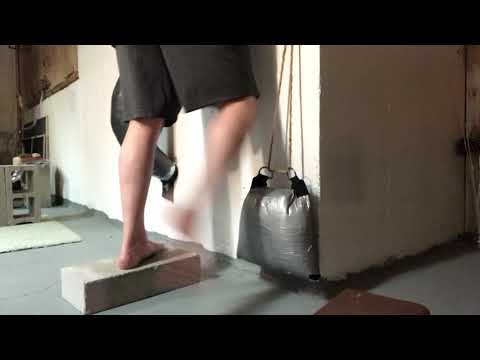
Basic demonstration for conditioning the instep -------------------------------------------- 🥋 My Bio Chip Quimby is…
Translation: instep kick
Haisoku Geri is a kick delivered using the instep (top of the foot) as the striking surface, typically in a roundhouse or snapping trajectory. [1] The instep provides a larger contact area than the ball of the foot, making it easier to land but distributing force over a wider surface. [1] In Muay Thai, the instep/shin is the primary roundhouse striking surface, while in traditional karate the ball of the foot is more common — Haisoku Geri represents the instep-contact approach. [1]
Documented in traditional karate manuals. [1]
The instep is the natural striking surface in Muay Thai and much of MMA — the wider contact area is more forgiving of accuracy errors. [1] For groin kicks, the instep provides a sweeping upward contact that is more effective than the ball of the foot. In competitive karate, the instep roundhouse kick (mawashi geri with haisoku) is the highest-percentage scoring kick. [1]
Primarily a training, demonstration, and point-fighting technique. Rarely seen in full-contact MMA or kickboxing due to acrobatic risk and telegraphing. Appears occasionally in TKD and point-fighting karate tournaments. [1]
No images yet for this technique.
Sign in to suggest an image.
Basic demonstration for conditioning the instep -------------------------------------------- 🥋 My Bio Chip Quimby is…
Building on the previous video, Rego Sensei highlights a few key pointers for those who are in the beginning stages of d…
Support us on Patreon: http://www.patreon.com/saikoukarate Follow us on Instagram: https://www.instagram.com/saikou_kara…
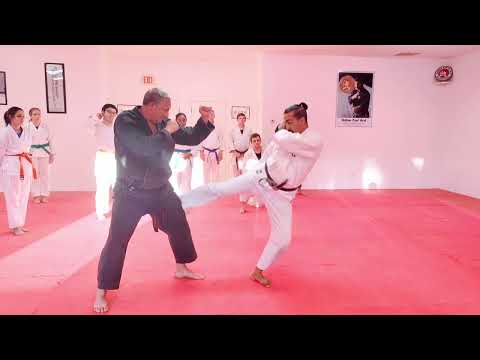
Haisoku geri, the instep roundhouse kick, is taught across multiple contexts emphasizing hip rotation, conditioning, and distance management. Jukido Academy stresses that the technique requires hip-driven rotation rather than isolated leg movement; practitioners should turn their hips fully to generate power, with the supporting foot pivoting to allow natural leg extension. The instructor notes that beginners may initially lead with the support foot to open the hip before integrating the motion smoothly. Guard positioning is critical—the rear arm should cover the jawline without blocking vision, maintaining defensive readiness during the strike. Distance management is paramount; the leg should form an extended line rather than a tight triangle, leveraging the kick's range advantage over close-range tools. The knee remains bent throughout to maintain connection to the ground. Chip Quimby & Authentic Karate Training Center provides extensive practical conditioning methodology for instep toughening, demonstrating a high-volume routine (approximately 500 strikes) performed on heavy bags using elevated platform placement to allow natural leg hang and target hip flexor development. Quimby emphasizes gradual progression, proper gel usage, and that conditioning contact builds surface integrity to withstand impact forces—critical for avoiding shin and elbow contact during combat applications. Both instructors agree that mechanical repetition and hip engagement form the foundation of effective haisoku geri execution.
Synthesized from 3 instructors
No instructional courses yet for this technique.
Sign in to suggest a course.
Risk of injury to the person this technique is applied to
Wider contact distributes force but covers more area.
Skill level needed to execute this technique reliably
Whether this technique is allowed under major competition rule sets
Oyama, M. This Is Karate / Essentials of Karate.
[1] Oyama / Funakoshi, Karate technique manuals
Official karate technique names (和語/漢語)
Established Japanese martial arts naming convention — native Japanese term (和語/漢語)
[1] Oyama / Funakoshi, Karate technique manuals
hip flexibility for horizontal chambering, ankle flexibility for instep extension
long legs for range, flexible ankles
hip rotators (swing arc), quadriceps (extension), calves (ankle position), core (rotation control)
Haisoku geri (instep kick) uses the instep as the striking surface — the natural striking surface in Muay Thai. In karate, the instep roundhouse is the highest-percentage scoring kick in WKF competition. (Oyama, This Is Karate; De Bremaeker & Faige, Essential Book of Martial Arts Kicks)
According to Chip Quimby at Authentic Karate Training Center, you should focus on the target areas that are most important to you and what you prioritize, rather than just standing there and kicking the bag, so you can get the best of both worlds in your conditioning.
Jukido Academy emphasizes that you need to turn your hips, not just touch with the foot—the hips should roll first and then the leg comes in after. If you're just touching with your leg and your support foot toes aren't positioned correctly, you're not generating proper power.
According to Jukido Academy, if your leg forms a triangle shape when extended, you're too close—this defeats the purpose of the kick since the leg is your longest tool and should be delivered from proper distance.
Haisoku Geri is a kick delivered using the instep (top of the foot) as the striking surface, typically in a roundhouse or snapping trajectory. The instep provides a larger contact area than the ball of the foot, making it easier to land but distributing force over a wider surface.
Documented in traditional karate manuals.
WKF Karate: Legal: legal — controlled contact; Unified MMA: Legal {src:Unified Rules of MMA, August 2025|/sources/Unified: legal — MMA-Rules-August-2025.pdf}; WAKO Kickboxing: Legal {src:WAKO Full Contact Rules|/sources/WAKO: legal — Full-Contact-Rules.pdf}
Danger rating 5/10. Moderate — wider contact distributes force but covers more area.
The standard setup chain: Jab-cross to face → opponent raises guard → haisoku geri mawashi to ribs → Fake low kick → opponent checks → switch to haisoku geri high to head → Push kick (teep) to create distance → opponent steps back → close with haisoku geri to body.
Standard counters include: Check with shin — raise the shin to block the instep before impact / Catch and sweep — grab the kicking leg and sweep the standing leg / Cross counter — step inside the arc and fire a straight punch.
Common variants: Roundhouse haisoku (instep roundhouse to body or head); Snapping haisoku (rising instep snap to the groin); Low haisoku (instep kick to the inner or outer thigh); Muay Thai style (shin/instep contact for maximum damage).
Primarily a training, demonstration, and point-fighting technique. Rarely seen in full-contact MMA or kickboxing due to acrobatic risk and telegraphing.
Top errors to watch for: Toes not pointed — the ball of the foot contacts instead of the instep / Kicking with the shin only — missing the instep whip at the end / Not extending the ankle — the foot is flat instead of presenting the instep / Stubbing the toes — occurs when the foot isn't properly positioned.
The Haisoku Geri is also known as Haisoku Geri, Haisoku-Geri, Instep Kick, Top of Foot Kick.