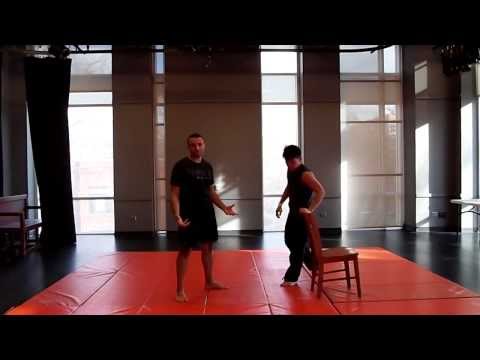
Various ways to set up the Head Kick (Roundhouse) tutorial.
0
Head Kick·Have Gi. Will Travel.
This is a requested follow up to a previous video compilation in which I introduced several ways to set up a high roundh…
Translation: head kick / high kick
The Head Kick subfamily covers roundhouse kicks aimed above the shoulders, targeting the opponent's jaw, temple, or neck — areas where impact produces the highest probability of knockout due to the rotational forces applied to the skull and brain. [1] Head kicks require greater flexibility and hip range of motion than body or low kicks, as the leg must travel a higher arc while maintaining speed and power. [1],[2] A clean head kick delivers massive rotational acceleration to the skull, frequently producing immediate unconsciousness, making it one of the most dramatic and decisive techniques in combat sports. [2],[3]
Head kicks have been prized in martial arts competition since the earliest full-contact tournaments, with taekwondo specifically rewarding head kicks with bonus points in its scoring system. [1] In Muay Thai, the head kick is considered the ultimate striking weapon, and knockouts by head kick are among the most celebrated moments in Thai boxing history. [1],[2] MMA has produced some of the sport's most iconic finishes via head kicks, including Gabriel Gonzaga's knockout of Mirko Cro Cop and Edson Barboza's spinning heel kick knockout of Terry Etim. [2],[3]
Head kicks are used in Muay Thai, TKD, karate, and MMA. [1]
Head kick knockouts are among the most spectacular finishes in MMA and kickboxing. [1]
No images yet for this technique.
Sign in to suggest an image.
This is a requested follow up to a previous video compilation in which I introduced several ways to set up a high roundh…
No instructional courses yet for this technique.
Sign in to suggest a course.
Risk of injury to the person this technique is applied to
Most common KO kick; generates ~1,000N force to head (Falco et al. 2009)
Skill level needed to execute this technique reliably
Whether this technique is allowed under major competition rule sets
Karate-Do Kyohan: The Master Text (Gichin Funakoshi, 1935)
Alias sources — [1] Muay Thai: The Art of Fighting (Kraitus & Kraitus, 1988) [2] Karate-Do Kyohan (Funakoshi, 1935) [3] Muay Thai Unleashed (Delp, 2006)
Effectiveness sources — [1] Muay Thai Unleashed (Delp, 2006) [2] Comprehensive Asian Fighting Arts (Draeger & Smith, 1969)
Standard katakana transliteration of Western martial arts terminology (外来語) — used in Japanese MMA, boxing, and BJJ communities
Alias sources — [1] Muay Thai: The Art of Fighting (Kraitus & Kraitus, 1988) [2] Karate-Do Kyohan (Funakoshi, 1935) [3] Muay Thai Unleashed (Delp, 2006)
Effectiveness sources — [1] Muay Thai Unleashed (Delp, 2006) [2] Comprehensive Asian Fighting Arts (Draeger & Smith, 1969)
hip flexibility, rotational hip power, balance on support leg
long legs for reach, flexible hips for high kicks
hip flexors, glutes, quadriceps, obliques, calves
Every move, in any martial art, shares a few universal traits. Mix and match below to pinpoint the right tool — or compare equivalents across styles.
The Question Mark Kick is a deceptive head kick that begins with the trajectory of a body kick or front kick before curving upward at the last moment to strike the opponent's jaw or temple, tracing a path resembling a question mark. [1] The initial low or mid-level trajectory causes the opponent to drop their guard to defend the body, and the sudden upward redirection catches the now-exposed head. [1,2] The question mark kick requires exceptional hip control and the ability to change the leg's trajectory mid-flight through hip rotation and knee adjustment. [2,3]
The Standard High Kick is the fundamental roundhouse kick delivered to head height, where the kicker rotates the hips and drives the shin or instep into the opponent's temple, jaw, or neck. [1] The technique uses the same mechanical principles as the body kick but requires the kicker to elevate the leg higher through increased hip rotation and flexibility. [1,2] The standard high kick is the most commonly attempted head kick in Muay Thai, kickboxing, and MMA competition. [2,3]
The Switch High Kick is a head-level roundhouse kick preceded by a rapid switch of the feet, converting the lead leg into the kicking leg with added rear-leg power and timing disruption. [1] The switch step creates an unexpected rhythm change that can catch the opponent off guard, and the momentary stance change loads the kicking hip for a more powerful strike than a standard lead-leg high kick. [1,2] The switch high kick is particularly effective as a counter or interrupt technique, exploiting moments when the opponent is stepping forward. [2,3]
Cross face your opponent to get them off you, then push them out to create distance before stepping in and executing the kick. According to Have Gi. Will Travel, cross facing is an effective way to create the space needed for the technique.
Come straight up with your leg like a front leg raise or axe kick, and once you're high enough, turn over and come around the back of the head or neck. This approach reduces the distance your leg travels compared to a wide curve.
Your partner should let their shoulder relax and allow it to move with the impact rather than resisting the pad. This prevents rotator cuff injuries, especially when kicking with significant power.
Set up with a front kick that your opponent expects, then follow up immediately with a roundhouse kick. Have Gi. Will Travel demonstrates the Brazilian kick variation, where you disguise the roundhouse by using the front kick as a feint.
The Head Kick subfamily covers roundhouse kicks aimed above the shoulders, targeting the opponent's jaw, temple, or neck — areas where impact produces the highest probability of knockout due to the rotational forces applied to the skull and brain. Head kicks require greater flexibility and hip range of motion than body or low kicks, as the leg must travel a higher arc while maintaining speed and power.
Head kicks have been prized in martial arts competition since the earliest full-contact tournaments, with taekwondo specifically rewarding head kicks with bonus points in its scoring system. In Muay Thai, the head kick is considered the ultimate striking weapon, and knockouts by head kick are among the most celebrated moments in Thai boxing history.
Unified MMA: legal — Legal striking technique; WBC/Boxing: banned — All kicks prohibited in boxing; WKF: legal — Legal, chudan (body) kick scores 2 points, jodan (head) kick scores 3 points; Kyokushin: legal — Legal at full power to body and head; WT: legal — Legal, body kick 2 points, head kick 3 points, spinning body 4 points, spinni…; WAKO: legal — Legal in Full Contact and Low Kick formats; K: legal — 1/GLORY — Legal; IFMA: legal — Legal — kicks are a core Muay Thai technique
Danger rating 6/10. High — most common KO kick; generates ~1,000N force to head (Falco et al. 2009)
The standard setup chain: Stance and Range → Chamber the Leg → Execute the Kick → Recover.
Standard counters include: Check (Shin Block) — raise the shin to intercept the kick before it lands / Catch and Sweep — catch the kicking leg and sweep the standing leg / Step Inside — close distance inside the kick's effective range to smother it.
Common variants: Standard roundhouse (rear leg) (full hip rotation, shin strikes the target); Lead leg roundhouse (switch kick) (switch-step to generate power from the lead side); Low roundhouse (leg kick) (targeting the thigh to damage the opponent's base); Head kick (high roundhouse targeting the temple or jaw).
Head kick knockouts are among the most spectacular finishes in MMA and kickboxing.
Top errors to watch for: Not disguising the head kick and simply throwing it from neutral — the high trajectory is easy to see and duck / Sacrificing hip rotation to gain height by leaning back — this weakens the kick dramatically / Kicking with the instep to the head, which risks broken toes and metatarsals — use the shin / Dropping both hands during the high kick, leaving the entire body exposed if the kick misses.
The Head Kick is also known as Hai Kikku, Tee Khang, Jodan Mawashi Geri, High Round Kick.