7 TKD INVERTED ROUNDHOUSE KICKS
0
Downward Roundhouse Kick·TN AEON MARTIAL ARTS
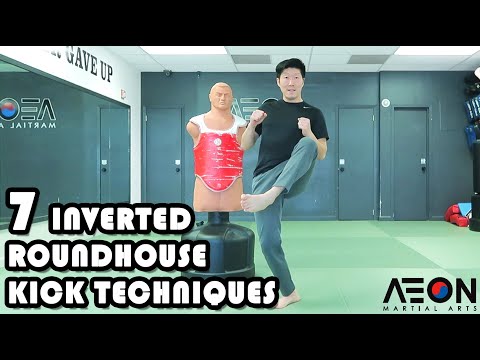
Hi everyone, try these step by step to achieve the Kick Up! Today's video consists of 7 techniques to use an Inverted R…
Translation: downward roundhouse kick
The Downward Roundhouse Kick is a roundhouse kick that travels in a high-to-low descending arc, striking the target from above. [1] The leg chambers high and the shin or instep drops downward onto the target — typically the collarbone, shoulder, or side of the neck. [1] This trajectory reverses the typical roundhouse path and catches defenders who expect horizontal attacks, making it effective against opponents with high guard positions. [1]
Practiced in Muay Thai, kickboxing, and taekwondo. In Muay Thai, it targets the collarbone — strikes to the collarbone can cause fractures. [1]
Modern kickboxing/MMA technique. The descending arc roundhouse was popularized by Brazilian fighters and is sometimes called the 'Brazilian kick.' [1]
Primarily a training, demonstration, and point-fighting technique. Rarely seen in full-contact MMA or kickboxing due to acrobatic risk and telegraphing. Appears occasionally in TKD and point-fighting karate tournaments. [1]
No images yet for this technique.
Sign in to suggest an image.
Hi everyone, try these step by step to achieve the Kick Up! Today's video consists of 7 techniques to use an Inverted R…
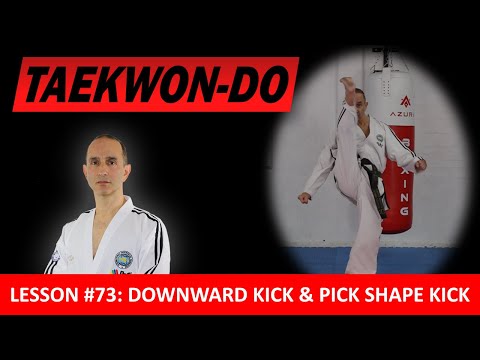
This video teaches the Downward Kick and the Pick Shape Kick. You’ll see clear explanations of each kick’s mechanics, th…
The downward roundhouse kick is an inverted variation of the standard roundhouse kick used in Taekwondo competition. As described by TN Aeon Martial Arts, the technique involves raising the knee and rotating the hip and knee in the opposite direction from a conventional roundhouse kick, striking with the instep toward the opponent's torso. Donato Nardizzi distinguishes between two related but separate kicks: the downward kick, which uses the heel and curves in an arc (inward or outward) to clear obstacles like the opponent's arm, targeting primarily the head and clavicle above the solar plexus; and the pick shape kick, which moves vertically without an arc and can strike with either the heel (keeping the leg straight for skull and clavicle targets) or the ball of the foot (with slight knee bend for face and jaw targets). TN Aeon emphasizes practical fight applications including clinch entries, double-tap combinations, and fakes to set up opposite-side strikes. Nardizzi provides historical context, noting the pick shape kick's introduction in the early 1980s as an ITF innovation distinct from the WTF axe kick, and corrects common misconceptions about knee bend requirements based on direct instruction from General Choi. Both instructors stress the importance of proper trajectory and target selection for maximum power and effectiveness.
Synthesized from 2 instructors
No instructional courses yet for this technique.
Sign in to suggest a course.
Risk of injury to the person this technique is applied to
Collarbone strikes can cause fractures. Descending angle concentrates force.
Skill level needed to execute this technique reliably
Whether this technique is allowed under major competition rule sets
De Bremaeker, M. & Faige, R. (2010). Essential Book of Martial Arts Kicks. Tuttle Publishing.
[1] De Bremaeker & Faige, Essential Book of Martial Arts Kicks (2010), Section 3.8, pp. 115-117
[1] De Bremaeker & Faige, Essential Book of Martial Arts Kicks (2010), Section 3.8, pp. 115-117
excellent hip flexibility, good balance
hip flexors, hip rotators, core
The primary targets are the face, with the jaw and temple as secondary targets. According to Donato Nardizzi, the specific contact point depends on your target: use the heel with a straight leg to hit the skull or clavicle, and use the ball of the foot with a bent knee to hit the face or chest.
Yes, when using the ball of the foot, the leg should be bent at impact so the ball makes better contact and the kick accelerates more sharply, according to Donato Nardizzi's analysis of traditional technique.
Yes, lifting the supporting foot off the ground when raising the leg helps you gain more height, as noted by Donato Nardizzi.
The Downward Roundhouse Kick is a roundhouse kick that travels in a high-to-low descending arc, striking the target from above. The leg chambers high and the shin or instep drops downward onto the target — typically the collarbone, shoulder, or side of the neck.
Practiced in Muay Thai, kickboxing, and taekwondo. In Muay Thai, it targets the collarbone — strikes to the collarbone can cause fractures.
Unified MMA: Legal: legal — standard striking technique; WKF Karate: Legal: legal — controlled contact required; WT Taekwondo: Legal: legal — kicks are primary scoring technique; WAKO Kickboxing: Legal: legal — full contact permitted
Danger rating 7/10. High — collarbone strikes can cause fractures. Descending angle concentrates force.
The standard setup chain: Low roundhouse → opponent drops guard → downward roundhouse over it → Jab-cross to face → downward roundhouse to collarbone.
Standard counters include: Step inside the arc / Duck under — high arc creates gap below / Rear hand catch of descending shin.
Common variants: To the collarbone (most damaging target); To the shoulder (safer target); To the side of the neck (extremely dangerous).
Primarily a training, demonstration, and point-fighting technique. Rarely seen in full-contact MMA or kickboxing due to acrobatic risk and telegraphing.
Top errors to watch for: Not getting leg high enough — becomes a normal roundhouse / Forcing the downward angle with muscle instead of gravity / Leaning too far back / Telegraphing by raising hip excessively.
The Downward Roundhouse Kick is also known as Kahōkō Mawashi Geri, Descending Roundhouse, Dropping Roundhouse Kick, Downward Round Kick.