Round Kick/ Turning Kick Tip: How to Pivot with Power
0
Drop Roundhouse Kick·Ando Mierzwa
►Click here for my Kicking Basics Course! http://www.senseiando.com/kicking-basics-course/ There are many ways to thro…
Translation: Drop roundhouse kick
The Drop Roundhouse Kick is a roundhouse delivered while intentionally dropping the body, attacking from an unexpected low angle. [1] The dropping motion creates a unique circular trajectory that comes from below the opponent's visual field. [1] It can be used both offensively and as a surprise counter. [1]
Offers specific tactical advantages over the standard roundhouse kick in appropriate situations. [1]
Cross-style martial arts kicking tradition; documented in kick compendiums. [1]
An acrobatic kick variation primarily seen in demonstrations and point-fighting tournaments. Not practical in full-contact competition due to the ground recovery time required. [1]
No images yet for this technique.
Sign in to suggest an image.
►Click here for my Kicking Basics Course! http://www.senseiando.com/kicking-basics-course/ There are many ways to thro…
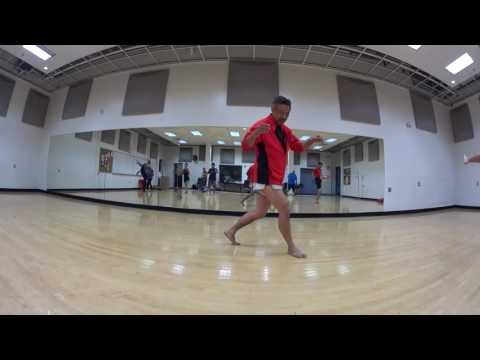
Intermediate level students at West Los Angeles College drill the drop step for kicking. www.muaythaiamerica.net
The drop roundhouse kick is a technical variation that emphasizes rapid foot repositioning to improve speed, range, and the ability to pursue a moving opponent. SenseiAndo.com focuses on the foundational pivot mechanics that underpin all roundhouse kicks, emphasizing that pivoting on the ball of the foot—not the heel or flat foot—is essential for power generation and knee safety. Ando's progressions stress drilling the pivot in isolation, from slow pivots to airborne pivots and squat-based pivots, to build core-driven power independent of the kicking leg. BAM Channel, teaching from a Muay Thai context, specifically addresses the drop step as a tactical tool: immediately dropping (resetting) the standing foot after the kick lands accelerates repositioning for multiple kicks, enables the fighter to chase a retreating opponent, and maintains hip mobility for continued offensive combinations. Both instructors agree on the importance of hip engagement—Ando emphasizes pivoting to set up the kick's power, while BAM stresses that the hip must move back after the drop step to maintain striking force. Where they diverge, Ando treats the roundhouse as a general striking tool with multiple valid expressions, whereas BAM presents the drop step within combative Muay Thai sequences, including chaining multiple kicks and applying the concept to push kicks and knees. Both note that beginners should practice the fundamental mechanics before adding speed or complexity.
Synthesized from 2 instructors
No instructional courses yet for this technique.
Sign in to suggest a course.
Risk of injury to the person this technique is applied to
Roundhouse Kick variant with standard striking power
Skill level needed to execute this technique reliably
Whether this technique is allowed under major competition rule sets
Essential Book of Martial Arts Kicks (De Bremaeker & Faige, 2010)
[1] De Bremaeker & Faige, Essential Book of Martial Arts Kicks (2010)
Requires solid roundhouse kick foundation
Good balance and coordination
Documented in De Bremaeker & Faige, Section 3.5. A roundhouse kick delivered while dropping to the ground — the dropping motion adds a downward angle to the circular trajectory. (De Bremaeker & Faige, Essential Book of Martial Arts Kicks, 2010)
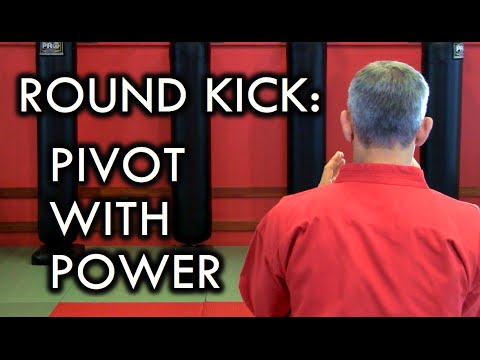
According to Ando Mierzwa, pivoting on your heel or flat foot is a major mistake that can injure your knee. Always pivot on the ball of your foot to maintain proper control and protect your joints.
Ando Mierzwa recommends starting with slow, controlled pivots on the ball of your foot without throwing the kick, so you can focus on your setup and core engagement rather than just your kicking foot. Once you feel comfortable, gradually add speed and power to the pivot.
Ando Mierzwa notes that both approaches work—you can lead with a knee chamber or step out and throw the hip. The key is that either way, you must maintain a proper pivot on the ball of your foot.
According to the BAM Channel, resetting your foot with a drop step allows you to get the kick off faster, and the hip still needs to move back to generate proper power and maintain distance management against a moving opponent.
The Drop Roundhouse Kick is a roundhouse delivered while intentionally dropping the body, attacking from an unexpected low angle. The dropping motion creates a unique circular trajectory that comes from below the opponent's visual field.
The Drop Roundhouse Kick is a specialised variant documented in cross-style kicking methodology. It represents an advanced development of the standard roundhouse kick.
Unified MMA: legal — Legal striking technique; WBC/Boxing: banned — All kicks prohibited in boxing; WKF: legal — Legal, chudan (body) kick scores 2 points, jodan (head) kick scores 3 points; Kyokushin: legal — Legal at full power to body and head; WT: legal — Legal, body kick 2 points, head kick 3 points, spinning body 4 points, spinni…; WAKO: legal — Legal in Full Contact and Low Kick formats; K: legal — 1/GLORY — Legal; IFMA: legal — Legal — kicks are a core Muay Thai technique
Danger rating 6/10. Roundhouse Kick variant with standard striking power
The standard setup chain: Feint → Drop Roundhouse Kick → Follow-up combination.
Standard counters include: Step inside range / Block and counter / Low kick to support leg.
Common variants: High variant; Mid variant; Low variant.
An acrobatic kick variation primarily seen in demonstrations and point-fighting tournaments. Not practical in full-contact competition due to the ground recovery time required.
Top errors to watch for: Attempting without solid roundhouse kick foundation / Poor balance / Insufficient power generation.
The Drop Roundhouse Kick is also known as Doroppu Raundohausu Kikku, Dropping Roundhouse, Sacrifice Roundhouse.