Drop Kick Techniques
0
Drop Twin Roundhouse Kick·Jun Chong Martial Arts
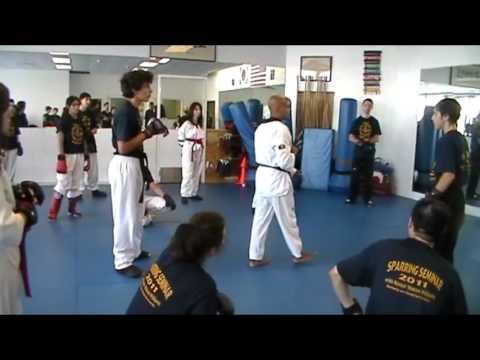
Master Mason Williams demonstrates how to execute an effective defense against a drop kick and an effective drop kick at…
Translation: Drop twin roundhouse kick
The Drop Twin Roundhouse Kick delivers two successive roundhouse kicks during a single controlled drop to the ground, attacking with rapid alternating legs. [1] The momentum of the first kick helps power the chamber of the second, creating a rapid two-kick combination from an unusual angle. [1]
Offers specific tactical advantages over the standard roundhouse kick in appropriate situations. [1]
Cross-style martial arts kicking tradition; documented in kick compendiums. [1]
An acrobatic kick variation primarily seen in demonstrations and point-fighting tournaments. Not practical in full-contact competition due to the ground recovery time required. [1]
No images yet for this technique.
Sign in to suggest an image.
Master Mason Williams demonstrates how to execute an effective defense against a drop kick and an effective drop kick at…
No instructional courses yet for this technique.
Sign in to suggest a course.
Risk of injury to the person this technique is applied to
Roundhouse Kick variant with standard striking power
Skill level needed to execute this technique reliably
Whether this technique is allowed under major competition rule sets
Essential Book of Martial Arts Kicks (De Bremaeker & Faige, 2010)
[1] De Bremaeker & Faige, Essential Book of Martial Arts Kicks (2010)
Requires solid roundhouse kick foundation
Good balance and coordination
Documented in De Bremaeker & Faige, Section 3.12. Two roundhouse kicks delivered in rapid succession while dropping — an acrobatic double kick primarily for demonstrations. (De Bremaeker & Faige, Essential Book of Martial Arts Kicks, 2010)
According to Jun Chong Martial Arts, the drop kick is a perfect opportunity when your opponent is coming in with a kick—you lean out and kick underneath their guard. The technique works best when your opponent leaves themselves open by attacking high.
Jun Chong emphasizes that you need to commit fully and pass your opponent's head with significant distance. If you come in too short, you'll create an opportunity for them to counter with an under kick instead.
According to Jun Chong, you want to position yourself close enough to your opponent that you can push your body against them for follow-up techniques, rather than staying at too much distance or being right on top of them.
The Drop Twin Roundhouse Kick delivers two successive roundhouse kicks during a single controlled drop to the ground, attacking with rapid alternating legs. The momentum of the first kick helps power the chamber of the second, creating a rapid two-kick combination from an unusual angle.
The Drop Twin Roundhouse Kick is a specialised variant documented in cross-style kicking methodology. It represents an advanced development of the standard roundhouse kick.
Unified MMA: legal — Legal striking technique; WBC/Boxing: banned — All kicks prohibited in boxing; WKF: legal — Legal, chudan (body) kick scores 2 points, jodan (head) kick scores 3 points; Kyokushin: legal — Legal at full power to body and head; WT: legal — Legal, body kick 2 points, head kick 3 points, spinning body 4 points, spinni…; WAKO: legal — Legal in Full Contact and Low Kick formats; K: legal — 1/GLORY — Legal; IFMA: legal — Legal — kicks are a core Muay Thai technique
Danger rating 6/10. Roundhouse Kick variant with standard striking power
The standard setup chain: Feint → Drop Twin Roundhouse Kick → Follow-up combination.
Standard counters include: Step inside range / Block and counter / Low kick to support leg.
Common variants: High variant; Mid variant; Low variant.
An acrobatic kick variation primarily seen in demonstrations and point-fighting tournaments. Not practical in full-contact competition due to the ground recovery time required.
Top errors to watch for: Attempting without solid roundhouse kick foundation / Poor balance / Insufficient power generation.
The Drop Twin Roundhouse Kick is also known as Doroppu Tsuin Raundohausu Kikku, Double Drop Roundhouse.