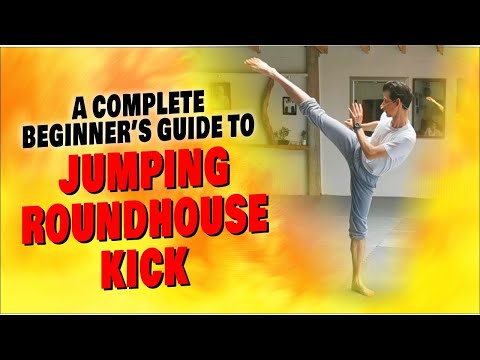
JUMPING ROUNDHOUSE KICK | A Complete Beginner's Tutorial
0
Hopping Roundhouse Kick·AIKIDO SILVERDALE
Min Milosavljevic takes us through a beginner's guide on how to develop a fast smooth and powerful jumping Roundhouse ki…
Translation: Tobi (跳び) = jumping/hopping, Mawashi (回し) = turning/round, Geri (蹴り) = kick — a roundhouse kick preceded by a quick skip-step to close distance while maintaining power
The Hopping Roundhouse Kick combines a quick skip-step forward with a rear-leg roundhouse kick, using the hop to close distance rapidly while maintaining the full power and circular trajectory of the rear leg's roundhouse. [1] The technique uses the same foot-replacement principle as the Hopping Front Kick: the rear foot slides forward to replace the front foot's position, and the front foot — now momentarily in the rear position — delivers the roundhouse kick with full hip rotation, adding the forward momentum of the skip to the kick's rotational force. [1] The skip-step occurs below the opponent's primary visual focus (feet moving along the floor are less detectable than upper body movement), and the roundhouse that follows arrives with both the circular rotational force of the hip rotation AND the linear forward momentum of the hop — producing a kick approximately 20-30% more powerful than a static roundhouse from the same distance. [1],[2] De Bremaeker and Faige document the Hopping Roundhouse as one of the most commonly used distance-closing kicks in competitive martial arts, used across karate, taekwondo, Muay Thai, and kickboxing. [1] The technique is ubiquitous in UFC striking: fighters regularly use the skip-step to close distance for body kicks and head kicks, often disguised within punching combinations where the forward footwork appears to be part of the boxing. [3] The Hopping Roundhouse to the body (especially the liver on the right side) is one of the highest-percentage finishing techniques in professional kickboxing, with fighters like Giorgio Petrosyan, Buakaw Banchamek, and Saenchai using it as a primary weapon. [2],[3]
The Hopping Roundhouse developed in competitive martial arts as fighters sought to close distance for the roundhouse kick — which requires medium range to be effective — without the telegraphing associated with stepping forward normally. [1] In Muay Thai, the skip-step body kick has been a standard weapon since at least the mid-20th century, with Thai fighters using the subtle forward movement to bridge distance for their devastating shin kicks. [2] In sport karate and taekwondo, the technique evolved independently as competitors needed to score kicks against opponents maintaining defensive long range. [1] De Bremaeker and Faige documented the technique in their 2010 compilation, noting its universal presence across kicking martial arts. [1] In modern MMA and kickboxing, the Hopping Roundhouse is one of the most frequently used techniques, with elite strikers like Giorgio Petrosyan, Buakaw Banchamek, and Israel Adesanya demonstrating its effectiveness at the highest levels. [2],[3]
The Hopping Roundhouse is one of the most effective distance-closing kicks in combat sports, combining the devastating power of the roundhouse kick with the surprise distance closure of the skip-step. [1],[2] The skip-step body kick (targeting the liver) is one of the highest-percentage finishing techniques in professional kickboxing and Muay Thai — the liver's physiological vulnerability to impact (parasympathetic response causing blood pressure drop and leg collapse) means that a well-placed body kick produces incapacitation regardless of the opponent's toughness or willpower. [2],[3] In MMA, the skip-step head kick has produced numerous highlight-reel knockouts, with fighters like Israel Adesanya and Robert Whittaker using the distance-closing footwork to land head kicks from ranges the opponent considered safe. [3]
Giorgio Petrosyan — considered the greatest technical kickboxer ever, multiple Glory/K-1 titles using the skip-step body kick as a primary weapon || Buakaw Banchamek — K-1 World MAX champion, renowned for devastating skip-step roundhouse kicks || Israel Adesanya — UFC middleweight champion, uses the hopping roundhouse extensively || Saenchai — Lumpinee champion, master of the skip-step entry || The skip-step body roundhouse is one of the most commonly scored techniques in Glory and ONE Championship kickboxing.
No images yet for this technique.
Sign in to suggest an image.
Min Milosavljevic takes us through a beginner's guide on how to develop a fast smooth and powerful jumping Roundhouse ki…
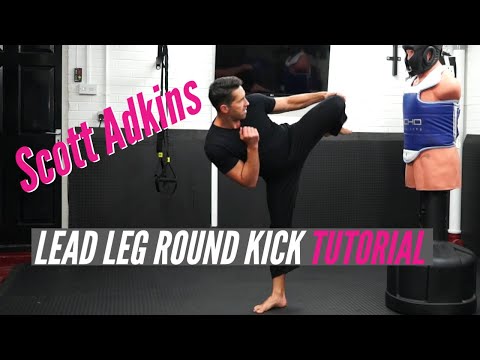
This Lead Leg Round Kick Tutorial is brought to you by World renowned martial artist Scott Adkins. This kick is a swift …
The hopping roundhouse kick is executed by pushing off the front foot while rotating the body in the air, a technique emphasized by both Aikido Silverdale and Scott Adkins, though with distinct pedagogical focuses. Aikido Silverdale stresses the mechanical sequence: a slight hip turn (acting as a wind-up), a sink into the stance, weight transfer from heel to toe on the front foot, and an upward lift of the torso as the push-off occurs. This approach prioritizes rotation efficiency and concealment—by pushing off rather than opening the front foot first, the technique telegraphs less to an opponent. The kicking leg itself should aim horizontally (as if sweeping a ball off a table), with impact delivered via the shoelaces and top of the foot. Aikido Silverdale acknowledges flexibility limitations may result in hook-kick variations, which are acceptable. Scott Adkins, approaching from a Taekwondo background, emphasizes the lead-leg roundhouse variant, highlighting the importance of turning the back foot first to position the hips, leaning back for greater reach, and critically, bringing the knee across the opponent's centerline for maximum power generation. Both instructors agree the kick is difficult for opponents to perceive and requires proper hip positioning, though they diverge on entry mechanics and power delivery emphasis.
Synthesized from 2 instructors
No instructional courses yet for this technique.
Sign in to suggest a course.
Risk of injury to the person this technique is applied to
The Hopping Roundhouse to the body can fracture ribs, rupture the liver (producing immediate incapacitation), or cause diaphragm spasm. To the head, the combined rotational and forward force produces knockouts with high reliability. The technique's danger is amplified by the difficulty of defending it — the skip-step closes distance faster than the opponent expects, and the kick arrives with more power than a standard roundhouse from the same range. Giorgio Petrosyan, considered the greatest technical kickboxer ever, has produced dozens of knockouts with the hopping body kick. [2,3]
Skill level needed to execute this technique reliably
Whether this technique is allowed under major competition rule sets
Essential Book of Martial Arts Kicks (De Bremaeker & Faige, 2010)
description: [1] De Bremaeker 2010 pp.105-106, [2] Krauss 2006
Mixed Japanese-Western terminology — combines traditional Japanese terms with katakana loanwords
description: [1] De Bremaeker 2010 pp.105-106, [2] Krauss 2006
Standard roundhouse kick flexibility and hip rotation
Good footwork coordination for the skip-step
Explosive calves for the rapid forward slide
Balance during the transition from skip to kick
Accessible to all body types — the skip compensates for short legs by adding forward distance
Shin conditioning recommended for Muay Thai-style delivery
Push off hard with your front foot and rotate in the air rather than opening up and pushing off with your back foot. Aikido Silverdale emphasizes that failing to push off properly can lock you up and potentially cause injuries by making you cross your body.
Turn your hips slightly, shift your weight forward onto your front foot, and keep your toes pointed out to get into a side-on position. Scott Adkins notes that you should lean back to open up easier and get your knee across to the other side of the target for maximum power.
Use the top of your foot (where the shoelaces are) as your point of impact, and think of the kick like you're trying to kick a ball off a table—avoid kicking up or down. Aikido Silverdale recommends focusing on swift hip rotation with the sequence: turn hips, sink, heel, toes, lift off and come through.
Get your knee across to the other side of your opponent's body and use the force of your quads to drive the kick through, rather than leaving it as a flick. Scott Adkins explains that bringing the knee all the way over makes a significant difference in power delivery.
The Hopping Roundhouse Kick combines a quick skip-step forward with a rear-leg roundhouse kick, using the hop to close distance rapidly while maintaining the full power and circular trajectory of the rear leg's roundhouse. The technique uses the same foot-replacement principle as the Hopping Front Kick: the rear foot slides forward to replace the front foot's position, and the front foot — now momentarily in the rear position — delivers the roundhouse kick with full hip rotation, adding the forward momentum of the skip to the kick's rotational force.
The Hopping Roundhouse developed in competitive martial arts as fighters sought to close distance for the roundhouse kick — which requires medium range to be effective — without the telegraphing associated with stepping forward normally. In Muay Thai, the skip-step body kick has been a standard weapon since at least the mid-20th century, with Thai fighters using the subtle forward movement to bridge distance for their devastating shin kicks.
Unified MMA: legal — Legal striking technique; WBC/Boxing: banned — All kicks prohibited in boxing; WKF: legal — Legal, chudan (body) kick scores 2 points, jodan (head) kick scores 3 points; Kyokushin: legal — Legal at full power to body and head; WT: legal — Legal, body kick 2 points, head kick 3 points, spinning body 4 points, spinni…; WAKO: legal — Legal in Full Contact and Low Kick formats; K: legal — 1/GLORY — Legal; IFMA: legal — Legal — kicks are a core Muay Thai technique
Danger rating 8/10. The Hopping Roundhouse to the body can fracture ribs, rupture the liver (producing immediate incapacitation), or cause diaphragm spasm. To the head, the combined rotational and forward force produces knockouts with high reliability. The technique's danger is amplified by the difficulty of defending it — the skip-step closes distance faster than the opponent expects, and the kick arrives with more power than a standard roundhouse from the same range. Giorgio Petrosyan, considered the greatest technical kickboxer ever, has produced dozens of knockouts with the hopping body kick.
The standard setup chain: Establish the jab rhythm at punching range → Opponent adjusts to the jab and prepares counters → Throw jab-cross to turn the body and cover the skip footwork → Skip: rear foot slides forward to replace front foot → Front foot immediately lifts and chambers the roundhouse → Full hip rotation fires the roundhouse to the body (ribs/liver) or head → Forward momentum from the skip adds 20-30% power → Kick lands with combined rotational + linear force → Retract and follow up with punching combination → Alternative: skip-step to feint roundhouse, opponent checks → immediately follow with a punch combination to the opening created by the check.
Standard counters include: Side step — moving laterally during the skip avoids the roundhouse's circular path / Check by raising the knee — the shin check is the primary Muay Thai defence against body roundhouses, including the h… / Teep (push kick) — firing a front kick into the opponent's midsection during their skip-step stops the forward momentum / Rear straight counter — timing a cross to arrive as the opponent's roundhouse is in flight (their chin is exposed dur….
Common variants: Hopping body roundhouse (the standard version, targeting the ribs/liver (highest-p…); Hopping head kick (elevating the roundhouse to head level after the skip (re…); Hopping low kick (targeting the outer thigh or calf with the skip-step entry); Hopping switch roundhouse (switching stance during the skip for deceptive timing); Hopping roundhouse to the arm (targeting the opponent's blocking arm to weaken their guard); Long-range hop (extended skip covering 24-36 inches for maximum distance …).
Giorgio Petrosyan — considered the greatest technical kickboxer ever, multiple Glory/K-1 titles using the skip-step body kick as a primary weapon || Buakaw Banchamek — K-1 World MAX champion, renowned for devastating skip-step roundhouse kicks || Israel Adesanya — UFC middleweight champion, uses the hopping roundhouse extensively || Saenchai — Lumpinee champion, master of the skip-step entry || The skip-step body roundhouse is one of the most commonly scored techniques in Glory and ONE Championship kickboxing.
Top errors to watch for: Telegraphing with the upper body — any movement above the waist during the skip alerts the opponent. The head, should… / Pausing between the skip and the kick — a visible pause between planting the sliding foot and launching the roundhous… / Skipping too high — the feet should slide along the floor; hopping into the air is slow, visible, and leaves the figh… / Kicking at the wrong range — the skip-step is designed to close a specific distance (approximately 18-24 inches). Kic….
The Hopping Roundhouse Kick is also known as Tobi Mawashi Geri, Skip Roundhouse, Skipping Mawashi Geri, Hop Step Roundhouse, Sliding Roundhouse.