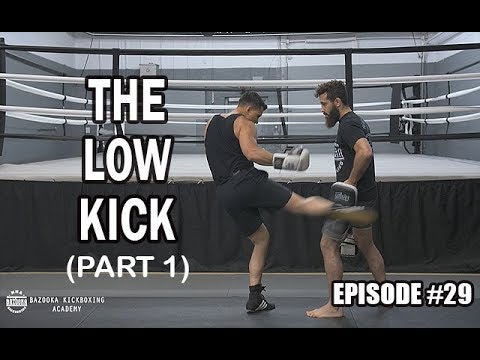
BKA - Episode #29 - The Low Kick (Part 1)
0
Low Kick·Bazooka Joe Valtellini
Each week i will be releasing a video which is part of the online Bazooka Kickboxing Academy. It will start with a begin…
Translation: low kick
The Low Kick subfamily covers roundhouse kicks targeting the opponent's legs, primarily the outer thigh (quadriceps), inner thigh (adductors), and calf, delivered below the waistline. [1] Low kicks are the workhorse of Muay Thai and kickboxing, used to degrade the opponent's mobility, punish forward movement, and accumulate damage that compounds over rounds as the targeted leg muscles bruise and lose function. [1],[2] While individual low kicks rarely end fights immediately, their cumulative effect can render an opponent unable to stand, move, or generate power in their own techniques, as famously demonstrated in the decline of opponents' mobility in extended kickboxing bouts. [2],[3]
Low kicks are a defining feature of Muay Thai, where attacks to the legs have always been legal and are scored as effective techniques. [1] The Dutch kickboxing school further systematised low kick usage in the 1980s and 1990s, integrating low kicks into boxing combinations and popularising them in European and Japanese kickboxing competition. [1],[2] Rob Kaman, the legendary Dutch Muay Thai fighter, earned the nickname 'Mr. Low Kick' for his devastating use of leg kicks in the 1980s and 1990s. [2],[3]
Low kicks are fundamental in Muay Thai and kickboxing. [1]
Low kicks are one of the most frequently thrown kicks in MMA and Muay Thai competition. [1]
No images yet for this technique.
Sign in to suggest an image.
Each week i will be releasing a video which is part of the online Bazooka Kickboxing Academy. It will start with a begin…
You can sharpen up your low kick and land it more frequently with these tips. __________________________________________…
No instructional courses yet for this technique.
Sign in to suggest a course.
Risk of injury to the person this technique is applied to
Most common KO kick; generates ~1,000N force to head (Falco et al. 2009)
Skill level needed to execute this technique reliably
Whether this technique is allowed under major competition rule sets
Muay Thai: The Art of Fighting (Yod Ruerngsa, Khun Kao Charuad & James Cartmell, 2002)
Alias sources — [1] Muay Thai: The Art of Fighting (Kraitus & Kraitus, 1988) [2] Muay Thai Unleashed (Delp, 2006)
Effectiveness sources — [1] Muay Thai Unleashed (Delp, 2006) [2] Muay Thai: The Art of Fighting (Kraitus & Rennehan, 2002)
Standard katakana transliteration of Western martial arts terminology (外来語) — used in Japanese MMA, boxing, and BJJ communities
Alias sources — [1] Muay Thai: The Art of Fighting (Kraitus & Kraitus, 1988) [2] Muay Thai Unleashed (Delp, 2006)
Effectiveness sources — [1] Muay Thai Unleashed (Delp, 2006) [2] Muay Thai: The Art of Fighting (Kraitus & Rennehan, 2002)
hip flexibility, rotational hip power, balance on support leg
long legs for reach, flexible hips for high kicks
hip flexors, glutes, quadriceps, obliques, calves
Every move, in any martial art, shares a few universal traits. Mix and match below to pinpoint the right tool — or compare equivalents across styles.
The Inside Low Kick is a roundhouse kick targeting the inside of the opponent's lead or rear leg, striking the inner thigh (adductor muscles) or the inner knee area. [1] The inside low kick attacks a less commonly defended angle, as most fighters train to check low kicks coming from the outside, making the inside angle a tactical surprise. [1,2] Striking the inner thigh can compromise the opponent's stance width and balance, and repeated inside low kicks weaken the adductors, making it painful for the opponent to maintain a stable base. [2,3]
The Outside Low Kick is the most commonly thrown low kick in combat sports, targeting the outside of the opponent's lead thigh (vastus lateralis and IT band) with a circular shin strike. [1] The outside low kick attacks the large quadriceps muscle group, causing bruising and progressive loss of leg function that affects the opponent's ability to move, kick, and maintain balance. [1,2] When delivered repeatedly to the same area, outside low kicks produce a cumulative effect that can render the targeted leg nearly immobile, as demonstrated in numerous high-profile fights where leg kick accumulation led to stoppages. [2,3]
Bazooka Joe Valtellini explains that standing directly in front of the target with no footwork or weight transfer kills your power. You need to step into the kick and exit afterward to generate force and actually damage your opponent.
Step on the ball of your foot with a small gap between your heel and the ground—don't be completely flat-footed. Lengthening your stance gives you more power, similar to loading up for a baseball swing rather than using a short chopping motion.
A setup low kick uses minimal pivot on your front foot to stay defensive and keep your hands ready for combinations. Once you've located the target with setup kicks and know where the leg is, you can step deeper and pivot to deliver a more powerful finish kick.
No. Gabriel Varga clarifies that for low kicks you should drop your foot flat into the floor by pivoting and dropping your heel or jumping and landing, because you're kicking downward. This drops your weight into the impact and intensifies it, unlike body kicks where you elevate through the heel.
Gabriel Varga recommends keeping your hands high and swinging across to create a barrier between you and your opponent, so incoming shots go off your gloves or elbows rather than landing clean.
Gabriel Varga suggests you need to close the distance yourself by jumping from your back foot to your front foot on a slight angle. Alternatively, use the low kick as a counter rather than as an aggressive opening, which doesn't require the same setup.
The Low Kick subfamily covers roundhouse kicks targeting the opponent's legs, primarily the outer thigh (quadriceps), inner thigh (adductors), and calf, delivered below the waistline. Low kicks are the workhorse of Muay Thai and kickboxing, used to degrade the opponent's mobility, punish forward movement, and accumulate damage that compounds over rounds as the targeted leg muscles bruise and lose function.
Low kicks are a defining feature of Muay Thai, where attacks to the legs have always been legal and are scored as effective techniques. The Dutch kickboxing school further systematised low kick usage in the 1980s and 1990s, integrating low kicks into boxing combinations and popularising them in European and Japanese kickboxing competition.
Unified MMA: legal — Legal striking technique; WBC/Boxing: banned — All kicks prohibited in boxing; WKF: banned — Kicks below the waist prohibited in sport karate; Kyokushin: legal — Legal at full power; WT: banned — Kicks below the waist prohibited; WAKO: legal — Legal in Low Kick and K-1 formats; K: legal — 1/GLORY — Legal — low kicks are a core technique; IFMA: legal — Legal — leg kicks are highly scored in Muay Thai
Danger rating 6/10. High — most common KO kick; generates ~1,000N force to head (Falco et al. 2009)
The standard setup chain: Stance and Range → Chamber the Leg → Execute the Kick → Recover.
Standard counters include: Check (Shin Block) — raise the shin to intercept the kick before it lands / Catch and Sweep — catch the kicking leg and sweep the standing leg / Step Inside — close distance inside the kick's effective range to smother it.
Common variants: Standard roundhouse (rear leg) (full hip rotation, shin strikes the target); Lead leg roundhouse (switch kick) (switch-step to generate power from the lead side); Low roundhouse (leg kick) (targeting the thigh to damage the opponent's base); Head kick (high roundhouse targeting the temple or jaw).
Low kicks are one of the most frequently thrown kicks in MMA and Muay Thai competition.
Top errors to watch for: Kicking too high on the leg and hitting the hip bone, which hurts the kicker more than the target / Not angling the kick downward — a flat roundhouse at thigh level is easier to check than a chopping one / Leaving the guard down after kicking low, inviting the head-punch counter that follows most low kicks / Standing too close so the knee connects instead of the shin — damaging your own knee.
The Low Kick is also known as Rō Kikku, Leg Kick, Low Roundhouse.