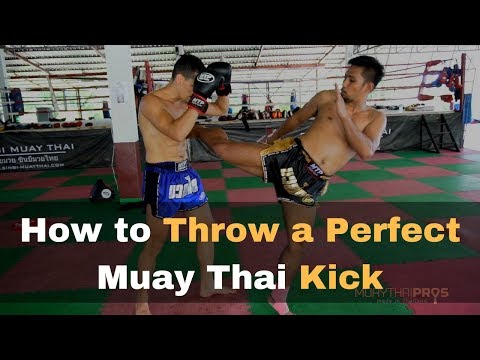
Top 3 Ways To Land A Clean Body Kick | EXCLUSIVE CONTENT FROM LIAMHARRISONTRAINING.COM
0
Body Kick·Liam Harrison
Here are my Top 3 ways of landing a clean body kick. This is content straight from my website www.LiamHarrisonTraining.c…
Translation: body kick
The Body Kick subfamily covers roundhouse kicks targeting the opponent's torso, including the ribs, liver, spleen area, and floating ribs, delivered at midsection height. [1] Body kicks are among the most tactically effective strikes in Muay Thai and kickboxing because they accumulate damage over rounds, degrading the opponent's endurance and willingness to engage, while individual clean body kicks can produce instant stoppages by impacting the liver or solar plexus. [1],[2] The body kick is scored highly in Muay Thai judging, where heavy body kicks are considered indicators of dominance and ring control. [2],[3]
Body kicks have been a cornerstone of Muay Thai scoring and strategy since the sport's formalisation, with Thai judges awarding significant points for clean, powerful round kicks to the midsection. [1] Dutch kickboxing further emphasised body kicks within combination striking, integrating them with boxing punches in a systematic attack methodology. [1],[2] In MMA, body kicks gained strategic importance as fighters recognised their ability to sap opponents' energy and set up finishing sequences. [2],[3]
Body kicks are fundamental in Muay Thai and kickboxing. [1]
Body kicks are one of the most effective scoring techniques in Muay Thai and MMA. [1]
No images yet for this technique.
Sign in to suggest an image.
Here are my Top 3 ways of landing a clean body kick. This is content straight from my website www.LiamHarrisonTraining.c…
Shop: https://mtpfightgear.com My Instagram: https://www.instagram.com/muaythaipros/ Learn how to throw a Muay Thai bod…
No instructional courses yet for this technique.
Sign in to suggest a course.
Risk of injury to the person this technique is applied to
Most common KO kick; generates ~1,000N force to head (Falco et al. 2009)
Skill level needed to execute this technique reliably
Whether this technique is allowed under major competition rule sets
Muay Thai: The Art of Fighting (Yod Ruerngsa, Khun Kao Charuad & James Cartmell, 2002)
Alias sources — [1] Muay Thai: The Art of Fighting (Kraitus & Kraitus, 1988) [2] Karate-Do Kyohan (Funakoshi, 1935) [3] Muay Thai Unleashed (Delp, 2006)
Effectiveness sources — [1] Muay Thai Unleashed (Delp, 2006) [2] Muay Thai: The Art of Fighting (Kraitus & Rennehan, 2002)
Standard katakana transliteration of Western martial arts terminology (外来語) — used in Japanese MMA, boxing, and BJJ communities
Alias sources — [1] Muay Thai: The Art of Fighting (Kraitus & Kraitus, 1988) [2] Karate-Do Kyohan (Funakoshi, 1935) [3] Muay Thai Unleashed (Delp, 2006)
Effectiveness sources — [1] Muay Thai Unleashed (Delp, 2006) [2] Muay Thai: The Art of Fighting (Kraitus & Rennehan, 2002)
hip flexibility, rotational hip power, balance on support leg
long legs for reach, flexible hips for high kicks
hip flexors, glutes, quadriceps, obliques, calves
Every move, in any martial art, shares a few universal traits. Mix and match below to pinpoint the right tool — or compare equivalents across styles.
The Liver Kick targets the right side of the opponent's body at the level of the floating ribs, aiming to impact the liver — an organ highly sensitive to blunt trauma that, when struck cleanly, produces immediate incapacitating pain and involuntary collapse. [1] The liver sits beneath the right ribcage and is only partially protected by the lower ribs, making it vulnerable to powerful roundhouse kicks delivered with proper aim. [1,2] A clean liver kick produces a delayed but unavoidable pain response that causes the legs to buckle and the body to fold, regardless of the recipient's toughness or willpower. [2,3]
The Standard Body Kick is the fundamental midsection roundhouse kick, executed by pivoting on the lead foot, rotating the hips fully, and driving the shin into the opponent's ribcage or abdomen with a full hip-through motion. [1] The kick strikes with the lower third of the tibia (shin), and the kicker rotates completely through the target, allowing the hip to turn over for maximum power transfer. [1,2] This is the most frequently thrown kick in Muay Thai and kickboxing competition. [2,3]
The Switch Body Kick is a body-level roundhouse kick preceded by a rapid switch of the feet, where the fighter hops and swaps the lead and rear leg positions before immediately launching the kick from what was the lead leg. [1] The switch adds power to the lead-leg kick by momentarily placing it in the rear position, engaging the full hip rotation and weight transfer typically associated with rear-leg kicks. [1,2] The switch motion also serves as a timing disruptor, as the hop-and-swap creates an unexpected rhythm change that makes the kick harder to anticipate. [2,3]
Liam Harrison recommends using a fake to set up your opponent—throw a feint that causes them to react defensively, then land the actual kick as they escape the fake and their leg comes back down, which is when they're most vulnerable.
According to Muay Thai PROS, watch your hip rotation and twisting motion when throwing the kick, as the power comes from the rotational drive of your hips rather than just the leg.
Liam Harrison suggests you can mix up your follow-ups based on your style—after landing the kick, you can skip, punch, kick again, or do whatever suits your fighting approach; it doesn't have to be another kick.
The Body Kick subfamily covers roundhouse kicks targeting the opponent's torso, including the ribs, liver, spleen area, and floating ribs, delivered at midsection height. Body kicks are among the most tactically effective strikes in Muay Thai and kickboxing because they accumulate damage over rounds, degrading the opponent's endurance and willingness to engage, while individual clean body kicks can produce instant stoppages by impacting the liver or solar plexus.
Body kicks have been a cornerstone of Muay Thai scoring and strategy since the sport's formalisation, with Thai judges awarding significant points for clean, powerful round kicks to the midsection. Dutch kickboxing further emphasised body kicks within combination striking, integrating them with boxing punches in a systematic attack methodology.
Unified MMA: legal — Legal striking technique; WBC/Boxing: banned — All kicks prohibited in boxing; WKF: legal — Legal, chudan (body) kick scores 2 points, jodan (head) kick scores 3 points; Kyokushin: legal — Legal at full power to body and head; WT: legal — Legal, body kick 2 points, head kick 3 points, spinning body 4 points, spinni…; WAKO: legal — Legal in Full Contact and Low Kick formats; K: legal — 1/GLORY — Legal; IFMA: legal — Legal — kicks are a core Muay Thai technique
Danger rating 6/10. High — most common KO kick; generates ~1,000N force to head (Falco et al. 2009)
The standard setup chain: Stance and Range → Chamber the Leg → Execute the Kick → Recover.
Standard counters include: Check (Shin Block) — raise the shin to intercept the kick before it lands / Catch and Sweep — catch the kicking leg and sweep the standing leg / Step Inside — close distance inside the kick's effective range to smother it.
Common variants: Standard roundhouse (rear leg) (full hip rotation, shin strikes the target); Lead leg roundhouse (switch kick) (switch-step to generate power from the lead side); Low roundhouse (leg kick) (targeting the thigh to damage the opponent's base); Head kick (high roundhouse targeting the temple or jaw).
Body kicks are one of the most effective scoring techniques in Muay Thai and MMA.
Top errors to watch for: Aiming too low and hitting the hip bone, which hurts the kicker and does minimal damage / Not turning the hip over, resulting in a slapping kick with the foot instead of a driving kick with the shin / Kicking the opponent's elbow — this damages your shin; set up the kick so their elbow is displaced by punches first / Dropping the lead hand completely during the kick — a body kick with no guard invites the counter hook.
The Body Kick is also known as Bodi Kikku, Tee Lam Tua, Mawashi Geri Chudan, Middle Roundhouse.