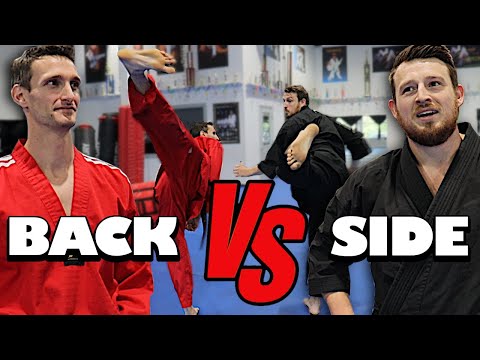
Spinning BACK KICK vs Spinning SIDE KICK
0
Back Kick·Sensei Seth
Here are the main similarities and differences in the Spinning Back Kick vs Spinning Side Kick!! Now, everybody calls …
Перевод: back kick
The Back Kick family groups kicking techniques where the striker turns away from the opponent and thrusts the heel of the foot directly backward in a linear trajectory, impacting with the heel or sole. [1] The back kick is one of the most powerful kicks in martial arts because it combines the thrust of the entire leg with the rotational momentum of the body turn, directed through the hardest part of the foot. [1],[2] Biomechanical studies have measured back kicks among the highest force-producing kicks, comparable to or exceeding the roundhouse kick, due to the full leg extension and hip drive along the kick's linear path. [2],[3] The technique is used extensively in taekwondo, karate, and MMA as both an offensive and counter-attacking weapon. [3]
The back kick has roots in Korean martial arts, where dwi chagi (back kick) is a fundamental technique in taekwondo's kicking arsenal, taught at beginner levels and used at the highest levels of competition. [1] The technique also appears in karate as ushiro geri and has been adopted extensively in kickboxing and MMA. [1],[2] The back kick gained widespread recognition in MMA through fighters such as Bas Rutten and later Conor McGregor, who demonstrated its knockout potential in UFC competition. [2],[3]
The back kick is a powerful technique in taekwondo, karate, and kickboxing. [1]
The back kick is used in TKD, kickboxing, and MMA competition. [1]
Изображений для этой техники пока нет.
Войдите, чтобы предложить изображение.
Here are the main similarities and differences in the Spinning Back Kick vs Spinning Side Kick!! Now, everybody calls …
Учебных курсов по этой технике пока нет.
Войдите, чтобы предложить курс.
Риск травмы для человека, к которому применяется техника
Spinning back kick generates extreme force; liver/solar plexus KO risk
Уровень мастерства, необходимый для надёжного выполнения техники
Разрешена ли техника по основным соревновательным правилам
Karate-Do Kyohan: The Master Text (Gichin Funakoshi, 1935)
Alias sources — [1] Kukkiwon Textbook (2006) [2] Dynamic Karate (Nakayama, 1966) [3] Kukkiwon Textbook (2006)
Effectiveness sources — [1] Comprehensive Asian Fighting Arts (Draeger & Smith, 1969) [2] Muay Thai Unleashed (Delp, 2006)
Official karate technique names (和語/漢語)
Established Japanese martial arts naming convention — native Japanese term (和語/漢語)
Alias sources — [1] Kukkiwon Textbook (2006) [2] Dynamic Karate (Nakayama, 1966) [3] Kukkiwon Textbook (2006)
Effectiveness sources — [1] Comprehensive Asian Fighting Arts (Draeger & Smith, 1969) [2] Muay Thai Unleashed (Delp, 2006)
hip flexibility, rotational hip power, balance on support leg
long legs for reach, flexible hips for high kicks
hip flexors, glutes, quadriceps, obliques, calves
Каждое движение в любом боевом искусстве обладает рядом универсальных свойств. Комбинируйте параметры ниже, чтобы найти нужный инструмент или сравнить аналоги из разных стилей.
The Back Ghost Lift Kick is a deceptive back kick that feints low then redirects upward, catching the opponent off-guard with the height change. [1] The initial motion suggests a low back kick, triggering a downward defensive response, before the kicker lifts the trajectory to strike the body or head. [1] The name 'ghost' refers to the phantom-like nature of the initial feint. [1]
The Double Drop Back Kick delivers two back kicks in rapid succession while dropping to the ground, alternating legs for a devastating two-strike combination. [1] The momentum from the first kick's recoil helps chamber the second, creating a rapid-fire sequence from ground level. [1]
The Downward Back Kick drives the heel downward and backward at approximately 30-45° below horizontal, targeting the opponent's knee joint, shin, or instep (top of the foot) from behind — a stomping back kick that attacks the structural integrity of the opponent's legs rather than their body. [1] The technique combines the backward direction of the standard back kick with the downward stomping trajectory of the oblique kick, creating a hybrid that targets the most structurally vulnerable part of the human body — the knee — from the direction the knee is least able to resist force (from above-behind). [1] The human knee is a hinge joint designed to flex and extend along a single axis; forces applied from above and behind force the joint to buckle forward (hyperflexion), which can tear the ACL, PCL, and popliteal ligaments that stabilise the joint. [1] De Bremaeker and Faige document the Downward Back Kick as one of the back kick variants, noting its tactical application when the opponent is standing close behind the practitioner — the downward trajectory targets the lead leg's knee, which is the opponent's primary weight-bearing structure in that position. [1] The technique is sometimes called the 'Donkey Kick' because it resembles the kicking motion of a donkey — a powerful downward-backward stamp that drives the heel into whatever is behind and below the animal. [1] In MMA, the oblique kick to the knee (a related front-facing technique popularised by Jon Jones) has demonstrated the devastating effectiveness of stomping kicks to the knee joint — the Downward Back Kick applies the same principle from a rearward direction. [2] In self-defence, the Downward Back Kick is one of the most effective responses to being grabbed from behind: the heel stomps down onto the attacker's shin, knee, or instep without requiring the defender to turn around. [1]
The Drop Back Kick is a back kick delivered while intentionally dropping the body forward to the ground. [1] The forward drop creates momentum that adds power to the backward kick, while the unexpected level change makes the kick difficult to defend. [1] This sacrifice technique requires practiced falling skills for safe execution. [1]
The Drop Hooking Back Kick combines a body drop with a back kick that hooks at the end, creating a sweeping attack from ground level. [1] The combination of the drop and the hook creates a wide, unpredictable arc that is extremely difficult to anticipate. [1]
The Drop Overhead Back Kick is a dramatic technique where the practitioner drops forward while kicking the heel overhead and behind, striking a target above and behind them in a scorpion-like motion. [1] This highly acrobatic kick requires exceptional flexibility and body control. [1] It is sometimes called the scorpion kick for the arched-back position during execution. [1]
The Flying Back Kick (Twimyo Dwit Chagi) is a back kick executed with a jumping/flying motion, delivering a powerful heel thrust while airborne. [1] The principle is the same as a standard back pushing kick except the fighter becomes airborne before impact, adding the body's dropping weight to the kick's force. [1] The technique requires the fighter to jump, rotate to sight the target over the shoulder, and drive the heel backward — all while in the air. It is one of the most powerful but highest-risk kicking techniques in the TKD arsenal. [1]
The Low Back Kick targets the opponent's knee, shin, or lower thigh from behind, aiming to damage the structural support of the lead leg. [1] By directing the back kick downward at the opponent's lower body, the practitioner attacks a target that is difficult to defend when struck from behind. [1] This technique is particularly effective as a counter when the opponent is advancing. [1]
The One-Legged Drop Back Kick is a drop back kick that lands on one leg only, allowing immediate follow-up techniques without the need for full ground recovery. [1] By controlling the landing to a single-leg base, the practitioner maintains enough mobility to continue attacking or transition to a takedown. [1]
The Penetrating Back Kick is the foundational back kick — a straight-line thrust delivered backward using the heel, driving through the target with full hip extension. [1] From fighting stance, the fighter looks over the shoulder to sight the target, chambers the kicking leg with the knee raised, and drives the heel straight back into the opponent's midsection. [1] This is one of the most powerful kicks in martial arts — the alignment of the spine, hip, and heel in a straight line allows maximum force transfer. [1] It is particularly effective as a counter against opponents who rush forward, using their own momentum against them. [1]
The Short Back Kick is a compact variant of the back kick that uses minimal leg extension to deliver the heel into a target directly behind the practitioner, optimised for very close range situations where a full-extension back kick (ushiro geri kekomi) would over-extend and miss or lose power. [1] The technique resembles a mule's kicking motion — hence the common name 'Mule Kick' — with a short, sharp hip extension that drives the heel straight backward into the opponent's midsection, groin, knee, or shin from distances as close as 12-18 inches. [1] While the standard back kick chambers the knee high and thrusts the leg out to full extension (reaching targets 3-4 feet behind), the Short Back Kick keeps the knee relatively low and the extension minimal — the power comes from a sharp hip extension (gluteal contraction) rather than a full leg thrust, producing a compact, fast kick that operates in the space between clinch range and standard kicking range. [1] De Bremaeker and Faige document the Short Back Kick as the close-range member of the back kick family, filling the tactical gap where the opponent is too close for a standard back kick but positioned behind the practitioner — a common situation in multiple-attacker scenarios, after a missed spinning technique, or when the opponent circles to the practitioner's rear quarter. [1] In MMA, the Short Back Kick has been used effectively against opponents who circle behind the fighter during cage-wall exchanges — the compact kick fires backward without the fighter needing to fully turn around, maintaining their position against the cage while punishing the opponent's circling movement. [2] The technique's simplicity — it is essentially a backward hip thrust with the heel — makes it accessible to beginners while remaining effective at the highest levels. [1]
The Spin-Back Back Kick combines a 180-degree spin with a straight back kick, using rotational momentum to increase the power of the heel thrust. [1] The fighter pivots on the lead foot, rotates the body backward while sighting the target over the shoulder, and drives the rear leg straight back as the rotation completes. [1] The spin adds significant power to what is already one of the strongest kicks in martial arts. [1] Unlike the standard back kick which is thrown from a static position, the spin-back version is typically used as an offensive technique to close distance while attacking. [1]
The Spin-Forward Back Kick is a back kick preceded by a forward-moving spin, simultaneously closing distance and generating rotational power. [1] Unlike a standard spinning back kick which maintains position, this variant covers ground forward during the spin, making it an effective attacking technique against retreating opponents. [1]
The Spin-Forward Hook Back Kick combines a forward spin with a back kick that hooks at the end, creating a complex multi-phase attack. [1] The forward spin closes distance, the back kick delivers power, and the hook redirects the strike around the opponent's defence. [1]
The Standard Back Kick subfamily covers the fundamental back kick execution, where the fighter looks over the shoulder, pivots on the lead foot, and drives the heel of the rear foot straight back into the opponent's midsection or solar plexus. [1] The kicking leg extends fully in a linear thrust, and the power is generated by driving the hip backward while maintaining a rigid leg structure at the moment of impact. [1,2] The standard back kick is one of the most powerful linear kicks, and its trajectory makes it difficult to catch or sweep compared to circular kicks. [2,3]
The Uppercut Back Kick delivers a back kick with an upward-rising trajectory, targeting the opponent's chin, solar plexus, or groin from below and behind, combining the directional advantage of the back kick (striking behind the practitioner) with the angular advantage of an uppercut (rising from below the opponent's visual field). [1] While the standard back kick (ushiro geri kekomi) travels in a straight horizontal line backward, the Uppercut Back Kick angles upward at approximately 30-60° from horizontal, driving the heel upward and behind into targets that are above the standard back kick's trajectory. [1] The technique is particularly effective against opponents who lean forward or duck — the rising heel catches them under the chin as they drop their head, or drives upward into the solar plexus from below the protective arm guard. [1] De Bremaeker and Faige document the Uppercut Back Kick as one of the back kick variants in their 89-kick compilation, noting that it fills a tactical gap: the standard back kick misses opponents who duck or lean forward, while the uppercut variant rises to meet them at their lowered position. [1] The mechanical execution uses the same hip extension as a standard back kick but adds hip flexion to elevate the heel's trajectory — the kick effectively 'scoops' upward behind the practitioner rather than thrusting straight backward. [1] In MMA, the rising back kick has been used by fighters to catch opponents who duck under spinning attacks — the opponent ducks to avoid a spinning head kick, and the rising heel catches them under the chin as they come up. [2]
The Upward Hook Back Kick combines back kick power with a hooking redirection at the end of the trajectory, sweeping upward and around the target. [1] The initial motion is a standard back kick, but near full extension, the foot hooks upward and inward, creating a scooping effect that can catch targets behind the opponent's guard. [1]
The back kick generates more force than any other kick due to the combined hip extension and body weight driving backward through the heel. Biomechanical studies measure back kick force at 1,500+ newtons — exceeding roundhouse and front kicks. (De Bremaeker & Faige, Essential Book of Martial Arts Kicks; Pieter & Pieter, Speed and Force in Selected Karate Techniques, 1995)
According to Sensei Seth, you want to keep your knees together as you sweep straight up and back, which is an important detail that distinguishes the back kick from similar spinning techniques.
Sensei Seth emphasizes that you want the back kick to be linear—moving in a straight line back toward your target, rather than following a curved or angled path.
Sensei Seth uses the back kick to drop an opponent's guard down with confidence, while the back hook kick swings up higher—the difference in angle is what makes each technique suited to its own purpose.
The Back Kick family groups kicking techniques where the striker turns away from the opponent and thrusts the heel of the foot directly backward in a linear trajectory, impacting with the heel or sole. The back kick is one of the most powerful kicks in martial arts because it combines the thrust of the entire leg with the rotational momentum of the body turn, directed through the hardest part of the foot.
The back kick has roots in Korean martial arts, where dwi chagi (back kick) is a fundamental technique in taekwondo's kicking arsenal, taught at beginner levels and used at the highest levels of competition. The technique also appears in karate as ushiro geri and has been adopted extensively in kickboxing and MMA.
Unified MMA: разрешён — Legal striking technique; WBC/Boxing: запрещён — All kicks prohibited in boxing; WKF: разрешён — Legal, chudan (body) kick scores 2 points, jodan (head) kick scores 3 points; Kyokushin: разрешён — Legal at full power to body and head; WT: разрешён — Legal, body kick 2 points, head kick 3 points, spinning body 4 points, spinni…; WAKO: разрешён — Legal in Full Contact and Low Kick formats; K: разрешён — 1/GLORY — Legal; IFMA: разрешён — Legal — kicks are a core Muay Thai technique
Оценка опасности 7/10. Very High — spinning back kick generates extreme force; liver/solar plexus KO risk
Стандартная цепочка подготовки: Stance and Range → Chamber the Leg → Execute the Kick → Recover.
Стандартные контрприёмы: Check (Shin Block) — raise the shin to intercept the kick before it lands / Catch and Sweep — catch the kicking leg and sweep the standing leg / Step Inside — close distance inside the kick's effective range to smother it.
Распространённые варианты: Standard roundhouse (rear leg) (full hip rotation, shin strikes the target); Lead leg roundhouse (switch kick) (switch-step to generate power from the lead side); Low roundhouse (leg kick) (targeting the thigh to damage the opponent's base); Head kick (high roundhouse targeting the temple or jaw).
The back kick is used in TKD, kickboxing, and MMA competition.
Основные ошибки, на которые стоит обратить внимание: Not looking over the shoulder to spot the target — blind kicks miss and leave you exposed / Hooking the kick instead of thrusting it straight back — this is a spinning hook kick, a different technique / Not driving the hip through the kick — the power comes from hip extension, not leg swing / Over-rotating past the target and ending up sideways or facing the wrong direction.
Back Kick также известен как Ushiro-geri, Dwi Chagi, Ushiro Geri, Donkey Kick.