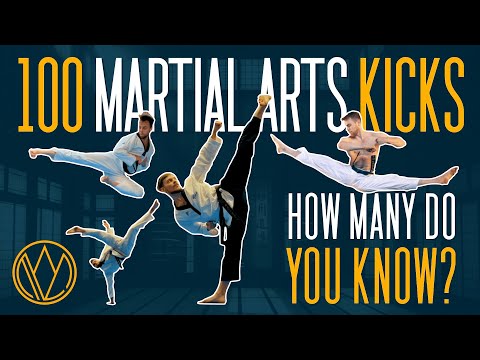
100 DIFFERENT KICKS! | FOC Kicktionary | Taekwondo, Karate, Capoeira, Tricking, Martial Arts
0
Strike·FOC Taekwondo
Here are 100 different martial arts kicks and kicking variations! Our background is in taekwondo but we tried to borrow …
Перевод: striking technique
The Strike class encompasses all combat techniques in which a fighter delivers percussive force to an opponent using a part of the body — fist, elbow, knee, shin, foot, or head — to cause damage, create distance, or set up subsequent attacks. [1] Striking is the most instinctive form of unarmed combat, and biomechanical research has shown that the kinetic chain linking the feet, hips, torso, and striking limb is the primary determinant of impact force, with elite athletes generating peak forces exceeding 4,000 newtons in punches alone. [1],[2] The class is organised into groups by the primary weapon used: punches (closed fist), kicks (foot and shin), elbows, knees, headbutts, and open-hand strikes, each governed by distinct biomechanical principles and tactical applications. [2],[3] Striking arts span the globe and represent some of the oldest documented fighting systems, from Western boxing codified under the London Prize Ring Rules in 1743, to Muay Thai's eight-weapon system refined over centuries in Thailand, to karate's formalisation in Okinawa and Japan during the early 20th century. [3],[4] Modern sport science has advanced striking methodology considerably, with three-dimensional motion capture and electromyography studies revealing that sequential activation of lower-limb, trunk, and upper-limb muscles — the proximal-to-distal sequencing principle — underlies maximum-force generation across all strike types. [4],[5] In competitive contexts, striking techniques are regulated by sport-specific rule sets: boxing permits only closed-fist punches above the waist, Muay Thai allows the full range of punches, kicks, elbows, and knees, while MMA under the Unified Rules prohibits twelve-to-six elbows and certain headbutts. [5],[6] The strategic depth of striking lies in combining these weapons across ranges — long-range kicks to control distance, mid-range punches for volume damage, and close-range elbows and knees in the clinch — to create a layered offensive system that overwhelms defensive structures. [6],[7]
Striking in combat is as old as human conflict, with the earliest pictorial evidence appearing in Sumerian reliefs from approximately 3000 BCE depicting boxers and in Egyptian tomb paintings at Beni Hasan (circa 2000 BCE) showing wrestlers and strikers. [1] The ancient Greeks formalised striking within pygmachia (boxing) and pankration, which were Olympic events by 688 BCE and 648 BCE respectively, introducing hand wrappings and basic rules of engagement. [1],[2] In East Asia, Chinese martial arts texts such as the Ji Xiao Xin Shu (1561) by General Qi Jiguang codified striking methods, while Okinawan te evolved through trade-route contact with Chinese kung fu into the karate systems formalised by Gichin Funakoshi in the 1920s. [2],[3] Muay Thai evolved from the battlefield art muay boran, with the first formal ring rules established in Thailand during the 1920s under the patronage of King Rama VII. [3],[4] Western boxing was codified by Jack Broughton's rules in 1743 and further modernised by the Marquess of Queensberry Rules in 1867, introducing gloves, timed rounds, and the ten-count system. [4],[5] The 20th century saw the emergence of full-contact karate, kickboxing (formalised in the United States and Japan in the 1960s and 1970s), and savate's continued development in France. [5],[6] The advent of mixed martial arts in the 1990s, particularly the founding of the UFC in 1993, forced an unprecedented cross-pollination of striking traditions, leading to the integrated striking methodology seen in modern MMA. [6],[7]
Striking accounts for the majority of all finishes in MMA and is the sole scoring action in boxing, kickboxing, and Muay Thai. [1]
Изображений для этой техники пока нет.
Войдите, чтобы предложить изображение.
Here are 100 different martial arts kicks and kicking variations! Our background is in taekwondo but we tried to borrow …
Учебных курсов по этой технике пока нет.
Войдите, чтобы предложить курс.
Риск травмы для человека, к которому применяется техника
Striking techniques carry inherent risk of concussion, fracture, and soft tissue injury
Уровень мастерства, необходимый для надёжного выполнения техники
Разрешена ли техника по основным соревновательным правилам
Muay Thai: The Art of Fighting (Yod Ruerngsa, Khun Kao Charuad & James Cartmell, 2002)
Alias sources — [1] Karate-Do Kyohan (Funakoshi, 1935) [2] Boxing (Dempsey, 1950) [3] Biomechanics of Striking (Lenetsky et al., 2015)
Effectiveness sources — [1] Boxing: The Complete Guide to Training and Fitness (Hatmaker, 2004) [2] Muay Thai Unleashed (Delp, 2006)
Official karate technique names (和語/漢語)
Established Japanese martial arts naming convention — native Japanese term (和語/漢語)
Alias sources — [1] Karate-Do Kyohan (Funakoshi, 1935) [2] Boxing (Dempsey, 1950) [3] Biomechanics of Striking (Lenetsky et al., 2015)
Effectiveness sources — [1] Boxing: The Complete Guide to Training and Fitness (Hatmaker, 2004) [2] Muay Thai Unleashed (Delp, 2006)
hip rotation power, rear foot pivot, full kinetic chain coordination
reach advantage, strong hips for power transfer
glutes, obliques, pectorals, triceps, deltoids
Каждое движение в любом боевом искусстве обладает рядом универсальных свойств. Комбинируйте параметры ниже, чтобы найти нужный инструмент или сравнить аналоги из разных стилей.
The Elbow Strike group comprises all striking techniques delivered with the proximal end of the ulna — the hard, bony point of the elbow — making it one of the most devastating close-range weapons in unarmed combat. [1] Biomechanical analysis has demonstrated that elbow strikes generate significant force relative to their short range, because the compact lever arm concentrates kinetic energy into a small, dense impact surface, greatly increasing pressure per unit area compared to a gloved fist. [1,2] In Muay Thai, elbow strikes (sok) are classified into at least nine distinct trajectories — horizontal, uppercut, downward, spinning, reverse, diagonal, double, and chopping variations — forming one of the eight weapons (mae mai) of the art. [2,3] Elbow strikes are prized for their ability to produce lacerations due to the sharp bone edge contacting soft facial tissue, and they account for a significant proportion of cuts and stoppages in Muay Thai and MMA competition. [3,4] Effective elbow technique requires close distance entry, often from the clinch, and relies on hip rotation and shoulder torque rather than arm extension for power generation. [4,5] The group is organised by trajectory: downward elbows, horizontal elbows, reverse elbows, spinning elbows, and uppercut elbows, each presenting different angles of attack and tactical use cases. [5]
The Headbutt group encompasses all striking techniques in which the fighter uses the skull — particularly the hard frontal bone above the brow ridge — as an impact weapon to strike the opponent. [1] The human frontal bone is one of the thickest and most structurally dense bones in the body, capable of withstanding substantial impact forces, making it a naturally resilient weapon when directed against softer facial structures such as the nose, orbital bones, or cheekbones. [1,2] Headbutts are prohibited in virtually all modern regulated combat sports including boxing, MMA under the Unified Rules, and kickboxing, but they remain important techniques in self-defence systems, military combatives, and certain traditional arts. [2,3] Historically, headbutts were legal in early Vale Tudo and no-holds-barred events, where they proved to be brutally effective at close range, particularly from clinch and ground positions. [3,4] The group is organised by the direction of the headbutt: forward, rear, and side, each targeting different areas and used in distinct tactical situations. [4]
The Kick group encompasses all striking techniques delivered with the leg — using the foot, shin, heel, or knee of the extended leg — to attack an opponent at various ranges and heights. [1] Kicks are biomechanically the most powerful strikes in a fighter's arsenal, with studies showing that elite practitioners can generate peak impact forces exceeding 9,000 newtons in roundhouse kicks, substantially greater than the forces produced by punches, due to the longer lever arm and greater muscle mass of the lower extremities. [1,2] The group is organised by the kick's trajectory and mechanics: roundhouse kicks (circular), front kicks (linear push or snap), side kicks (lateral thrust), axe kicks (downward), crescent kicks (arcing), back kicks (rearward), hook kicks (hooking path), and flying kicks (airborne delivery), each presenting distinct biomechanical and tactical profiles. [2,3] Kicks are central to numerous martial arts traditions worldwide: Muay Thai's devastating shin kicks, taekwondo's acrobatic spinning and jumping kicks, karate's front kick (mae geri) and side kick (yoko geri), savate's precise foot-delivered techniques (chassé, fouetté), and capoeira's flowing, acrobatic kick vocabulary. [3,4] In modern competition, kick selection is heavily influenced by rule set — taekwondo's point system rewards head kicks, Muay Thai scoring favours powerful round kicks to the body, and MMA fighters must balance kick offence against takedown vulnerability. [4,5]
Strikes delivered using the knee as the primary impact surface, leveraging close-range body mechanics and clinch control to generate devastating force.
Strikes delivered with an open hand using the palm, edge of the hand, fingertips, or bottom of the fist, common in traditional martial arts and self-defense systems.
Strikes delivered with a closed fist, using rotational force from the hips and shoulders to generate power through the knuckles.
Striking — delivering force to the opponent using the body's natural weapons — is the most extensively documented combat category. 'Kick' appears in thousands of passages, 'punch' in thousands more. De Bremaeker & Faige document 89 distinct kicks alone. The human body has eight striking weapons: two fists, two elbows, two knees, two feet (the eight limbs of Muay Thai). (200+ books; De Bremaeker & Faige, Essential Book of Martial Arts Kicks; Dempsey, Championship Fighting; Delp, Muay Thai Unleashed)
The Strike class encompasses all combat techniques in which a fighter delivers percussive force to an opponent using a part of the body — fist, elbow, knee, shin, foot, or head — to cause damage, create distance, or set up subsequent attacks. Striking is the most instinctive form of unarmed combat, and biomechanical research has shown that the kinetic chain linking the feet, hips, torso, and striking limb is the primary determinant of impact force, with elite athletes generating peak forces exceeding 4,000 newtons in punches alone.
Striking in combat is as old as human conflict, with the earliest pictorial evidence appearing in Sumerian reliefs from approximately 3000 BCE depicting boxers and in Egyptian tomb paintings at Beni Hasan (circa 2000 BCE) showing wrestlers and strikers. The ancient Greeks formalised striking within pygmachia (boxing) and pankration, which were Olympic events by 688 BCE and 648 BCE respectively, introducing hand wrappings and basic rules of engagement.
Unified MMA: разрешён — Legal striking technique; WBC/Boxing: ограничен — Varies by technique — only closed-fist punches legal in boxing; WKF: ограничен — Varies — controlled contact required; Kyokushin: ограничен — Varies — body strikes legal, head punches banned; WT: ограничен — Varies by technique; WAKO: разрешён — Varies by format; K: разрешён — 1/GLORY — Varies by technique; IFMA: разрешён — Legal
Оценка опасности 5/10. High — striking techniques carry inherent risk of concussion, fracture, and soft tissue injury
Стандартная цепочка подготовки: Assume Fighting Stance → Generate Power → Execute Strike → Recover to Guard.
Стандартные контрприёмы: Check (Shin Block) — raise the shin to intercept the kick before it lands / Catch and Sweep — catch the kicking leg and sweep the standing leg / Step Inside — close distance inside the kick's effective range to smother it.
Распространённые варианты: Standard cross (rear-hand straight punch with full hip rotation); Counter cross (pull counter) (leaning back to avoid the jab, firing the cross as a counter); Step-in cross (stepping forward with the punch for added reach and power); Body cross (targeting the solar plexus or liver with the straight rea…).
Striking accounts for the majority of all finishes in MMA and is the sole scoring action in boxing, kickboxing, and Muay Thai.
Основные ошибки, на которые стоит обратить внимание: Loading up on every shot instead of mixing speed and power — telegraphs intent and drains energy / Dropping the non-striking hand during offence, leaving the chin or body exposed / Holding breath during combinations — exhale sharply on each strike to maintain rhythm and endurance / Flat-footed striking with no weight transfer, reducing power and mobility.
Strike также известен как Dageki-waza, Striking Technique, Percussive Technique.