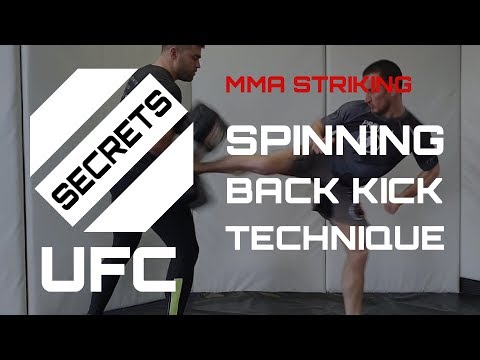
Be More CONFIDENT With Your SPINNING Back Kick Set Up
0
Uppercut Back Kick·MMA COACH
If you want to learn how to do a Spinning Back Kick then this video will help you understand the importance of the heel …
Перевод: Uppercut back kick — a back kick with an upward rising trajectory, targeting the chin or solar plexus from below-behind, combining the back kick's rearward direction with the uppercut's upward angle
The Uppercut Back Kick delivers a back kick with an upward-rising trajectory, targeting the opponent's chin, solar plexus, or groin from below and behind, combining the directional advantage of the back kick (striking behind the practitioner) with the angular advantage of an uppercut (rising from below the opponent's visual field). [1] While the standard back kick (ushiro geri kekomi) travels in a straight horizontal line backward, the Uppercut Back Kick angles upward at approximately 30-60° from horizontal, driving the heel upward and behind into targets that are above the standard back kick's trajectory. [1] The technique is particularly effective against opponents who lean forward or duck — the rising heel catches them under the chin as they drop their head, or drives upward into the solar plexus from below the protective arm guard. [1] De Bremaeker and Faige document the Uppercut Back Kick as one of the back kick variants in their 89-kick compilation, noting that it fills a tactical gap: the standard back kick misses opponents who duck or lean forward, while the uppercut variant rises to meet them at their lowered position. [1] The mechanical execution uses the same hip extension as a standard back kick but adds hip flexion to elevate the heel's trajectory — the kick effectively 'scoops' upward behind the practitioner rather than thrusting straight backward. [1] In MMA, the rising back kick has been used by fighters to catch opponents who duck under spinning attacks — the opponent ducks to avoid a spinning head kick, and the rising heel catches them under the chin as they come up. [2]
The Uppercut Back Kick represents a combination of two fundamental martial arts concepts: the backward-directed kick (present in all kicking martial arts) and the upward-rising strike (the uppercut principle). [1] The technique appears in various karate kata as back-kick applications that rise to meet lowered opponents, and in taekwondo as a competitive variant used against opponents who duck under spinning techniques. [1] De Bremaeker and Faige documented the Uppercut Back Kick as Section 4.6 in their 2010 compilation, noting its tactical value against the universal defensive reaction of ducking. [1] In MMA, the rising back kick has been used by fighters with karate and taekwondo backgrounds who recognise that opponents frequently duck when they see a spin beginning — the Uppercut Back Kick punishes this ducking response. [2]
The Uppercut Back Kick is a specialist technique that exploits the universal defensive reaction of ducking: when fighters perceive a high attack (spin, head kick), they instinctively duck — and the Uppercut Back Kick is designed specifically to catch the ducking opponent on the way down or on the way up. [1] The rising heel under the chin produces a knockout mechanism (head rotation + hyperextension) that is difficult to defend because it arrives from below and behind simultaneously. [1] The technique is most effective when used as a REACTION to ducking rather than as a standalone attack — it punishes a specific defensive response rather than initiating an exchange. [1] In MMA, the rising back kick has produced knockouts when opponents duck under spinning attacks, confirming the technique's viability at the highest competition levels. [2]
Traditional back kick + uppercut rising principle → combined as a specialist anti-ducking technique → documented by De Bremaeker & Faige (2010). [1]
Used in MMA by fighters with karate and taekwondo backgrounds as a counter to opponents who duck under spinning techniques. The technique has produced knockout finishes when the rising heel catches a ducking opponent's chin. In WT taekwondo competition, the rising back kick variant scores bonus points as a spinning technique.
Изображений для этой техники пока нет.
Войдите, чтобы предложить изображение.
If you want to learn how to do a Spinning Back Kick then this video will help you understand the importance of the heel …
Учебных курсов по этой технике пока нет.
Войдите, чтобы предложить курс.
Риск травмы для человека, к которому применяется техника
The Uppercut Back Kick to the chin produces the same knockout mechanism as a boxing uppercut — rotational acceleration of the head around the cervical spine — but delivered with the heel (a much harder surface than the fist) and from below (a more difficult angle to defend). When landing under the chin of a ducking opponent, the kick has produced spectacular knockouts. To the solar plexus from below, the upward-driving heel can cause severe diaphragm spasm. [1]
Уровень мастерства, необходимый для надёжного выполнения техники
Разрешена ли техника по основным соревновательным правилам
Essential Book of Martial Arts Kicks (De Bremaeker & Faige, 2010)
description: [1] De Bremaeker 2010 pp.156-157
Standard katakana transliteration of Western martial arts terminology (外来語) — used in Japanese MMA, boxing, and BJJ communities
description: [1] De Bremaeker 2010 pp.156-157
Requires good hip flexibility for the combined backward extension and upward elevation
Strong gluteal muscles for the hip extension power
Good hamstring flexibility for the upward trajectory
Exceptional spatial awareness for targeting behind and above without direct visual tracking
Good balance on the standing leg during the asymmetric backward-upward movement
The key is accurate heel positioning during your spin—point your heel directly at your target. If your heel faces off-target, you'll miss and expose your back to your opponent. Once you get the heel in the correct position, stop the rotation there instead of over-rotating, and deliver a straight kick from that locked position.
Taking too large a step across your body pushes your heel out of position, makes the kick more readable to your opponent, and reduces power. Instead, take only a small step and make your turn tight and compact—this keeps the heel in place and generates more power.
Always maintain control of your legs after the kick by bending it so you can step down facing your opponent. Letting the leg's momentum carry it uncontrolled is especially dangerous if your opponent dodges, as it can expose your back.
Once you build confidence and get the technique working in sparring, the spinning back kick unlocks a whole bunch of interesting follow-up attacks and different ways to go after your opponent.
The Uppercut Back Kick delivers a back kick with an upward-rising trajectory, targeting the opponent's chin, solar plexus, or groin from below and behind, combining the directional advantage of the back kick (striking behind the practitioner) with the angular advantage of an uppercut (rising from below the opponent's visual field). While the standard back kick (ushiro geri kekomi) travels in a straight horizontal line backward, the Uppercut Back Kick angles upward at approximately 30-60° from horizontal, driving the heel upward and behind into targets that are above the standard back kick's trajectory.
The Uppercut Back Kick represents a combination of two fundamental martial arts concepts: the backward-directed kick (present in all kicking martial arts) and the upward-rising strike (the uppercut principle). The technique appears in various karate kata as back-kick applications that rise to meet lowered opponents, and in taekwondo as a competitive variant used against opponents who duck under spinning techniques.
Unified MMA: разрешён — Legal striking technique; WBC/Boxing: запрещён — All kicks prohibited in boxing; WKF: разрешён — Legal, chudan (body) kick scores 2 points, jodan (head) kick scores 3 points; Kyokushin: разрешён — Legal at full power to body and head; WT: разрешён — Legal, body kick 2 points, head kick 3 points, spinning body 4 points, spinni…; WAKO: разрешён — Legal in Full Contact and Low Kick formats; K: разрешён — 1/GLORY — Legal; IFMA: разрешён — Legal — kicks are a core Muay Thai technique
Оценка опасности 8/10. The Uppercut Back Kick to the chin produces the same knockout mechanism as a boxing uppercut — rotational acceleration of the head around the cervical spine — but delivered with the heel (a much harder surface than the fist) and from below (a more difficult angle to defend). When landing under the chin of a ducking opponent, the kick has produced spectacular knockouts. To the solar plexus from below, the upward-driving heel can cause severe diaphragm spasm.
Стандартная цепочка подготовки: Throw a high technique (spinning hook kick, head-level roundhouse) → Opponent ducks to avoid the high technique → The high technique misses over their head → Immediately fire the Uppercut Back Kick: hip extends backward, then elevates to drive the heel UPWARD → Rising heel catches the opponent under the chin as they begin to rise from the duck → Head snaps upward from the impact → Follow up with additional techniques if the opponent is staggered but still standing.
Стандартные контрприёмы: Don't duck — the simplest counter: standing upright rather than ducking removes the target the Uppercut Back Kick is … / Step back — retreating creates distance that the kick cannot cover (its range is reduced by the upward angle) / Low level change — shooting for a takedown directly (going LOWER than the kick's trajectory) can pass under the risin… / Side step — lateral movement takes the chin off the kick's backward-upward path.
Распространённые варианты: Standard Uppercut Back Kick (rear leg fires backward and upward at 30-45° targeting th…); Deep Uppercut Back Kick (steeper angle (45-60°) for opponents who are very low (du…); Short-range Uppercut Back (compact version for close range, using minimal extension …); Spinning Uppercut Back Kick (adding a spin before the rising back kick for additional …); Mule-style Uppercut (using the Short Back Kick mechanics (minimal extension) w…).
Used in MMA by fighters with karate and taekwondo backgrounds as a counter to opponents who duck under spinning techniques. The technique has produced knockout finishes when the rising heel catches a ducking opponent's chin.
Основные ошибки, на которые стоит обратить внимание: Insufficient upward angle — the kick travels backward but not upward, becoming a standard back kick that misses the d… / Over-extending upward — elevating too steeply (past 60°) turns the kick into an awkward upward stamp with no backward… / Not presenting the heel — in the excitement of the complex trajectory, practitioners sometimes forget to dorsiflex th… / Loss of balance — the combined backward and upward movement significantly challenges balance; the standing leg must b….
Uppercut Back Kick также известен как Appākatto Bakku Kikku, Rising Back Kick, Upward Back Kick, Ushiro Age Geri, Scooping Back Kick.