3 Basic Punches
0
Penetrating Back Kick·World of Martial Arts Television
What are the Lead Jab Punch, the Hook Punch and the Cross Punch? How do they look, what are they attacking and protecti…
Перевод: back thrust kick
The Penetrating Back Kick is the foundational back kick — a straight-line thrust delivered backward using the heel, driving through the target with full hip extension. [1] From fighting stance, the fighter looks over the shoulder to sight the target, chambers the kicking leg with the knee raised, and drives the heel straight back into the opponent's midsection. [1] This is one of the most powerful kicks in martial arts — the alignment of the spine, hip, and heel in a straight line allows maximum force transfer. [1] It is particularly effective as a counter against opponents who rush forward, using their own momentum against them. [1]
Practiced across Taekwondo and karate. TKD lineage: General Choi Hong Hi → ITF/WT systems. In karate, the thrusting back kick (ushiro kekomi) traces to Okinawan traditions. [1]
Frequently used in MMA (UFC, ONE Championship, Bellator), kickboxing (GLORY, K-1), and Muay Thai (Lumpinee, Rajadamnern). One of the most commonly thrown kicks in professional striking competition. [1]
Изображений для этой техники пока нет.
Войдите, чтобы предложить изображение.
What are the Lead Jab Punch, the Hook Punch and the Cross Punch? How do they look, what are they attacking and protecti…
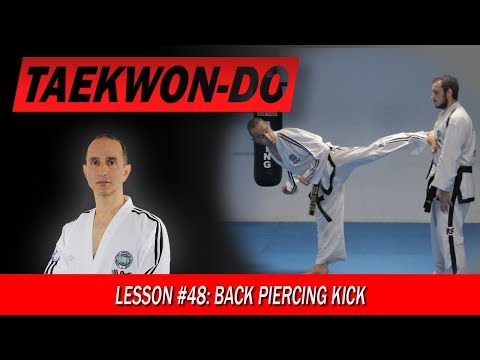
In this video I show you how to perform a Back Piercing Kick (Dwitcha Jirugi) I explain the application of the techniq…
The penetrating back kick, as taught by Donata Nardizzi, is a rear-directed striking technique using the foot sword (the blade of the foot) as the striking surface, distinguished from the heel strike which Nardizzi notes is incorrect according to Taekwondo Encyclopedia. The technique begins from bending ready stance type B, a preparatory posture involving a forward-pointing stance foot, raised knee at platform height with flat foot, slight forward lean, and bent elbow with fists held 25 centimeters from the thigh while looking behind. Execution involves extending the leg behind the body with minimal foot rotation—the foot sword rotates only slightly and toes point approximately 45 degrees downward to maintain hip position. Nardizzi emphasizes that excessive rotation elevates the hip and converts the technique into a side piercing kick, thus the back piercing kick requires disciplined hip control. Full knee extension at completion yields maximum power, though the kick can contact while the knee remains bent. Nardizzi prescribes four progressive practice stages: isolated kick from ready stance, kick without preparatory stance, forward-facing kick requiring prior rotation, and finally integrated execution from standing position. The technique differs from other back kicks such as back snap kick and back pushing kick, each serving distinct tactical purposes.
Сформировано на основе 2 инструкторов
Учебных курсов по этой технике пока нет.
Войдите, чтобы предложить курс.
Риск травмы для человека, к которому применяется техника
Linear alignment generates maximum force. Solar plexus strikes cause breathing failure; liver strikes cause collapse.
Уровень мастерства, необходимый для надёжного выполнения техники
Разрешена ли техника по основным соревновательным правилам
De Bremaeker, M. & Faige, R. (2010). Essential Book of Martial Arts Kicks. Tuttle Publishing.
[1] De Bremaeker & Faige, Essential Book of Martial Arts Kicks (2010), Section 4.1, pp. 145-147
Official karate technique names (和語/漢語)
Established Japanese martial arts naming convention — native Japanese term (和語/漢語)
[1] De Bremaeker & Faige, Essential Book of Martial Arts Kicks (2010), Section 4.1, pp. 145-147
sight target over shoulder, hip extension power, one-leg balance
gluteus maximus, hamstrings, quadriceps, core
Documented in De Bremaeker & Faige, Section 4.1. The standard thrusting back kick — the heel drives straight backward through the target. The most powerful kick in martial arts due to hip extension and full body weight alignment. (De Bremaeker & Faige, Essential Book of Martial Arts Kicks, 2010)
According to the Taekwondo Encyclopedia, you should use the ball of the foot, not the heel as some instructors incorrectly teach.
You should learn the bending ready stance type B, which is the proper preparatory stance for the back kick, as opposed to type A which is used for side piercing kick.
The Penetrating Back Kick is the foundational back kick — a straight-line thrust delivered backward using the heel, driving through the target with full hip extension. From fighting stance, the fighter looks over the shoulder to sight the target, chambers the kicking leg with the knee raised, and drives the heel straight back into the opponent's midsection.
The penetrating back kick (ushiro geri) is one of the most powerful kicks in traditional martial arts, practiced across taekwondo, karate, and kickboxing. The spine-hip-heel alignment allows maximum force transfer.
Unified MMA: Legal: разрешён — standard striking technique; WKF Karate: Legal: разрешён — controlled contact required; WT Taekwondo: Legal: разрешён — kicks are primary scoring technique; WAKO Kickboxing: Legal: разрешён — full contact permitted
Оценка опасности 8/10. Very High — linear alignment generates maximum force. Solar plexus strikes cause breathing failure; liver strikes cause collapse.
Стандартная цепочка подготовки: Counter → Feint a turn → deliver straight back kick instead of spin → Clinch break → back kick to create distance.
Стандартные контрприёмы: Angle off to the side / Wait for miss and counter on recovery / Don't rush forward — designed to punish forward movement.
Распространённые варианты: To the solar plexus (primary target); To the liver (fight-ending potential); To the head (requires flexibility and timing).
Frequently used in MMA (UFC, ONE Championship, Bellator), kickboxing (GLORY, K-1), and Muay Thai (Lumpinee, Rajadamnern). One of the most commonly thrown kicks in professional striking competition.
Основные ошибки, на которые стоит обратить внимание: Not looking at target — reduces accuracy / Kicking in an arc — becomes hook kick / Using ball of foot instead of heel / Not driving hip through.
Penetrating Back Kick также известен как Ushiro Geri, Back Thrust Kick, Dwi Chagi, Rear Straight Kick.