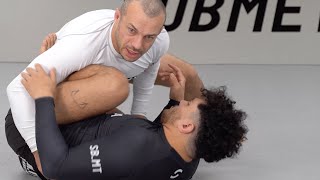
Importance of the Toreando Pass
The Toreando pass is considered foundational in Brazilian Jiu-Jitsu because leg control immediately upon contact determines offensive options. All successful passes require progressing to a chest-to-chest position over the opponent. Understanding this fundamental principle guides the technical approach.
Correct Approach Distance and Body Positioning
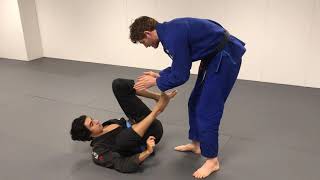
Practitioners commonly maintain excessive distance when approaching, fearing leg entanglement, which allows opponents to re-establish leg defense. The correct approach involves hinging at the hips, keeping legs relatively straight, and elbows back. This positioning creates a dangerous entry zone while preventing the opponent from controlling the passer's legs.
Assessing Opponent Leg Positioning
The opponent's leg placement determines which pass variations are available. When the opponent is flat on their back, the pass becomes more straightforward than when they are on their side. Passers must crowd the space and prevent the opponent's legs from extending outward to maintain control throughout the pass.
Managing Leg Height and Elevation
The vertical position of the opponent's feet significantly affects pass difficulty. Low feet are easier to clear and walk around, while elevated feet make leg control more challenging as they contact the passer's biceps. Extremely high legs risk stacking the opponent, requiring different finishing mechanics.
Palm Control and Leg Displacement
Using palms rather than grip initially allows the passer to respond dynamically to the opponent's positioning. The passer pushes the legs slightly to the side before stepping over, rather than backing away, which maintains proximity and prevents re-engagement of the opponent's defense. The stepping motion must proceed forward while keeping the body positioned above the opponent.
Positioning for Framing Resistance
When the passer comes over the opponent's torso from a high angle, framing attempts push the opponent into the mat rather than allowing escape. Conversely, lateral pressure allows the opponent to slide away when they frame. Maintaining vertical pressure directly downward prevents frame-based escapes.
Achieving Chest-to-Chest Positioning
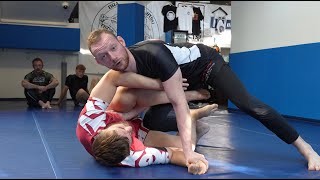
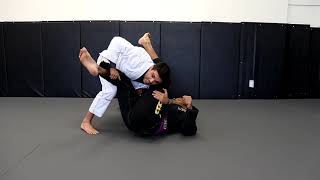
The intermediate goal is reaching a chest-over-chest position with the passer's upper leg high and lower leg near the opponent's hip, creating alignment along the center lines of both torsos. This position serves as the foundation for all finishing variations. Premature commitment to side control or neon belly can allow the opponent to defend with shin frames and leg repositioning.
Primary Finishing Mechanics
The Toreando pass concludes through two main mechanics: side control variations (including neon belly or traditional side control) or north-south position. The opponent's response to chest-to-chest positioning determines which finish becomes available. These options maintain the passer's positional superiority.
Managing Shoulder Frames and Neon Belly Transitions
When the opponent frames the passer's shoulder from the high chest-to-chest position, it generates minimal defensive effect due to the angle of applied force. The passer can then drop into neon belly while releasing the upper-arm control, using shoulder pressure to prevent leg lassos and threading attacks. Proximity and low positional control on the opponent's leg prevent 50-50 guard transitions.
Toreando Pass Comprehensive Guide
Key Takeaways
- •Importance of the Toreando Pass
- •Correct Approach Distance and Body Positioning
- •Assessing Opponent Leg Positioning
- •Managing Leg Height and Elevation
This video I go through in my opinion the most important pass to understand in jiu jitsu, the toreando pass. The toreando or bull fighter guard pass is so important because the first contact you will make with an opponent is dealing with their legs. Your ability to immediately attack allows you to control the pace of the match. I go through my system for understanding and attacking with this guard pass. more content on my site https://www.jonthomasbjj.com/collections Kimonos https://www.vitalkimonos.com/
Frequently Asked Questions
What does this video teach about toreando pass?
This video covers importance of the toreando pass, correct approach distance and body positioning, assessing opponent leg positioning. It provides detailed instruction from JonThomasBJJ.
How long does it take to learn toreando pass?
The basic mechanics can be understood in a single session, but developing reliable execution requires consistent drilling over weeks of practice. This 9-part breakdown helps structure your training by isolating each phase of the technique.
What are the key details for finishing toreando pass?
The Toreando pass concludes through two main mechanics: side control variations (including neon belly or traditional side control) or north-south position. The opponent's response to chest-to-chest positioning determines which finish becomes available. These options maintain the passer's positional superiority.