Pass the Knee Shield with These 3 Strategies
0
Knee Pass·Absolute MMA St Kilda - Melbourne
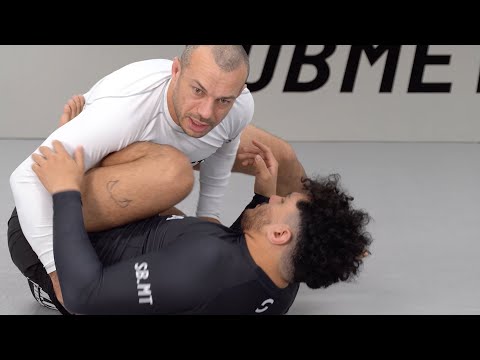
The knee shield is perhaps the most common method of blocking a guard pass, learn 3 basic ways to deal with this. For mo…
Not yet documented
The Knee Pass (knee cut / knee slice) family covers one of the most versatile and highest-percentage guard passing techniques in BJJ — driving one knee across the opponent's thigh while establishing a crossface with the upper body, slicing through the guard to achieve side control. [1] The knee cut pass is considered the Swiss Army knife of guard passing because it works against virtually every guard variation: closed guard (after breaking it open), half guard, De La Riva, butterfly, and open guard all have knee cut entries. [1],[2] The pass works from the 'headquarters' position (one knee up, one knee down between the opponent's legs) and uses diagonal forward pressure combined with the knee slice across the thigh to split the opponent's leg defence. [2],[3] The knee cut is often the first pass taught to intermediate students and remains the primary pass for many elite black belt competitors. [3]
The knee cut pass has been a staple of BJJ guard passing since the art's early development, with roots in judo ne waza passing. [1] It gained prominence as a primary competition pass in the 2000s-2010s as guard systems became more complex and the knee cut proved versatile against all of them. [1],[2]
The knee cut is one of the most commonly scored passes in IBJJF competition at all belt levels. [1]
No images yet for this technique.
Sign in to suggest an image.
The knee shield is perhaps the most common method of blocking a guard pass, learn 3 basic ways to deal with this. For mo…
No instructional courses yet for this technique.
Sign in to suggest a course.
Risk of injury to the person this technique is applied to
The knee cut is relatively safe; the primary risk is being caught in a half guard or deep half if the pass stalls, or the opponent attacking with an underhook during the pass
Skill level needed to execute this technique reliably
Whether this technique is allowed under major competition rule sets
Jiu-Jitsu University (Saulo Ribeiro, 2008)
Description sources — [1] Jiu-Jitsu University (Ribeiro, 2008) [2] BJJ competition passing analysis
Standard katakana transliteration of Western martial arts terminology (外来語) — used in Japanese MMA, boxing, and BJJ communities
Description sources — [1] Jiu-Jitsu University (Ribeiro, 2008) [2] BJJ competition passing analysis
crossface pressure, hip dexterity (dropping the hip after the cut), far-arm control
heavy upper body, strong crossface
shoulders (crossface), hip flexors (cutting motion), quadriceps (driving through), core (connecting upper and lower body)
Every move, in any martial art, shares a few universal traits. Mix and match below to pinpoint the right tool — or compare equivalents across styles.
The Backstep Pass is a guard passing technique where the passer steps backward and away from the guard player's legs, pivoting to pass from the back angle rather than driving forward through the guard — an unconventional passing direction that catches guard players expecting forward pressure. [1] The backstep also serves as the primary entry to leg lock positions (ashi garami) from the passing position, making it both a pass and a leg lock entry. [1,2]
The Knee-In-The-Middle Pass is a guard passing technique where the passer drives one knee directly through the centre of the opponent's guard, splitting the legs apart from the inside — a fundamental kneeling pass that works by establishing a wedge in the centre of the guard structure. [1] This differs from the knee slice (which goes diagonally across the thigh) by targeting the centre gap between the legs. [1,2]
The Knee Slice Pass is a specific variation of the knee cut where the passer drives the shin diagonally across the opponent's thigh in a slicing motion while establishing a crossface — the most commonly executed guard pass at black belt level in IBJJF competition. [1] The slice uses the shin as a wedge that splits the guard player's legs apart, with the sharp edge of the tibial crest creating a dividing line that the opponent's legs cannot cross. [1,2]
The knee cut/knee slide pass is the most commonly used guard pass in modern BJJ competition. It works in both gi and no-gi and chains into multiple positions. (Ribeiro, Jiu-Jitsu University; Danaher, Guard Passing instructionals)
According to Absolute MMA St Kilda, the key is to keep your torso and hips extremely close to your opponent's hips as you move in—any gap allows them to establish the knee shield. By maintaining chest-to-chest contact and blocking the knee shield before it fully forms, you prevent it from becoming a problem in the first place.
Absolute MMA St Kilda recommends using a goose neck grip on the knee, then briefly removing your chest pressure to fold the leg, and repositioning your chest on the outside of the leg. Alternatively, if the knee shield is slightly too high, come up into a tripod position to beat your opponent's frames and gain hip control.
Absolute MMA St Kilda emphasizes getting your hips low and arched up underneath the shield rather than hovering over the top—this creates a position where your opponent cannot effectively fight you opening their knee out.
According to Absolute MMA St Kilda, use your knee to press into your opponent's calf to open it. If they hook your foot, step on the mat and straighten that leg to clear the hook before opening their calf, lifting your foot, and stepping outside the legs.
The Knee Pass (knee cut / knee slice) family covers one of the most versatile and highest-percentage guard passing techniques in BJJ — driving one knee across the opponent's thigh while establishing a crossface with the upper body, slicing through the guard to achieve side control. The knee cut pass is considered the Swiss Army knife of guard passing because it works against virtually every guard variation: closed guard (after breaking it open), half guard, De La Riva, butterfly, and open guard all have knee cut entries.
The knee cut pass has been a staple of BJJ guard passing since the art's early development, with roots in judo ne waza passing. It gained prominence as a primary competition pass in the 2000s-2010s as guard systems became more complex and the knee cut proved versatile against all of them.
IBJJF: legal — Legal, guard pass scores 3 points; IJF: legal — Legal — transitioning past opponent's legs is part of newaza; ADCC: legal — Legal, guard pass scores 3 points; Unified MMA: legal — Legal; FIAS Sport Sambo: legal — Legal
Danger rating 3/10. Low — the knee cut is relatively safe; the primary risk is being caught in a half guard or deep half if the pass stalls, or the opponent attacking with an underhook during the pass
The standard setup chain: Establish Headquarters → Strip Guard Grips → Establish Crossface → Cut the Knee → Drop the Hip → Consolidate.
Standard counters include: Knee Shield — placing the shin across the passer's torso to prevent the cut / Underhook — fighting for the near-side underhook to prevent the crossface / Frame on the Hip — pushing against the cutting hip to create space / Deep Half Guard Entry — when the knee cut stalls, entering deep half guard.
Common variants: Standard knee cut (from headquarters through the thigh to side control [1]); Reverse knee cut (cutting to the opposite side); Knee cut with far-side underhook (controlling the far arm for additional security); Knee cut to mount (continuing the knee cut motion directly to mount instead …); Long step knee cut (stepping the far leg wide before the cut for additional base); Speed knee cut (explosive fast-twitch knee cut without heavy pressure [2]).
The knee cut is one of the most commonly scored passes in IBJJF competition at all belt levels.
Top errors to watch for: No crossface — the pass fails without head control; the opponent turns in and recovers / Knee cutting straight down instead of diagonally across — the diagonal angle is what creates the splitting force / Not controlling the far arm — the far-side frame enables guard recovery / Stalling in half guard — if the knee cut gets stuck, transition to another pass rather than grinding.
The Knee Pass is also known as Knee Cut, Knee Slide, Knee Through Pass.