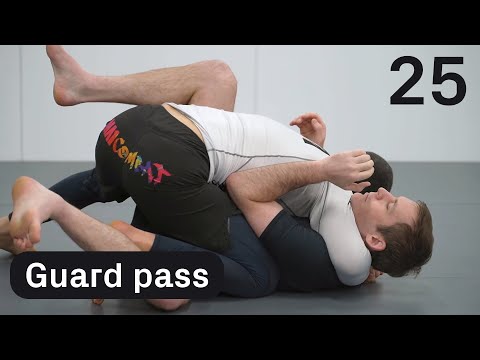
Basic Guard Pass
0
Fundamental Guard Pass·Absolute MMA St Kilda - Melbourne
Full Course Playlist → https://youtube.com/playlist?list=PLDrQXekZsfYZfV1QZ4T5UkxLwFwQ12EbP Find the Introduction course…
Translation: fundamental guard pass
The Fundamental Guard Pass family covers the core guard passing techniques that form the foundation of every grappler's passing game — the essential methods for navigating past the opponent's legs to achieve side control, mount, or back control. [1] This family includes the basic passes that every BJJ practitioner learns first: the standing guard break and toreando pass, the kneeling guard break with knee-through pass, the stack pass, and foundational passing concepts that apply regardless of the specific guard being passed. [1],[2] While modern BJJ has developed highly specialised passing systems (pressure passing, leg drag, body lock), all of them build upon the fundamental passing mechanics covered in this family — posture, base, grip control, and the ability to advance past the leg line while preventing guard recovery. [2],[3] Every BJJ World Champion has mastered these fundamental passes before developing their advanced passing systems. [3]
No images yet for this technique.
Sign in to suggest an image.
Full Course Playlist → https://youtube.com/playlist?list=PLDrQXekZsfYZfV1QZ4T5UkxLwFwQ12EbP Find the Introduction course…
No instructional courses yet for this technique.
Sign in to suggest a course.
Risk of injury to the person this technique is applied to
Moderate — fundamental passing is relatively safe; the primary risk is being caught in triangles, armbars, or guillotines during the passing attempt when the arms or head are positioned incorrectly
Skill level needed to execute this technique reliably
Whether this technique is allowed under major competition rule sets
Jiu-Jitsu University (Saulo Ribeiro, 2008)
Description sources — [1] Jiu-Jitsu University (Ribeiro, 2008) [2] Mastering Jujitsu (Gracie & Danaher, 2003) [3] BJJ competition analysis
Description sources — [1] Jiu-Jitsu University (Ribeiro, 2008) [2] Mastering Jujitsu (Gracie & Danaher, 2003) [3] BJJ competition analysis
hip mobility (hip switching), grip strength (controlling legs and stripping grips), balance (maintaining base during passing)
strong core, explosive hips, long arms
hip flexors/extensors, shoulders (crossface pressure), forearms (grip fighting), quadriceps (driving knee-cut)
Every move, in any martial art, shares a few universal traits. Mix and match below to pinpoint the right tool — or compare equivalents across styles.
The Butterfly Pass in MMA context combines pressure passing with striking, using strikes to disrupt the butterfly guard player's hooks before driving through. [1]
The DeSouza Special is an MMA-specific technique that converts a defended double-leg takedown attempt directly into a guard pass, bypassing the intermediate step of landing in the opponent's guard. [1] In standard MMA grappling, when a double-leg takedown is defended (the opponent sprawls or posts), the attacker typically either backs out and resets to striking range or continues wrestling from the front headlock/scramble position. [1] The DeSouza Special offers a third option: instead of abandoning the failed shot, the attacker drives through the opponent's defence, threading past the legs directly into a guard pass — arriving in side control or mount without ever entering the opponent's closed guard. [1] BJ Penn documented the technique in The Book of Knowledge (2007) as one of several 'failed shot' recovery options, noting that the transition from the double-leg position to the guard pass uses the opponent's sprawl as an anchor point — the opponent's hips are lowered from the sprawl, and the attacker uses this lowered hip position to drive over or around the legs rather than fighting to complete the original double-leg. [1] The tactical brilliance of the DeSouza Special is that it turns a defensive failure (the shot was stopped) into an offensive success (direct pass to dominant position) — the opponent, having successfully defended the takedown, believes the danger has passed, and the immediate transition to the guard pass catches them mentally unprepared. [1] The technique requires excellent mat awareness: the attacker must recognise in real-time that the double-leg has been defended and IMMEDIATELY convert to the pass rather than continuing to fight for the original takedown. [1]
The Esgrima Pass is a half guard passing technique where the passer uses a fencing-like leg threading motion — sliding the shin forward and through the opponent's half guard like a sword being drawn from a scabbard — to extract the trapped leg and establish mount or side control. [1] The name 'esgrima' (fencing in Portuguese) perfectly describes the mechanic: rather than muscling the leg free or using a wide circular motion, the passer slides the trapped shin forward along the opponent's inner thigh in a straight, blade-like motion that is difficult to resist because it follows the natural gap between the opponent's legs. [1] Saulo Ribeiro presents multiple Esgrima Pass variations in Jiu-Jitsu University, including the standard version, the Esgrima Mount (threading directly to mount rather than side control), and Fredson Alves' variation (named after the Ribeiro affiliate instructor who refined a specific grip and angle). [1] The Esgrima Pass is particularly effective against the lockdown and deep half guard — positions where many other passing methods fail because the bottom player's legs are tightly entangled with the passer's. [1] The key mechanical principle is that the pass uses a FORWARD sliding motion rather than a backward extraction: instead of trying to pull the trapped leg backward out of half guard (which the bottom player can resist by squeezing), the passer slides the shin FORWARD through the guard, using the top of the foot and the shin as a wedge that opens the bottom player's guard from the inside. [1] This forward sliding direction is counter-intuitive — most passers instinctively try to extract backward, which plays into the bottom player's squeezing strength — and this counter-intuitive nature is what makes the Esgrima Pass so effective once learned. [1]
The Floating Pass involves hovering above the opponent's guard without committing weight, then quickly floating past the legs when an opening appears. [1] Used primarily against reverse De La Riva guard. [1]
The Half Mount Pass transitions from half mount (where the passer has nearly passed but one leg is still trapped) to full mount or side control. [1] Ribeiro demonstrates the knee-cross variation. [1]
The Half Stack Pass combines stacking pressure with half guard passing, using the opponent's folded position to create space to extract the trapped leg. [1]
The Lemon Squeeze Pass compresses the opponent's half guard by squeezing the legs together like squeezing a lemon, forcing the guard open through pressure rather than technique. [1]
The Mike Pyle Special is a guard pass named after UFC veteran Mike Pyle, combining wrestling-based pressure with a specific leg threading movement to bypass the open guard. [1]
The No Hand Pass to Mount bypasses the half guard using hip pressure and weight distribution alone, without relying on arm grips or underhooks. [1] The passer uses their hips to slide through the half guard directly to mount. [1]
The No Hand Pass to Side Control is the side control variant of the no-hands passing concept, using pressure and hip movement to clear the half guard. [1]
The Open Guard Stack Pass in MMA involves stacking the opponent's legs overhead while maintaining posture for strikes, transitioning from striking to passing in one movement. [1]
The Opposite Side Pass exits the half guard by passing to the opposite side from where the opponent expects, using an underhook and hip switch to reverse direction. [1]
The Shin Slide Pass uses the shin to slide across the opponent's thigh while passing half guard, maintaining heavy pressure throughout. [1]
The Shin-to-Shin Pass uses shin-on-shin pressure to collapse the opponent's open guard frame, driving through with forward pressure. [1]
The Stand-Up Wheel Pass is a standing guard pass using a circular stepping motion to bypass the opponent's legs. [1]
Xande's Flattening Pass is a half guard passing technique developed by Xande Ribeiro that focuses on flattening the opponent before extracting the trapped leg. [1] The emphasis is on crushing pressure rather than speed. [1]
The X Pass is a fundamental open guard pass where the passer steps to the side and drives the knee across while controlling the opponent's legs. [1] It is one of the simplest and most effective open guard passes. [1]
Guard passing appears in 289 passages across 19 books. The single most important skill in top-game BJJ — without passing the guard, the top player cannot achieve dominant position. Andre Galvao, Rodolfo Vieira, and Gordon Ryan are considered the greatest guard passers in competition history. (19 books; BJJ competition records)
Pinning the legs first stops your opponent from bringing their knee towards their chest and makes it hard for them to move away and escape. Looking for upper body control without pinning the leg exposes you to having your opponent keep their leg in the way or push you back into guard.
A cross face involves reaching your arm across the face and gripping underneath the far shoulder to turn your opponent away, making it difficult for them to face you and escape. An underhook means reaching underneath your opponent's arm, which is a critical battle for establishing control between the shoulders and knees.
Putting your hand too high and pressuring too high with the cross face is a common mistake. Instead, you want to make sure your hand goes low and your shoulder goes underneath the chin.
You need to make sure you stay below the line of the elbow when underhooking. If you underhook at least below the elbow line, your opponent can't bring their elbow back if they try to re-establish position, allowing you to connect your hands.
The Fundamental Guard Pass family covers the core guard passing techniques that form the foundation of every grappler's passing game — the essential methods for navigating past the opponent's legs to achieve side control, mount, or back control. This family includes the basic passes that every BJJ practitioner learns first: the standing guard break and toreando pass, the kneeling guard break with knee-through pass, the stack pass, and foundational passing concepts that apply regardless of the specific guard being passed.
Fundamental guard passing developed as the necessary counterpart to the Gracie guard system. Early BJJ passing was relatively simple — stack passes and basic toreando movements — before the modern passing revolution of the 2000s–2010s.
IBJJF: legal — Legal, guard pass scores 3 points; IJF: legal — Legal — transitioning past opponent's legs is part of newaza; ADCC: legal — Legal, guard pass scores 3 points; Unified MMA: legal — Legal; FIAS Sport Sambo: legal — Legal
Danger rating 3/10. Low-moderate — fundamental passing is relatively safe; the primary risk is being caught in triangles, armbars, or guillotines during the passing attempt when the arms or head are positioned incorrectly
The standard setup chain: Establish Base → Strip Grips → Break Guard → Initiate Pass → Navigate Legs → Consolidate.
Standard counters include: Guard Retention — hip movement and frames to prevent the pass / Sweep — timing a sweep as the passer commits / Submission — triangles, armbars, guillotines during passing / Inversion — going upside down to recover guard when nearly passed.
Common variants: Toreando (bullfighter) pass (standing, grip both pant legs, throw to one side and step…); Knee-cut (knee slice) pass (driving one knee across the opponent's thigh while establ…); Stack pass (compressing the opponent by driving their legs over their…); Standing break to over-under (standing to break the guard, then dropping to one side fo…); X-pass (standing, stepping one leg over the opponent's shin and d…).
Guard pass scores 3 points in IBJJF/ADCC — it is one of the highest-scoring actions. Toreando and knee-cut remain the most commonly executed passes at all belt levels.
Top errors to watch for: Passing without stripping grips — attempting to pass while the guard player controls sleeves/collar results in sweeps… / Leaning too far forward — over-committing past the legs invites triangles and back takes / Not consolidating after passing — celebrating the pass before establishing crossface lets the opponent recover guard / Only passing to one side — predictable passers are swept; develop passes to both sides.
The Fundamental Guard Pass is also known as Fandamentaru Gādo Pasu, Guard Pass Technique, Passing Technique, Guard Navigation.