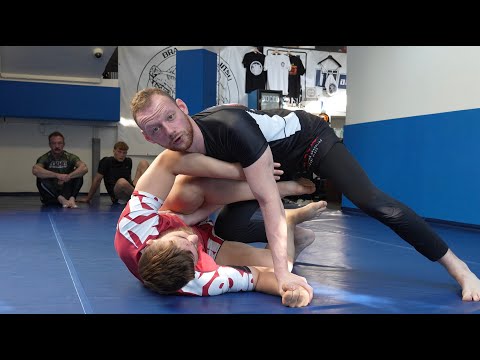
Pass with pressure.
0
Pressure Pass·Dima Murovanni Bjj
This is a video from my Patreon https://www.patreon.com/c/dimamurovanni Passing isn’t just technique vs. technique—it’s …
Not yet documented
The Pressure Pass family covers guard passing techniques that use heavy bodyweight, chest-to-chest compression, and methodical forward drive to flatten the guard player, immobilise their hips, and slowly advance past their legs — the grinding, dominant approach to guard passing favoured by heavier grapplers and competitors who prefer control over speed. [1] Pressure passing is exemplified by the over-under pass (one arm under the leg, one arm over), the smash pass (driving the opponent's legs to one side and flattening them), and Bernardo Faria's signature half guard pressure system. [1],[2] The philosophy of pressure passing is that the guard player's offensive tools (sweeps, submissions) require hip movement — heavy pressure eliminates hip movement, reducing the guard player to a passive recipient of the pass. [2],[3] Pressure passing is considered the most reliable passing approach against dangerous guard players because it minimises risk and creates an inescapable grinding advance. [3]
Pressure passing has existed since the earliest BJJ guard interactions but was systematised and popularised by Bernardo Faria (5x IBJJF World Champion), who built his entire competitive career on the over-under pressure pass. [1] Gordon Ryan further evolved pressure passing with his body lock passing system, demonstrating its effectiveness at the ADCC level. [1],[2]
No images yet for this technique.
Sign in to suggest an image.
This is a video from my Patreon https://www.patreon.com/c/dimamurovanni Passing isn’t just technique vs. technique—it’s …
No instructional courses yet for this technique.
Sign in to suggest a course.
Risk of injury to the person this technique is applied to
Pressure passing is one of the safest passing approaches because the passer maintains constant heavy contact, reducing the guard player's offensive options; the primary risk is the guard player attempting submissions during the pass transitions
Skill level needed to execute this technique reliably
Whether this technique is allowed under major competition rule sets
Pressure Passing (Bernardo Faria, BJJ Fanatics instructional)
Description sources — [1] Bernardo Faria's competition career and teaching [2] Gordon Ryan's body lock system
Standard katakana transliteration of Western martial arts terminology (外来語) — used in Japanese MMA, boxing, and BJJ communities
Description sources — [1] Bernardo Faria's competition career and teaching [2] Gordon Ryan's body lock system
bodyweight distribution skill, hip switching, patience
heavy bodyweight (more pressure), wide chest/shoulders, cardio endurance (maintaining pressure is tiring)
chest (pressure surface), core (hip switching), shoulders (crossface), hips (dropping weight)
Every move, in any martial art, shares a few universal traits. Mix and match below to pinpoint the right tool — or compare equivalents across styles.
The Body Lock Pass is a modern pressure-based guard pass where the passer secures a body lock (arms locked around the opponent's waist/hips) and uses heavy forward drive to pass the guard — the technique that defined Gordon Ryan's dominance at ADCC 2019 and 2022. [1] The body lock provides the most secure connection between the passer and the guard player, preventing the guard player from creating distance, re-guarding, or disengaging. [1,2] Ryan systematised the body lock pass as part of his comprehensive passing hierarchy: secure the body lock, establish heavy pressure, and methodically advance past the legs using hip-switching and leg-clearing techniques while the body lock prevents the guard player from adjusting. [2,3] The body lock pass has become the dominant passing strategy in modern no-gi grappling because it doesn't rely on gi grips. [3]
The Double Under Pass is a classic pressure pass where the passer threads both arms under the opponent's legs, stacks them by walking forward, and passes around the compressed guard — one of the most powerful closed guard and open guard passes in BJJ, particularly effective against guard players who rely on hip-based attacks. [1] With both arms under the legs, the passer can control the opponent's entire lower body, stack them to eliminate hip movement, and choose to pass left or right based on the opponent's defensive reactions. [1,2] The double under position is also a powerful defensive tool — when caught in an armbar from guard, securing double unders and stacking is the primary escape. [2,3]
The Leg Weave Pass is a pressure-based guard pass where the passer weaves one arm through and around the opponent's legs, creating a configuration that pins one leg while clearing the other — a methodical pass that combines elements of the over-under and the smash pass. [1] The weaving arm threads through the guard structure, immobilising one leg and creating a clear lane to pass on the unweaved side. [1,2]
The Over-Under Pass is the signature pressure pass where the passer secures one arm OVER the opponent's far leg and one arm UNDER the near leg, clasps the hands, and drives heavy chest pressure to flatten and advance past the guard — the technique that defined Bernardo Faria's 5x World Championship career. [1] The over-under configuration creates a split in the guard player's leg defence, with each arm controlling one leg in a different direction, making it impossible for the guard player to use both legs defensively. [1,2] This is the quintessential 'grinding' pass — slow, methodical, heavy, and nearly inescapable when properly applied. [2,3]
The Stack Pass is a pressure-based guard pass where the passer drives the opponent's legs over their head by walking forward with chest pressure, compressing the guard player's spine until their hips leave the mat and their guard structure collapses — one of the most powerful and demoralising passes in BJJ. [1] The stack exploits the guard player's flexibility limit — by walking the hips forward while driving chest-to-chest, the passer progressively bends the guard player in half until their legs are over their head, at which point passing around the compressed legs is straightforward. [1,2] The stack pass is particularly effective against closed guard and against guard players who rely on hip movement (shrimping), because the stacking action pins the hips above the head, eliminating all hip-based defence. [2,3]
Pressure passing uses body weight and slow, methodical advancement to flatten the opponent's guard. Bernardo Faria's over-under pass and pressure half-guard passing are the gold standard. (Ribeiro, Jiu-Jitsu University)
According to Dima Murovanni, when you collapse your weight into proper position during a pressure pass, the defender has only two options: explode or get passed. The key is positioning yourself so that the defender must choose between these two outcomes.
Dima Murovanni explains that technical pressure is superior to relying on weight alone. Technical pressure comes from proper positioning—for example, if your opponent extends their leg, you can step over; if they don't extend, you can pump the pass. This allows the technique to work regardless of size differences.
By positioning yourself to collapse your full weight onto your opponent in a controlled way, you force them to work against your weight placement rather than letting them stay passive. This creates the pressure that limits their defensive options.
The Pressure Pass family covers guard passing techniques that use heavy bodyweight, chest-to-chest compression, and methodical forward drive to flatten the guard player, immobilise their hips, and slowly advance past their legs — the grinding, dominant approach to guard passing favoured by heavier grapplers and competitors who prefer control over speed. Pressure passing is exemplified by the over-under pass (one arm under the leg, one arm over), the smash pass (driving the opponent's legs to one side and flattening them), and Bernardo Faria's signature half guard pressure system.
Pressure passing has existed since the earliest BJJ guard interactions but was systematised and popularised by Bernardo Faria (5x IBJJF World Champion), who built his entire competitive career on the over-under pressure pass. Gordon Ryan further evolved pressure passing with his body lock passing system, demonstrating its effectiveness at the ADCC level.
IBJJF: legal — Legal, guard pass scores 3 points; IJF: legal — Legal — transitioning past opponent's legs is part of newaza; ADCC: legal — Legal, guard pass scores 3 points; Unified MMA: legal — Legal; FIAS Sport Sambo: legal — Legal
Danger rating 3/10. Low — pressure passing is one of the safest passing approaches because the passer maintains constant heavy contact, reducing the guard player's offensive options; the primary risk is the guard player attempting submissions during the pass transitions
The standard setup chain: Establish Contact → Strip Grips → Establish Passing Grip → Drive Pressure → Advance → Consolidate.
Standard counters include: Frame and Shrimp — creating distance through frames and hip escape / Underhook from Half Guard — fighting for the underhook to prevent flattening / Inverting — going upside down to recover guard when being stacked / Sweeping During Transition — timing a sweep as the passer shifts weight.
Common variants: Over-under pass (arms over and under the legs with chest pressure; the sig…); Smash pass (driving the opponent's legs to one side with shoulder pre…); Body lock pass (securing a body lock around the hips and driving through …); Half guard pressure (crossface and underhook from top half guard with flatteni…); Stack pass (driving the opponent's legs over their head with forward …); Double under pass (both arms under the legs with stacking pressure).
Bernardo Faria won 5 IBJJF World Championships with pressure passing. Gordon Ryan dominated ADCC 2019 and 2022 with body lock passing.
Top errors to watch for: Hips too high — high hips create space for the guard player; drop the hips flat and heavy / Rushing the pass — pressure passing is slow by design; hurrying creates scrambles / Not maintaining chest contact — lifting the chest to advance creates space for guard retention / Ignoring grips — the guard player's grips enable their defence; strip grips while maintaining pressure.
The Pressure Pass is also known as Smash Pass, Heavy Pass, Grinding Pass.