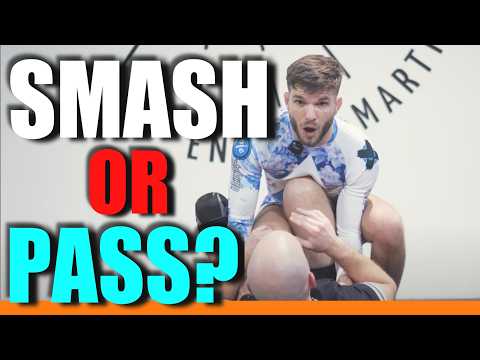
Headquarters PASSING system | 4 ways to pass
0
Headquarters Pass·Energia Martial Arts
Headquarters PASSING system | 4 ways to pass Passing the open guard is hard! Especially in no-gi with a huge lack of gri…
Not yet documented
The Headquarters Pass family covers passing techniques from the 'headquarters' stance — the kneeling position with one knee up (foot flat on the mat) and one knee down, positioned between the opponent's legs, which serves as the central launching pad for multiple guard passes. [1] The headquarters position is considered the most tactically versatile passing stance because from this single position, the passer can launch a knee cut pass (to the knee-up side), a backstep pass (to the other side), a toreando (by standing up), or a leg drag (by gripping and pulling). [1],[2] The term 'headquarters' was popularised by BJJ instructors who recognised that this position is the 'base of operations' from which all passing decisions are made — the passer reads the guard player's reaction from headquarters and chooses the appropriate pass. [2],[3] Headquarters has become the standard intermediate passing position in modern BJJ, replacing the older approach of choosing a specific pass before engaging the guard. [3]
The headquarters position was codified as a passing concept in the 2010s as BJJ instruction became more systematic. [1] While the kneeling stance between the opponent's legs has existed since BJJ's earliest era, naming it 'headquarters' and teaching it as a deliberate decision-making position was a modern pedagogical innovation. [1],[2]
Headquarters was codified as a named passing concept in the 2010s within modern BJJ instruction. [1]
Headquarters is the most commonly used intermediate passing position in IBJJF competition. [1]
No images yet for this technique.
Sign in to suggest an image.
Headquarters PASSING system | 4 ways to pass Passing the open guard is hard! Especially in no-gi with a huge lack of gri…
No instructional courses yet for this technique.
Sign in to suggest a course.
Risk of injury to the person this technique is applied to
Headquarters is a relatively stable position; the primary risk is being swept from the kneeling stance or pulled into guard
Skill level needed to execute this technique reliably
Whether this technique is allowed under major competition rule sets
Jiu-Jitsu University (Saulo Ribeiro, 2008)
Description sources — [1] Modern BJJ passing instruction [2] Competition passing analysis
Standard katakana transliteration of Western martial arts terminology (外来語) — used in Japanese MMA, boxing, and BJJ communities
Description sources — [1] Modern BJJ passing instruction [2] Competition passing analysis
balance (kneeling stance), grip fighting, tactical awareness (reading the guard)
mobile hips, quick reactions, multi-directional passing ability
quadriceps (maintaining the stance), core (balance), forearms (grip fighting)
Every move, in any martial art, shares a few universal traits. Mix and match below to pinpoint the right tool — or compare equivalents across styles.
Stepping your inside leg too far in can give your opponent attacks on your leg. Instead, control your partner's legs as you step in and get an inside position, keeping your knee close to their body to prevent them from wrestling up.
Weight distribution is critical—keep your knee on the inside and your other foot close by for stability. Position your hands on the inside (hips, armpits, or inside of the armpits on the mat) so you can lean in effectively.
The more your opponent resists the smash pass, the more you should transition into a knee cut pass. Similarly, if they resist the knee cut, you pivot back to the smash pass.
Don't slide to two knees immediately or put your knees on the mat too early, as this creates too much space and allows your opponent to recover their guard. Instead, keep your weight into your partner and maintain control of the arm as you pass.
The Headquarters Pass family covers passing techniques from the 'headquarters' stance — the kneeling position with one knee up (foot flat on the mat) and one knee down, positioned between the opponent's legs, which serves as the central launching pad for multiple guard passes. The headquarters position is considered the most tactically versatile passing stance because from this single position, the passer can launch a knee cut pass (to the knee-up side), a backstep pass (to the other side), a toreando (by standing up), or a leg drag (by gripping and pulling).
The headquarters position was codified as a passing concept in the 2010s as BJJ instruction became more systematic. While the kneeling stance between the opponent's legs has existed since BJJ's earliest era, naming it 'headquarters' and teaching it as a deliberate decision-making position was a modern pedagogical innovation.
IBJJF: legal — Legal, guard pass scores 3 points; IJF: legal — Legal — transitioning past opponent's legs is part of newaza; ADCC: legal — Legal, guard pass scores 3 points; Unified MMA: legal — Legal; FIAS Sport Sambo: legal — Legal
Danger rating 3/10. Low — headquarters is a relatively stable position; the primary risk is being swept from the kneeling stance or pulled into guard
The standard setup chain: Break/Open Guard → Drop to Headquarters → Read the Guard → Strip Grips → Choose Pass Direction → Execute.
Standard counters include: De La Riva Hook — hooking the raised knee side to off-balance / Sleeve Grips — controlling the passer's arms from guard / Butterfly Hook — inserting a hook under the kneeling knee for elevation / Collar Tie — gripping the collar to control posture from guard.
Common variants: Standard headquarters (one knee up, one knee down between the legs [1]); Low headquarters (both knees down but one hip loaded forward; more pressure…); High headquarters (standing with one leg forward and one back; more mobile); Combat base (a related stance with one knee up, used for stability in …).
Headquarters is the most commonly used intermediate passing position in IBJJF competition.
Top errors to watch for: Sitting in headquarters too long — headquarters is a launch pad, not a base camp; lingering allows the guard player t… / Only passing to one side — headquarters' value is multi-directional passing; using only the knee cut makes you predic… / Not strip-gripping — allowing the guard player to establish deep grips from headquarters makes passing from any direc… / Knees too close together — the knees should be at least shoulder-width apart for base and mobility.
The Headquarters Pass is also known as HQ Pass, Headquarters Position, Combat Base Pass.