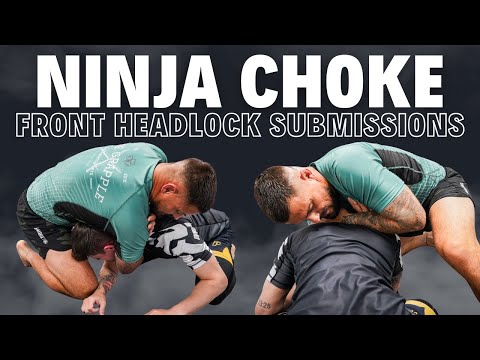
Ninja Choke | Schultz Choke | Anaconda Choke | Front Headlock Submissions
0
Front Headlock Choke·KD Grappling | Kieran Davern
In this video I break down some of my favourite submissions from the front headlock position, including the Ninja Choke,…
Translation: Front Headlock Choke (katakana loanword)
Front headlock chokes are submissions applied from a front headlock position — where the attacker controls the opponent's head and one arm from the front, typically after a sprawl or snap-down. [1] This family includes the guillotine choke (mae-hadaka-jime), the anaconda choke, the D'Arce/Brabo choke, the Peruvian necktie, and various head-and-arm wrapping variations. The guillotine choke — applied by wrapping an arm around the opponent's neck from the front and squeezing — is one of the most common submissions in MMA, effective from standing, in the clinch, and from guard. [1] The anaconda and D'Arce chokes use an arm-in configuration where the attacker threads an arm through the space between the opponent's head and arm, creating a figure-four compression against the neck. [3] Front headlock positions are high-value transitional positions in both wrestling and grappling.
The guillotine choke has roots in catch wrestling's front chancery and Japanese judo's mae-hadaka-jime (front naked strangle). [2],[3] In modern grappling, the guillotine became a signature technique of Marcelo Garcia, who developed the 'Marcelotine' — a high-elbow guillotine variation with devastating effectiveness. The D'Arce choke is named after Joe D'Arce, a BJJ black belt who popularized the arm-in variation in the early 2000s; it is also called the Brabo choke after Milton Vieira, who independently developed the same technique in Brazil. [3] The anaconda choke gained popularity through Nogueira brothers' use in PRIDE Fighting Championships.
The front headlock is one of the most dominant submission positions in no-gi grappling, offering access to guillotines, D'Arces, anacondas, Peruvian neckties, and numerous other chokes — collectively among the highest-finishing submission families in competition [1]
Front headlock control has roots in wrestling and catch wrestling. The submission possibilities were systematically developed by Marcelo Garcia, John Danaher, and 10th Planet Jiu-Jitsu through the 2000s-2020s [1]
Front headlock chokes collectively account for a significant percentage of no-gi submission finishes at ADCC, no-gi worlds, and in MMA. The position is considered essential at all competitive levels [1]
No images yet for this technique.
Sign in to suggest an image.
In this video I break down some of my favourite submissions from the front headlock position, including the Ninja Choke,…
No instructional courses yet for this technique.
Sign in to suggest a course.
Risk of injury to the person this technique is applied to
Front headlock position enables powerful guillotine and anaconda variants
Skill level needed to execute this technique reliably
Whether this technique is allowed under major competition rule sets
Wikipedia ja (フロントチョーク); Japanese BJJ community
Japanese Wikipedia — martial arts technique articles
Standard katakana transliteration of Western martial arts terminology (外来語) — used in Japanese MMA, boxing, and BJJ communities
Japanese terminology sourced from Wikipedia ja (フロントチョーク); Japanese BJJ community
forearm and grip strength, hip flexibility for guard retention
longer arms for deeper chin-strap wrap
forearm flexors, biceps, hip flexors
Every move, in any martial art, shares a few universal traits. Mix and match below to pinpoint the right tool — or compare equivalents across styles.
The D'Arce choke from turtle is a species where the head-and-arm strangle is applied against an opponent who has assumed the turtle (all-fours) position. [1] The attacker positions to the side of the turtled opponent, slides the near arm under the chin and through the gap between the neck and the far arm, threading until a figure-four or palm-to-palm grip can be locked on the far side. [1,2] The turtle position exposes the neck-and-arm channel because the opponent's elbows are typically planted on the mat, creating a natural gap for the D'Arce thread. [2] Once the grip is secured, the attacker rolls the opponent to their side or sprawls heavy to complete the compression. [2,3] This entry is particularly common in wrestling-heavy grappling where opponents frequently turtle to avoid guard passes. [3]
The forearm-wrap guillotine is the classical guillotine choke — the attacker wraps one arm around the opponent's neck from the front, clasps hands, and squeezes while pulling upward to compress the throat and/or carotids. [1,2] Variations include the high-elbow guillotine (Marcelotine), which uses an elevated elbow position to create a tighter seal and more effective blood choke, and the arm-in guillotine, which traps the opponent's arm alongside the neck. [3]
Fulcrum front headlock chokes use the attacker's body (typically the hip, shoulder, or posted arm) as a fulcrum point to amplify the choking pressure from a front headlock position. [1,2] Rather than relying solely on arm strength, the attacker drives the opponent's neck into a fixed point while applying a headlock, creating leverage-based compression. [3]
Gator-roll wraps combine a front headlock choke grip with a rolling motion (the 'gator roll') to take the opponent to the ground while maintaining choking pressure. [1] The anaconda choke is the defining technique: the attacker threads an arm from the inside (opposite direction from a D'Arce), locks a figure-four around the head and arm, then performs a gator roll to tighten the squeeze and land in a dominant finishing position. [2,3]
The cattle choke from standing headlock is a species where the bulldog-style compression strangle is applied while both practitioners are on their feet, with the attacker controlling the opponent's head in a standing headlock. [1] The attacker wraps one arm tightly around the opponent's neck from the side, trapping the head against the attacker's ribcage, then reinforces with the free hand to squeeze both sides of the neck simultaneously. [1,2] Standing application adds the threat of snap-down or takedown as auxiliary pressure, compelling the opponent to fight the choke while also managing balance and takedown defence. [2] This species is frequently seen in MMA and self-defence contexts where the fight begins on the feet. [2,3] The attacker may finish standing or transition to the ground while maintaining the choke throughout. [3]
The Japanese Necktie is a front headlock choke/crank hybrid that combines elements of the D'Arce choke and the front headlock guillotine — the attacker threads the choking arm under the opponent's armpit and around the neck from the front headlock position, using a figure-four or clasp grip to create bilateral compression. [1] The technique creates both a choking/strangling action and a cervical crank simultaneously, making it extremely uncomfortable and difficult to defend. [1,2]
Necktie-lever chokes use a necktie grip (arm draped over the back of the opponent's neck) combined with a leg or body lever to apply choking pressure. [1] The Peruvian necktie is the primary technique: the attacker secures a front headlock, steps a leg over the opponent's back, and sits back, using the leg as a lever to drive the forearm into the throat. [2,3]
Reverse-wrap front chokes apply choking pressure from the front headlock using a reverse grip configuration — the choking arm wraps in the opposite direction from a standard guillotine. [1] This can involve wrapping the arm from the far side of the neck, or using an inverted grip that creates compression from a different angle than the standard front choke. [2,3]
The wrist choke from front headlock is a species of the wrist-control-assisted front choke family where the attacker uses the bony edge of their own wrist as the primary choking surface against the opponent's neck. [1] From a standard front headlock position, the attacker drives the radial bone (wrist bone) across the opponent's throat or carotid arteries while the opposite hand controls the back of the head, preventing escape. [1,2] Unlike forearm-based chokes that use the soft inner forearm, the wrist choke concentrates pressure on a narrow, hard surface — the distal radius — creating intense localised compression. [2] The front headlock provides the necessary head control to keep the opponent's neck pressed firmly against the wrist. [2,3] This technique is legal in most rulesets but can cause significant discomfort even at low pressure levels. [3]
According to Kieran Davern, when your palm faces down, your elbow can't go high enough to properly apply the shoulder choke. With your palm facing up, you can raise your elbow higher, which is essential for driving the blade of your forearm effectively into the neck.
Kieran Davern teaches that you should imagine holding a football between your arm and lap—nestling the opponent's head between your rib cage and bicep. Then bring both elbows up toward your head while keeping the opponent's head trapped in this position.
Kieran Davern emphasizes placing your ear into the opponent's armpit while keeping their elbow away from their body and raising your elbow high, which controls their position and opens up multiple finishing options including the ninja choke.
Kieran Davern recommends using a chin strap to expose the neck, then bringing the opponent's head from one shoulder to the other (e.g., right to left) to bring the neck high before locking up the choke.
Front headlock chokes are submissions applied from a front headlock position — where the attacker controls the opponent's head and one arm from the front, typically after a sprawl or snap-down. This family includes the guillotine choke (mae-hadaka-jime), the anaconda choke, the D'Arce/Brabo choke, the Peruvian necktie, and various head-and-arm wrapping variations.
The guillotine choke has roots in catch wrestling's front chancery and Japanese judo's mae-hadaka-jime (front naked strangle). In modern grappling, the guillotine became a signature technique of Marcelo Garcia, who developed the 'Marcelotine' — a high-elbow guillotine variation with devastating effectiveness.
IBJJF: legal — Legal at all belt levels, gi and no-gi — chokes are the safest submission cat…; IJF: legal — Legal (shime-waza) — strangulation techniques are one of three permitted subm…; ADCC: legal — Legal; Unified MMA: legal — Legal — choke submissions are among the most common finishes in MMA; FIAS Sport Sambo: banned — All chokes prohibited in Sport Sambo; FIAS Combat Sambo: legal — Legal
Danger rating 7/10. Very High — front headlock position enables powerful guillotine and anaconda variants
The standard setup chain: Achieve Controlling Position → Isolate the Neck → Set the Grip → Apply Pressure.
Standard counters include: Tuck Chin — protect the neck by lowering the chin to prevent the choke from sinking / Two-on-One Grip Fight — use both hands to strip the choking grip before it locks / Turn Into — rotate toward the choking arm to relieve carotid pressure / Posture Up — straighten the spine and create distance to break the choking angle.
Common variants: Arm-in guillotine (traps the opponent's arm inside the choke for additional …); High-elbow guillotine (Marcelotine) (elevates the elbow above the head for stronger carotid co…); Standing guillotine (finished from the feet without pulling guard); Power guillotine (chin-strap grip with a rear-naked-choke-style finish for …).
Front headlock chokes collectively account for a significant percentage of no-gi submission finishes at ADCC, no-gi worlds, and in MMA.
Top errors to watch for: Only knowing guillotines from front headlock — the position supports 5+ choking subfamilies; limiting yourself to gui… / Not establishing control before attacking — the front headlock must be secure (head trapped, hips driving) before att… / Attempting front headlock chokes from inferior position — these are top/neutral attacks; from bottom, the headlock la… / Not switching between subfamilies when one is defended — the opponent defends the guillotine? Try the D'Arce. D'Arce ….
The Front Headlock Choke is also known as Furonto Heddorokku Chōku, Mae-hadaka-jime, Front Choke, Front Headlock Submissions.