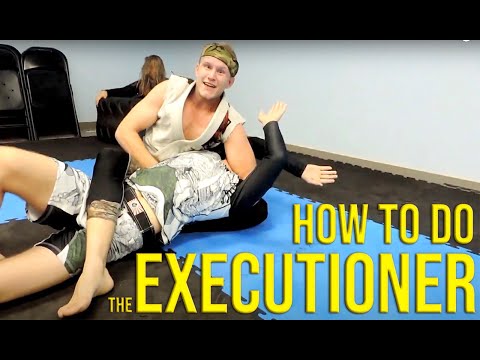
HOW TO DO THE REVERSE GUILLOTINE CHOKE EXECUTIONER BJJ JIU JITSU
0
Reverse Wrap Front Choke·Redneckjiujitsu
Master Gator demostrates the "Make America Great Again" Submission on Jiu Jitsu Black Belt Jon Van Buren
Translation: Front Headlock Choke (katakana loanword)
Reverse-wrap front chokes apply choking pressure from the front headlock using a reverse grip configuration — the choking arm wraps in the opposite direction from a standard guillotine. [1] This can involve wrapping the arm from the far side of the neck, or using an inverted grip that creates compression from a different angle than the standard front choke. [2],[3]
The reverse wrap mechanic provides an alternative angle of attack from front headlock, maintaining head control while redirecting choking pressure to the far side of the neck [1]
Developed as part of the comprehensive front headlock submission system explored by Danaher, Marcelo Garcia, and modern no-gi competitors [1]
The reverse wrap principle has produced competition finishes primarily at regional and national no-gi events [1]
No images yet for this technique.
Sign in to suggest an image.
Master Gator demostrates the "Make America Great Again" Submission on Jiu Jitsu Black Belt Jon Van Buren
No instructional courses yet for this technique.
Sign in to suggest a course.
Risk of injury to the person this technique is applied to
Reverse-wrap chokes use an inverted grip pattern from front headlock for a different angle of attack
Skill level needed to execute this technique reliably
Whether this technique is allowed under major competition rule sets
Wikipedia ja (フロントチョーク); Japanese BJJ community
Japanese Wikipedia — martial arts technique articles
Standard katakana transliteration of Western martial arts terminology (外来語) — used in Japanese MMA, boxing, and BJJ communities
Japanese terminology sourced from Wikipedia ja (フロントチョーク); Japanese BJJ community
forearm and grip strength, hip flexibility for guard retention
longer arms for deeper chin-strap wrap
forearm flexors, biceps, hip flexors
Every move, in any martial art, shares a few universal traits. Mix and match below to pinpoint the right tool — or compare equivalents across styles.
You end up in side control after executing the freedom flip, from which you can transition into the technique.
Step over and come back around to re-establish control when your opponent pushes into you aggressively.
Reverse-wrap front chokes apply choking pressure from the front headlock using a reverse grip configuration — the choking arm wraps in the opposite direction from a standard guillotine. This can involve wrapping the arm from the far side of the neck, or using an inverted grip that creates compression from a different angle than the standard front choke.
Reverse-wrap variations developed in modern BJJ and MMA competition as practitioners explored alternative angles from the front headlock position.
IBJJF: legal — Legal at all belt levels, gi and no-gi — chokes are the safest submission cat…; IJF: legal — Legal (shime-waza) — strangulation techniques are one of three permitted subm…; ADCC: legal — Legal; Unified MMA: legal — Legal — choke submissions are among the most common finishes in MMA; FIAS Sport Sambo: banned — All chokes prohibited in Sport Sambo; FIAS Combat Sambo: legal — Legal
Danger rating 8/10. Reverse-wrap chokes use an inverted grip pattern from front headlock for a different angle of attack
The standard setup chain: Achieve Controlling Position → Isolate the Neck → Set the Grip → Apply Pressure.
Standard counters include: Tuck Chin — protect the neck by lowering the chin to prevent the choke from sinking / Two-on-One Grip Fight — use both hands to strip the choking grip before it locks / Turn Into — rotate toward the choking arm to relieve carotid pressure / Posture Up — straighten the spine and create distance to break the choking angle.
Common variants: Arm-in guillotine (traps the opponent's arm inside the choke for additional …); High-elbow guillotine (Marcelotine) (elevates the elbow above the head for stronger carotid co…); Standing guillotine (finished from the feet without pulling guard); Power guillotine (chin-strap grip with a rear-naked-choke-style finish for …).
The reverse wrap principle has produced competition finishes primarily at regional and national no-gi events
Top errors to watch for: Treating the reverse wrap as a separate system from standard front headlock — it uses the same position; the only dif… / Not understanding when to switch from near-side to far-side wrap — the switch is triggered by the opponent's defensiv… / Attempting the cross-over wrap from too far away — the far arm must reach across; if the distance is too great, the w… / Not training transitions between near and far wrap — the ability to switch wrapping direction mid-sequence is the key….
The Reverse Wrap Front Choke is also known as Furonto Heddorokku Chōku, Reverse-Wrap Guillotine, Inverted Headlock Choke.