Translation: Front Headlock Choke (katakana loanword)
Range & classification
Category
Strike & defenceLocksClose rangeFighting multiple people
Distance
CloseMiddleLong
Body target
Upper bodyMiddle bodyLower body
Overview
The wrist choke from front headlock is a species of the wrist-control-assisted front choke family where the attacker uses the bony edge of their own wrist as the primary choking surface against the opponent's neck. [1] From a standard front headlock position, the attacker drives the radial bone (wrist bone) across the opponent's throat or carotid arteries while the opposite hand controls the back of the head, preventing escape. [1],[2] Unlike forearm-based chokes that use the soft inner forearm, the wrist choke concentrates pressure on a narrow, hard surface — the distal radius — creating intense localised compression. [2] The front headlock provides the necessary head control to keep the opponent's neck pressed firmly against the wrist. [2],[3] This technique is legal in most rulesets but can cause significant discomfort even at low pressure levels. [3]
Also known as
Wrist Control Front Choke[1]Wrist-Assisted Headlock ChokeWrestling[2]
Wrist-based choking mechanics appear in various self-defense systems and military combatives where precision pressure points are emphasized over broad compression. [1],[2] In competitive grappling, the wrist choke from front headlock developed as a supplementary option when the standard guillotine grip could not be fully secured. [1] The technique reflects the principle that smaller, harder contact surfaces can produce effective strangles with less overall grip strength required. [1],[2]
Country of origin· shown in random order
🇧🇷BrazilBJJ, Submission Grappling, MMA
🇯🇵JapanBJJ, Judo, Submission Grappling
🇺🇸USASubmission Grappling, MMA
🇷🇺RussiaSambo
Effectiveness
Wrist-control-assisted chokes provide an alternative to standard forearm mechanics from front headlock; effective in specific scenarios but generally lower percentage than guillotine family attacks [1]
Lineage
Descended from catch wrestling and Japanese jujutsu wrist-control principles; systematized for modern no-gi by Neil Melanson and Craig Jones [1]
Competition Record
Uncommon at elite competition; the wrist-control concept has found more application in MMA than pure grappling [1]
Images
No images yet for this technique.
Sign in to suggest an image.
Biomechanical Mechanism
Primary Action — Bilateral compression of the carotid arteries — restricts blood flow to the brain, causing unconsciousness within seconds
Joints Involved — Cervical spine (lateral flexion), glenohumeral joint of the trapped arm (if arm-in), nuchal region
Force Vector — Lateral squeeze creates inward pressure on both sides of the neck simultaneously
Choking Mechanism — Vascular strangle — occludes carotid arteries and jugular veins, distinct from airway (tracheal) chokes
Position & Entry
From back control with seatbelt — Establish hooks or body triangle, slide choking arm under the chin, connect hands and squeeze
From turtle top (back take) — Break down the turtle, insert hooks, secure seatbelt grip, slide to back control and apply the choke
From standing back clinch — Secure rear body lock, drag opponent to the mat while inserting hooks, transition to choking position
✓The wrist-control-assisted front choke subfamily groups front headlock chokes where the second hand grips the wrist of the choking arm for reinforcement — the doubled grip concentrates force through a single choking surface (Danaher, Front Headlock System: Go Further Faster, 2019)
✓The defining characteristic: instead of the second hand performing an independent function (wrapping the arm, gripping the collar, or controlling the head), it grips the wrist of the choking arm to double the force
✓This subfamily includes the two-on-one choke (forearm driven by wrist grip) and the wrist choke (wrist bone pressed by hand reinforcement) — both sharing the wrist-grip-reinforcement principle
✓The wrist-control approach is mechanically efficient: concentrating both hands' force through a single contact point creates higher pressure than distributing force across two contact points
✓The subfamily is particularly relevant in no-gi grappling: without gi fabric for grips, the wrist-to-wrist connection provides a secure, non-slippable reinforcement
✓The wrist-control-assisted chokes are defensive-reaction resistant: the opponent must address a doubled-grip force, which is significantly harder to pry apart than single grips
✓The subfamily represents the 'force concentration' principle in submission grappling: rather than attacking with two separate arms, unify the force through one
Common Mistakes
!Using the wrist grip without proper forearm placement — the grip reinforces the forearm's position; if the forearm isn't on the artery, the reinforcement amplifies nothing
!Gripping too far from the wrist — grip close to the wrist joint for maximum control; gripping the mid-forearm reduces the structural advantage
!Not using both variants — the two-on-one (forearm on neck) and wrist choke (wrist bone on neck) create different pressures; train both
!Attempting wrist-control chokes from inferior position — these techniques require the front headlock; from bottom, the doubled grip lacks sufficient compressive force
!Over-gripping and fatiguing the hands — the wrist grip should be firm but efficient; death-gripping wastes energy
!Not transitioning when the wrist-control choke is defended — the opponent's reaction creates openings; switch to guillotine, anaconda, or positional advance
!Treating wrist-control chokes as unsophisticated — the force concentration principle is a biomechanical advantage, not a sign of crude technique
What's the biggest mistake people make when setting up a front choke from turtle position?
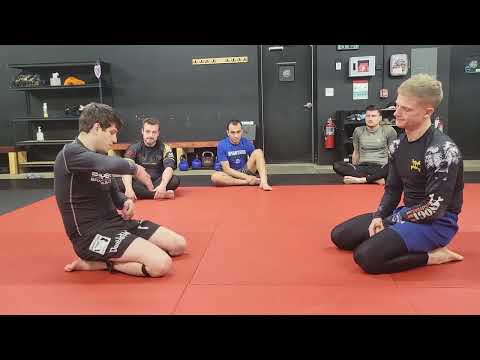
According to Pica Pau Jiu Jitsu & Grappling, the main mistake is trying to throw your arm around too quickly without controlling the chin first—if your opponent tucks their chin, you'll never finish the choke. Instead, you should grab their chin to prevent this defense.
How should I secure my grip when applying wrist control for this choke?
Pica Pau Jiu Jitsu & Grappling recommends making a fist with your choking hand, which naturally influences you to grab your own wrist more firmly than just holding your palm, creating a stronger grip.
What's the correct way to transition into the choke without letting my opponent escape?
Instead of falling straight back, keep your shoulder connected to their back and rotate to throw your leg over their back first before dropping back—this prevents them from scrambling and maintaining their position while you solidify the choke, as emphasized by Pica Pau Jiu Jitsu & Grappling.
What should I do if my opponent defends by tucking their chin or defending the choke?
Pica Pau Jiu Jitsu & Grappling teaches that you can create a tight front headlock by pulling your hands up high, and if your opponent reaches between your legs, you can still drop back and finish the choke from that position.
How does the Wrist Control Assisted Front Choke work?
The wrist choke from front headlock is a species of the wrist-control-assisted front choke family where the attacker uses the bony edge of their own wrist as the primary choking surface against the opponent's neck. From a standard front headlock position, the attacker drives the radial bone (wrist bone) across the opponent's throat or carotid arteries while the opposite hand controls the back of the head, preventing escape.
Where does the Wrist Control Assisted Front Choke come from?
Wrist-based choking mechanics appear in various self-defense systems and military combatives where precision pressure points are emphasized over broad compression. In competitive grappling, the wrist choke from front headlock developed as a supplementary option when the standard guillotine grip could not be fully secured.
Is the Wrist Control Assisted Front Choke legal in competition?
IBJJF: legal — Legal at all belt levels, gi and no-gi — chokes are the safest submission cat…; IJF: legal — Legal (shime-waza) — strangulation techniques are one of three permitted subm…; ADCC: legal — Legal; Unified MMA: legal — Legal — choke submissions are among the most common finishes in MMA; FIAS Sport Sambo: banned — All chokes prohibited in Sport Sambo; FIAS Combat Sambo: legal — Legal
How dangerous is the Wrist Control Assisted Front Choke?
Danger rating 8/10. Wrist-control chokes use grip manipulation to create front headlock strangles
How do I set up the Wrist Control Assisted Front Choke?
The standard setup chain: Achieve Controlling Position → Isolate the Neck → Set the Grip → Apply Pressure.
How do I defend against the Wrist Control Assisted Front Choke?
Standard counters include: Tuck Chin — protect the neck by lowering the chin to prevent the choke from sinking / Two-on-One Grip Fight — use both hands to strip the choking grip before it locks / Turn Into — rotate toward the choking arm to relieve carotid pressure / Posture Up — straighten the spine and create distance to break the choking angle.
What are the variants of the Wrist Control Assisted Front Choke?
Common variants: Standard grip variation (primary hand configuration for maximum choking pressure); Gi variation (uses the lapel or collar as an anchor for additional fric…); No-gi variation (adapted grip and positioning for submission grappling wit…); Transition finish (applied during a positional change to catch the opponent …).
How effective is the Wrist Control Assisted Front Choke in competition?
Uncommon at elite competition; the wrist-control concept has found more application in MMA than pure grappling
What are common mistakes when doing the Wrist Control Assisted Front Choke?
Top errors to watch for: Using the wrist grip without proper forearm placement — the grip reinforces the forearm's position; if the forearm is… / Gripping too far from the wrist — grip close to the wrist joint for maximum control; gripping the mid-forearm reduces… / Not using both variants — the two-on-one (forearm on neck) and wrist choke (wrist bone on neck) create different pres… / Attempting wrist-control chokes from inferior position — these techniques require the front headlock; from bottom, th….
What are other names for the Wrist Control Assisted Front Choke?
The Wrist Control Assisted Front Choke is also known as Furonto Heddorokku Chōku, Wrist Control Front Choke, Wrist-Assisted Headlock Choke.