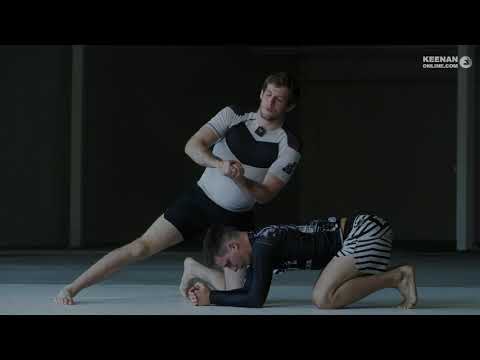
The Peruvian Necktie - Use all 4 limbs to finish this exotic choke
0
Necktie Lever·Keenan Cornelius
The Peruvian Necktie strangulation technique will make your opponent helpless. Helpless as you descend upon them with al…
Translation: Front Headlock Choke (katakana loanword)
Necktie-lever chokes use a necktie grip (arm draped over the back of the opponent's neck) combined with a leg or body lever to apply choking pressure. [1] The Peruvian necktie is the primary technique: the attacker secures a front headlock, steps a leg over the opponent's back, and sits back, using the leg as a lever to drive the forearm into the throat. [2],[3]
The necktie lever mechanic — using leg pressure across the back of the neck combined with head-and-arm control — creates one of the most powerful compression chokes in no-gi grappling [1]
The lever concept underlying the Peruvian Necktie family; formalized by Tony DeSouza and subsequently analyzed by John Danaher in his front headlock instructional series [1]
The necktie lever principle has produced finishes across ADCC, no-gi worlds, and MMA at the highest levels since the mid-2000s [1]
No images yet for this technique.
Sign in to suggest an image.
The Peruvian Necktie strangulation technique will make your opponent helpless. Helpless as you descend upon them with al…
No instructional courses yet for this technique.
Sign in to suggest a course.
Risk of injury to the person this technique is applied to
Necktie chokes use leg pressure over the back combined with front headlock grip for extreme compression
Skill level needed to execute this technique reliably
Whether this technique is allowed under major competition rule sets
Wikipedia ja (フロントチョーク); Japanese BJJ community
Japanese Wikipedia — martial arts technique articles
Standard katakana transliteration of Western martial arts terminology (外来語) — used in Japanese MMA, boxing, and BJJ communities
Japanese terminology sourced from Wikipedia ja (フロントチョーク); Japanese BJJ community
grip or squeeze strength, positional control
strong upper body for sustained compression
forearms, biceps, pectorals, core stabilisers
Every move, in any martial art, shares a few universal traits. Mix and match below to pinpoint the right tool — or compare equivalents across styles.
The Peruvian necktie is especially effective when your opponent is turtled up tight or defending aggressively, and you can't get solid shoulder pressure or secure neck positioning. According to Keenan Cornelius, if your opponent is fighting your hands and you can only connect your hands without really solid positioning, the Peruvian necktie becomes a viable option.
Keenan Cornelius emphasizes falling backwards toward your top leg so your bottom leg comes off the ground—this creates more space and leverage to drop your leg into your opponent's neck. If you stay upright, you only have leverage until your leg hits the mat, but by falling back, you gain significantly more mechanical advantage.
Necktie-lever chokes use a necktie grip (arm draped over the back of the opponent's neck) combined with a leg or body lever to apply choking pressure. The Peruvian necktie is the primary technique: the attacker secures a front headlock, steps a leg over the opponent's back, and sits back, using the leg as a lever to drive the forearm into the throat.
The Peruvian necktie was popularized by Tony DeSouza, a Peruvian-American MMA fighter and grappler, who demonstrated its effectiveness in competition in the 2000s. It represents the innovative combination of wrestling-style head control with BJJ submission finishing.
IBJJF: legal — Legal at all belt levels, gi and no-gi — chokes are the safest submission cat…; IJF: legal — Legal (shime-waza) — strangulation techniques are one of three permitted subm…; ADCC: legal — Legal; Unified MMA: legal — Legal — choke submissions are among the most common finishes in MMA; FIAS Sport Sambo: banned — All chokes prohibited in Sport Sambo; FIAS Combat Sambo: legal — Legal
Danger rating 9/10. Necktie chokes use leg pressure over the back combined with front headlock grip for extreme compression
The standard setup chain: Achieve Controlling Position → Isolate the Neck → Set the Grip → Apply Pressure.
Standard counters include: Tuck Chin — protect the neck by lowering the chin to prevent the choke from sinking / Two-on-One Grip Fight — use both hands to strip the choking grip before it locks / Turn Into — rotate toward the choking arm to relieve carotid pressure / Posture Up — straighten the spine and create distance to break the choking angle.
Common variants: Standard grip variation (primary hand configuration for maximum choking pressure); Gi variation (uses the lapel or collar as an anchor for additional fric…); No-gi variation (adapted grip and positioning for submission grappling wit…); Transition finish (applied during a positional change to catch the opponent …).
The necktie lever principle has produced finishes across ADCC, no-gi worlds, and MMA at the highest levels since the mid-2000s
Top errors to watch for: Applying the lever without a proper headlock grip — the grip is the foundation; the lever amplifies what's already th… / Not understanding which lever to use — shin-across-neck provides the most direct force; leg-over-back provides weight… / Using only the lever without the arm strangle — the lever assists the choke; by itself, the lever is a control tool, … / Not training lever placement — the lever must contact the correct area (neck, upper back); imprecise placement reduce….
The Necktie Lever is also known as Furonto Heddorokku Chōku, Necktie Choke, Cravate Submission, Necktie Lock.