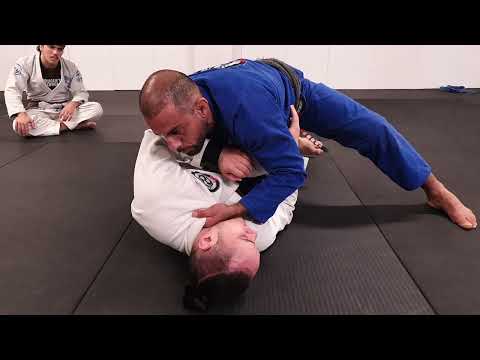
Gator roll pass, Flying Squad - Advanced Class
0
Gator-Roll Wrap·Combat Room Brazilian Jiu Jitsu
Translation: Front Headlock Choke (katakana loanword)
Gator-roll wraps combine a front headlock choke grip with a rolling motion (the 'gator roll') to take the opponent to the ground while maintaining choking pressure. [1] The anaconda choke is the defining technique: the attacker threads an arm from the inside (opposite direction from a D'Arce), locks a figure-four around the head and arm, then performs a gator roll to tighten the squeeze and land in a dominant finishing position. [2],[3]
The gator-roll mechanism is biomechanically brilliant — the entire body's rotation generates compression rather than isolated arm squeezing. The centrifugal force creates tightening that overcomes muscular resistance. [1]
Named after the alligator's hunting behaviour (death roll). The rolling finish for arm-triangle chokes was developed in BJJ and catch wrestling as an alternative to static squeezing. [1]
The gator roll is the most common finishing mechanism for anaconda chokes in competition. The dynamic tightening makes it the preferred finish at ADCC and no-gi events. [1]
No images yet for this technique.
Sign in to suggest an image.
No instructional courses yet for this technique.
Sign in to suggest a course.
Risk of injury to the person this technique is applied to
Anaconda/gator-roll chokes use a rolling motion to tighten the arm-in head-and-arm strangle
Skill level needed to execute this technique reliably
Whether this technique is allowed under major competition rule sets
Wikipedia ja (フロントチョーク); Japanese BJJ community
Japanese Wikipedia — martial arts technique articles
Standard katakana transliteration of Western martial arts terminology (外来語) — used in Japanese MMA, boxing, and BJJ communities
Japanese terminology sourced from Wikipedia ja (フロントチョーク); Japanese BJJ community
long arms for threading under armpit and around neck
longer limbs, lean build
biceps, deltoids, forearm flexors, core (for sprawl pressure)
Every move, in any martial art, shares a few universal traits. Mix and match below to pinpoint the right tool — or compare equivalents across styles.
When your opponent defends with a reversal de la riva, you can't progress the knee cut forward anymore. Instead, slide your knee out and adjust your approach accordingly.
Gator-roll wraps combine a front headlock choke grip with a rolling motion (the 'gator roll') to take the opponent to the ground while maintaining choking pressure. The anaconda choke is the defining technique: the attacker threads an arm from the inside (opposite direction from a D'Arce), locks a figure-four around the head and arm, then performs a gator roll to tighten the squeeze and land in a dominant finishing position.
The anaconda choke gained prominence through its use by fighters in PRIDE Fighting Championships, particularly by the Nogueira brothers. The gator-roll entry — named for the crocodilian death roll — became the standard method for applying the anaconda in competition.
IBJJF: legal — Legal at all belt levels, gi and no-gi — chokes are the safest submission cat…; IJF: legal — Legal (shime-waza) — strangulation techniques are one of three permitted subm…; ADCC: legal — Legal; Unified MMA: legal — Legal — choke submissions are among the most common finishes in MMA; FIAS Sport Sambo: banned — All chokes prohibited in Sport Sambo; FIAS Combat Sambo: legal — Legal
Danger rating 9/10. Anaconda/gator-roll chokes use a rolling motion to tighten the arm-in head-and-arm strangle
The standard setup chain: Achieve Controlling Position → Isolate the Neck → Set the Grip → Apply Pressure.
Standard counters include: Tuck Chin — protect the neck by lowering the chin to prevent the choke from sinking / Two-on-One Grip Fight — use both hands to strip the choking grip before it locks / Turn Into — rotate toward the choking arm to relieve carotid pressure / Posture Up — straighten the spine and create distance to break the choking angle.
Common variants: Standard D'Arce (arm threaded under the far armpit and around the neck fro…); Marce (short choke) (tighter, shorter threading for compact body types); Standing D'Arce (applied during a scramble without going to the ground); D'Arce from turtle (threaded as the opponent attempts to re-guard from turtle…).
The gator roll is the most common finishing mechanism for anaconda chokes in competition. The dynamic tightening makes it the preferred finish at ADCC and no-gi events.
Top errors to watch for: Rolling without a connected grip — the gator roll requires hands to be locked before rolling; rolling with an open gr… / Rolling in the wrong direction — always toward the trapped arm; opposite rolling loosens the grip / Using only upper body to roll — the roll must come from the hips and core; upper-body-only rolling lacks power / Stopping after one roll — the gator roll often requires multiple rotations to fully tighten.
The Gator-Roll Wrap is also known as Furonto Heddorokku Chōku, Gator Roll Submissions, Arm-In Rolling Chokes.