Every Jiu Jitsu Submission Explained in 8 Minutes
+1
Submission·JoshRichBJJ
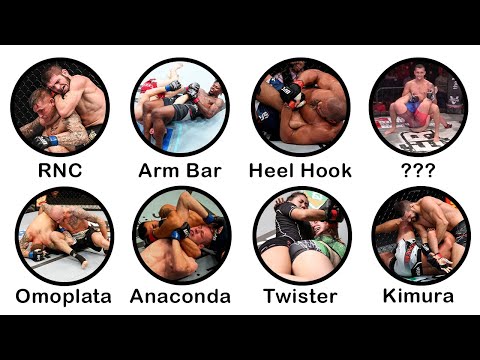
Every Jiu Jitsu Submission Explained in 8 minutes! XMartial: https://www.xmartial.com/?ref=joshrich Code:JOSHRICH The…
Translation: Grappling / Holding Techniques
Submissions are techniques that force an opponent to concede defeat — typically by tapping out — through the application of joint locks, chokes, strangles, cranks, compression locks, or pain compliance holds. [11] They target anatomical vulnerabilities: hyperextending or rotating joints beyond their natural range of motion, restricting blood flow to the brain (vascular strangles), occluding the airway (respiratory chokes), compressing muscles against bone, or applying pressure to nerve clusters. [3] In competitive grappling, the submission is the decisive finish — the equivalent of a knockout in striking arts or a pin in wrestling. A successful submission requires the attacker to control the opponent's posture and limbs, isolate the target joint or neck, and apply graduated force that leaves the defender no option but to concede or risk injury. [11] The major sub-categories of submission are: chokes and strangles (restricting blood or air), joint locks (hyperextending the elbow, shoulder, knee, ankle, wrist, or spine), compression locks (crushing muscle against bone), cranks and twists (rotational force on the neck or limbs), nerve locks (direct pressure on nerve bundles), pain compliance holds (sustained pressure without structural damage), grip and finger locks (small-joint manipulation), clinch locks (standing submission control), and smother locks (obstructing breathing through chest or body weight pressure). [15] Submissions are scored or permitted in varying degrees across martial arts: Brazilian Jiu-Jitsu and submission grappling allow the widest range [2], judo permits chokes (shime-waza) and elbow locks (kansetsu-waza) but prohibits leg locks [1], sambo permits leg locks including knee bars and ankle locks but historically prohibits chokes in sport sambo [5], and mixed martial arts (MMA) under Unified Rules permits nearly all submissions except small-joint manipulation and spine locks applied by spiking.
Submission techniques are among the oldest documented forms of unarmed combat. Ancient Greek Pankration (648 BCE) included chokes and joint locks — Arrichion of Phigalia famously died while applying a choke at the 54th Olympiad, and his opponent tapped out simultaneously, awarding the dead Arrichion the victory. [13],[14] In Japan, the classical jujutsu schools (koryu) of the Edo period (1603–1868) codified submission techniques within their kata systems; schools such as Takenouchi-ryū (founded 1532) and Sekiguchi-ryū included extensive kansetsu-waza (joint locks) and shime-waza (strangulation techniques). [12] Jigoro Kano's founding of Kodokan Judo in 1882 systematized submissions into the katame-waza (grappling techniques) division, establishing the classification framework — osaekomi-waza (pins), shime-waza (strangles), and kansetsu-waza (joint locks) — that still underpins modern judo competition rules. [3],[15] In the early 20th century, Vasili Oshchepkov and Viktor Spiridonov independently developed sambo in the Soviet Union (1920s–1930s), incorporating joint locks and leg attacks from judo, Mongolian wrestling, and indigenous Central Asian grappling traditions. [5],[6] The Gracie family's adaptation of Kodokan judo ground techniques in Brazil from the 1920s onward produced Brazilian Jiu-Jitsu, which elevated submissions — particularly chokes and armlocks from the guard position — to the central strategic objective. [22] Helio Gracie's emphasis on leverage-based submissions for smaller practitioners and the Gracie Challenge matches (1920s–1990s) demonstrated the effectiveness of submissions against larger, stronger opponents. [20] The first UFC event in 1993, where Royce Gracie submitted three opponents in a single night, brought submission grappling to global attention and catalyzed the development of modern MMA, where submissions remain one of the three primary victory methods alongside knockouts and decisions. [11]
No images yet for this technique.
Sign in to suggest an image.
Every Jiu Jitsu Submission Explained in 8 minutes! XMartial: https://www.xmartial.com/?ref=joshrich Code:JOSHRICH The…
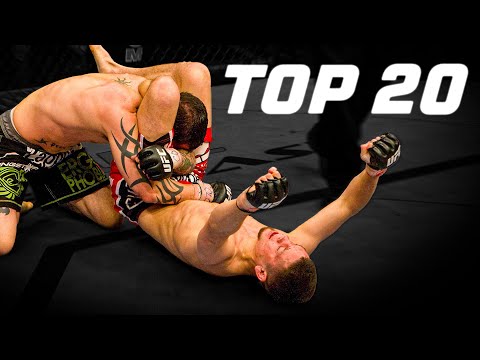
There's no denying that the art of submission has had a role in the 20 years of UFC history, which is we are showing you…
No instructional courses yet for this technique.
Sign in to suggest a course.
Risk of injury to the person this technique is applied to
Submissions carry inherent risk of joint damage or loss of consciousness; severity varies by type
Skill level needed to execute this technique reliably
Whether this technique is allowed under major competition rule sets
Kodokan Judo — Jigoro Kano (1986)
Katame-waza classification framework
Definitive BJJ technique reference, 255 pages
Foundational self-defense approach to submissions
Foundational sambo textbook, joint lock and leg lock methodology
Comprehensive Gracie family history and BJJ development
Alias sources — [1] IBJJF Rules and Regulations [2] Kodokan Judo (Kano, 1986) [3] Kodokan Judo (Kano, 1986) [4] Kodokan Judo (Kano, 1986)
Effectiveness sources — [1] Mastering Jujitsu (Gracie & Danaher, 2003) [2] Jiu-Jitsu University (Ribeiro, 2008) [3] UFC Stats (ufcstats.com, accessed 2024)
Official Kodokan ground technique classification system
Standard Japanese martial arts terminology (kanji/hiragana)
Established Japanese martial arts naming convention — native Japanese term (和語/漢語)
Katame-waza classification framework
Definitive BJJ technique reference, 255 pages
Foundational self-defense approach to submissions
Foundational sambo textbook, joint lock and leg lock methodology
Comprehensive Gracie family history and BJJ development
Alias sources — [1] IBJJF Rules and Regulations [2] Kodokan Judo (Kano, 1986) [3] Kodokan Judo (Kano, 1986) [4] Kodokan Judo (Kano, 1986)
Effectiveness sources — [1] Mastering Jujitsu (Gracie & Danaher, 2003) [2] Jiu-Jitsu University (Ribeiro, 2008) [3] UFC Stats (ufcstats.com, accessed 2024)
positional awareness, grip strength, body control
technical proficiency over raw physical attributes
varies by specific submission type
Every move, in any martial art, shares a few universal traits. Mix and match below to pinpoint the right tool — or compare equivalents across styles.
The Choke group encompasses submission techniques that restrict the opponent's breathing by compressing the trachea (windpipe) or obstructing the airway. [1] Unlike blood chokes (strangles) which target the carotid arteries and cause unconsciousness in 6–10 seconds, true chokes prevent air from reaching the lungs and require sustained pressure over 30–60 seconds to force a tap. [1,2] While generally considered less efficient than strangles, air chokes are devastating when applied with proper mechanics — the crushing pressure on the trachea creates intense pain and panic that can force submission even from experienced fighters. [2,3] This group covers tracheal compression chokes, 10th Planet system chokes, and various hybrid chokes that combine airway restriction with blood flow disruption. [3]
Chokes and strangles are submission techniques that restrict either blood flow (strangles) or airflow (chokes) to force a tap out or render an opponent unconscious. [6] The distinction between a choke and a strangle is physiological: a blood choke (strangle) compresses the carotid arteries on one or both sides of the neck, reducing cerebral blood flow and causing unconsciousness within 8–14 seconds if held correctly; an air choke compresses the trachea, blocking the airway, which takes significantly longer to produce unconsciousness and carries higher risk of laryngeal injury. [6] In practice, most techniques apply some combination of both mechanisms. This group encompasses all choking and strangling submissions organized by the primary mechanism and body configuration used: arm triangles (head-and-arm compression), back control chokes (rear naked choke and collar chokes from back mount), forearm and collar chokes (using the gi lapel or forearm against the throat), front headlock chokes (guillotine family and its derivatives), guard chokes (submissions applied from bottom guard positions), leg chokes (triangle choke family using the legs to compress the neck), neck crank chokes (combining cervical spine torque with vascular restriction), and the north-south choke (applied from the north-south position). [7] Chokes and strangles are permitted in virtually all submission grappling rule sets [2] and are the most common submission finish in professional MMA competition.
Clinch locks are standing submission techniques applied from a clinch position — an upright grappling engagement where both fighters maintain grip contact. [6] Unlike ground-based submissions, clinch locks must be executed while both practitioners are on their feet, which demands precise timing, grip strength, and the ability to control the opponent's posture and balance simultaneously. [6] Common clinch lock submissions include standing guillotines, standing arm triangles, standing kimuras, standing wrist locks, and various neck cranks applied from tie-up positions. Clinch locks are particularly relevant in MMA, where the cage or ropes provide a wall-based clinch environment that enables standing submission attempts, and in self-defense contexts where taking the fight to the ground may be undesirable. In wrestling, certain clinch-based holds that apply joint pressure (such as the double wristlock) blur the line between clinch control and submission. [1]
Compression locks are submission techniques that crush muscle tissue against bone, causing intense pain through deep tissue compression rather than joint hyperextension or vascular restriction. [7] The most common compression locks target the biceps (biceps slicer/biceps crush), the calf (calf slicer/calf crush), and the forearm. The mechanism involves trapping a limb across a fulcrum — typically the attacker's shin, forearm, or wrist — and then forcing the opponent's limb to fold, wedging the fulcrum deeper into the muscle belly against the underlying bone. [9] Compression locks can also indirectly stress the adjacent joint: a biceps slicer simultaneously threatens the elbow, and a calf slicer can hyperextend the knee. [9] In competition, compression locks occupy a contested regulatory space: IBJJF rules permit the biceps slicer only at brown and black belt level and the calf slicer at brown belt and above [1]; ADCC and most no-gi events permit all compression locks; judo prohibits them entirely. In MMA under Unified Rules, compression locks are legal.
Cranks and twists are submission techniques that apply rotational or torsional force to a body segment — most commonly the neck (neck cranks) or the arm — forcing the structure beyond its natural rotational range. [6] Unlike joint locks that target a single joint in a linear direction, cranks apply multidirectional torque that stresses ligaments, intervertebral discs, and surrounding soft tissue simultaneously. [6] Neck cranks can generate submission through cervical spine compression, rotation, or lateral flexion; common examples include the can opener (from closed guard), the twister (attacking the thoracic and cervical spine from back control), and various chin strap positions. Arm cranks apply rotational force along the long axis of the humerus or forearm. Cranks are among the most controversial submissions in competition: the IBJJF prohibits most neck cranks (cervical locks) at all belt levels [1]; judo prohibits them entirely; but ADCC, most no-gi events, and MMA under Unified Rules permit neck cranks. The twister, popularized by Eddie Bravo's 10th Planet Jiu-Jitsu system, is one of the most spectacular but rarely applied crank submissions in professional competition.
Grip and finger locks are submission techniques that target the small joints of the hand — the fingers and thumb — by hyperextending, hyperflexing, or twisting individual digits or groups of digits beyond their anatomical range. [7] These techniques exploit the relatively low structural strength of the finger joints compared to larger joints, making them effective but also prone to causing sudden, difficult-to-control injuries. Finger locks can be applied from virtually any grappling position and are particularly relevant in self-defense and traditional martial arts. [3] In competition, finger and small-joint manipulation is prohibited in nearly all major rule sets: the IBJJF [1], ADCC, judo (IJF), and MMA under Unified Rules all ban small-joint manipulation. The prohibition stems from the speed at which finger joints can be broken — there is minimal warning between the onset of pain and structural failure, making a controlled tap out unreliable. Despite competition restrictions, finger locks remain an important part of traditional jujutsu (yubi-waza), aikido (yubi-dori), and law enforcement control techniques. [3,4]
Joint locks are submission techniques that isolate a joint — elbow, shoulder, knee, ankle, hip, wrist, or spine — and apply force to hyperextend, hyperrotate, or compress it beyond its anatomical range of motion. [10] The attacker controls the limb on either side of the target joint and uses leverage (typically a fulcrum point such as the hips, thigh, or forearm) to generate mechanical advantage that the defender cannot resist through strength alone. [3] Joint locks are classified by the target joint: elbow locks (armbar, kimura, americana), shoulder locks (kimura, omoplata), knee locks (kneebar), ankle locks (straight ankle lock, toe hold), heel hooks (inside and outside), hip locks, wrist locks, and spine locks. [6,7] The danger rating varies significantly by joint: elbow hyperextension provides a gradual pain signal before structural failure, while heel hooks attack the knee's rotational ligaments (ACL, MCL) with minimal pain warning before catastrophic injury. [10] In judo competition, only elbow locks (kansetsu-waza) are permitted [1]; Brazilian Jiu-Jitsu permits all joint locks at advanced belt levels [2]; IBJJF rules restrict heel hooks and knee reaping until brown and black belt no-gi divisions; ADCC and most professional submission grappling events permit all joint locks. In MMA under Unified Rules, all joint locks are legal except small-joint manipulation (fingers and toes).
Nerve locks are submission techniques that apply focused pressure directly to nerve bundles or pressure points, causing acute pain without necessarily threatening joint, vascular, or respiratory integrity. [8] The mechanism involves compressing a superficial nerve against underlying bone — for example, pressing the knuckles or forearm into the mandibular nerve under the jawline, the peroneal nerve on the outer leg, or the radial nerve on the forearm. [3] The pain generated can be intense and immediate, forcing the opponent to move, release a grip, or submit. Nerve locks are not widely used as primary competition submissions because their effectiveness varies significantly between individuals — pain tolerance, body composition, and adrenaline can reduce their reliability. [1] However, they serve important roles as positional tools: a nerve-pressure application under the jaw can force an opponent to lift their chin, exposing the neck for a choke; pressure on the intercostal nerves can break a defensive frame. [8] In competition, nerve locks are generally legal (they do not violate small-joint or spine-lock prohibitions) but are rarely decisive at the highest levels.
Pain compliance holds are submission techniques that generate sustained pain through pressure, pinching, or grinding — without directly threatening a joint, blood supply, or airway. [5] The goal is to make the opponent's position so uncomfortable that they either submit, abandon a defensive posture, or create an opening for a more decisive technique. [5] Common pain compliance holds include ear pulls, sternum pressure (from mount), rib pressure (knee-on-belly with directed force), fish-hooking-adjacent face pressure, and various grinding applications of the forearm, elbow, or knee against sensitive areas. Pain compliance occupies a gray area in competition rules: many techniques are technically legal (they don't violate specific prohibitions) but may be viewed as unsportsmanlike by referees. In law enforcement and military contexts, pain compliance holds are primary control tools — wrist locks, arm bars, and pressure point controls taught in defensive tactics programs are designed to gain compliance without causing permanent injury. [2] In grappling competition, pain compliance is more commonly used as a transitional tool — for example, applying cross-face pressure to turn an opponent's head and expose the neck — rather than as a finishing submission. [1]
Smother locks are submission techniques that obstruct an opponent's breathing by covering the nose and mouth with the body — typically the chest, belly, shoulder, or arm — creating a seal that prevents air intake. [1] Unlike chokes and strangles, which target the neck's blood vessels or airway, smother locks work by physically blocking the external breathing passages with body mass. [3] The most common smother submissions involve chest-to-face pressure from mount (belly smother), shoulder pressure from side control (shoulder smother), or deliberate face burial in the chest or armpit. Smother locks are generally slower-acting than vascular chokes — they cause submission through progressive oxygen deprivation and the psychological distress of being unable to breathe, rather than rapid unconsciousness. [7] In competition, smothers exist in a regulatory gray area: they are not explicitly prohibited in most rule sets (IBJJF, ADCC, MMA), but their effectiveness is debated and they are rarely used as primary finishers at elite levels. Smother pressure is more commonly employed as a positional tool — a heavy shoulder-of-justice from side control or a tight mount with chest pressure forces defensive reactions that open up choke and armlock opportunities. [7,8]
Submissions — techniques that force the opponent to surrender through joint locks, chokes, or cranks — are the ultimate goal of grappling. The rear naked choke is the most common submission in MMA history. 'Arm bar' appears in 481 passages, 'choke' in thousands, 'kimura' in 523 passages across 65 books. (200+ books; Ribeiro, Jiu-Jitsu University; Danaher, Enter the System; UFC Stats)
Immediately secure a gable grip instead. As shown in the Khabib vs. McGregor fight, if you realize you're not in the correct position for the choke, locking a gable grip keeps control and prevents your opponent from escaping.
When your opponent attempts to escape the mount by going to their knees, that's when you can instantly shoot your hand in to set up the rear naked choke, as Khabib demonstrated against McGregor.
Submissions are techniques that force an opponent to concede defeat — typically by tapping out — through the application of joint locks, chokes, strangles, cranks, compression locks, or pain compliance holds. They target anatomical vulnerabilities: hyperextending or rotating joints beyond their natural range of motion, restricting blood flow to the brain (vascular strangles), occluding the airway (respiratory chokes), compressing muscles against bone, or applying pressure to nerve clusters.
Submission techniques are among the oldest documented forms of unarmed combat. Ancient Greek Pankration (648 BCE) included chokes and joint locks — Arrichion of Phigalia famously died while applying a choke at the 54th Olympiad, and his opponent tapped out simultaneously, awarding the dead Arrichion the victory.
IBJJF: legal — Legal at all belt levels, gi and no-gi — chokes are the safest submission cat…; IJF: legal — Legal (shime-waza) — strangulation techniques are one of three permitted subm…; ADCC: legal — Legal; Unified MMA: legal — Legal — choke submissions are among the most common finishes in MMA; FIAS Sport Sambo: banned — All chokes prohibited in Sport Sambo; FIAS Combat Sambo: legal — Legal
Danger rating 7/10. Submissions carry inherent risk of joint damage or loss of consciousness; severity varies by type
The standard setup chain: Achieve Controlling Position → Isolate the Neck → Set the Grip → Apply Pressure.
Standard counters include: Tuck Chin — protect the neck by lowering the chin to prevent the choke from sinking / Two-on-One Grip Fight — use both hands to strip the choking grip before it locks / Turn Into — rotate toward the choking arm to relieve carotid pressure / Posture Up — straighten the spine and create distance to break the choking angle.
Common variants: Standard variation (primary technique application from the most common position); Gi-specific variation (adapted to use lapel, collar, or sleeve for enhanced control); No-gi variation (modified grips and positioning for no-gi grappling); Competition variation (optimised for point-scoring and rule-set compliance).
Submissions are the primary winning method in BJJ competition (IBJJF, ADCC) and account for roughly 30% of UFC finishes. The ADCC Submission Wrestling World Championship (since 1998) is considered the premier no-gi grappling event.
Top errors to watch for: Hunting submissions without positional control — position before submission is the foundational principle; skipping p… / Relying on strength to finish submissions — proper technique creates mechanical advantage that requires minimal force… / Holding failed submissions too long — recognise when a submission attempt has been defended and transition to the nex… / Not drilling escapes as much as attacks — defensive submission knowledge is as important as offensive; you cannot att….
The Submission is also known as Katame-waza, Submissions, Locks, Chokes, Strangles.