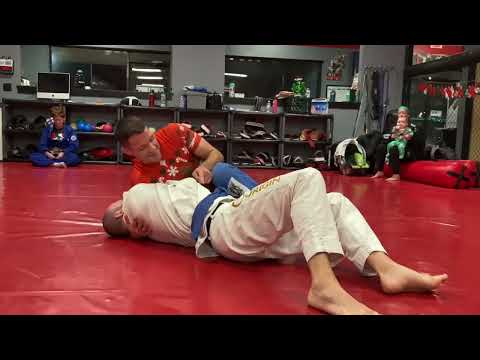
Wrap & Gift Wrap 11/12 - Gift Wrap to Guillotine to Back Take
0
Forearm-Wrap Guillotine·James Clingerman
This is video 11/12 of the Wrap & Gift Wrap Series. In this section, Professor James Clingerman demonstrates how to set …
Translation: Front Headlock Choke (katakana loanword)
The forearm-wrap guillotine is the classical guillotine choke — the attacker wraps one arm around the opponent's neck from the front, clasps hands, and squeezes while pulling upward to compress the throat and/or carotids. [1],[2] Variations include the high-elbow guillotine (Marcelotine), which uses an elevated elbow position to create a tighter seal and more effective blood choke, and the arm-in guillotine, which traps the opponent's arm alongside the neck. [3]
The guillotine choke derives from catch wrestling's front chancery and judo's mae-hadaka-jime (front naked strangle). [2] Marcelo Garcia's high-elbow variation (the 'Marcelotine') revolutionized the technique in the 2000s, making it one of the most effective no-gi submissions in competition history. [1],[3]
The forearm-wrap guillotine subfamily contains some of the most frequently finished submissions in all of grappling — the guillotine's versatility (standing, guard, sprawl, half guard) makes it universally applicable. [1]
The guillotine has ancient roots in wrestling and folk grappling. The modern BJJ guillotine was refined from basic headlock chokes into a precise arterial strangle, with Marcelo Garcia's high-elbow innovation being the most significant advancement. [1]
Guillotine chokes are statistically among the top 3 most common submissions in MMA and top 5 in no-gi grappling competition. They appear at every level from beginner to world championship. [1]
No images yet for this technique.
Sign in to suggest an image.
This is video 11/12 of the Wrap & Gift Wrap Series. In this section, Professor James Clingerman demonstrates how to set …
No instructional courses yet for this technique.
Sign in to suggest a course.
Risk of injury to the person this technique is applied to
Guillotine variants compress the trachea and carotids from front headlock control
Skill level needed to execute this technique reliably
Whether this technique is allowed under major competition rule sets
Wikipedia ja (フロントチョーク); Japanese BJJ community
Japanese Wikipedia — martial arts technique articles
Standard katakana transliteration of Western martial arts terminology (外来語) — used in Japanese MMA, boxing, and BJJ communities
Japanese terminology sourced from Wikipedia ja (フロントチョーク); Japanese BJJ community
forearm and grip strength, hip flexibility for guard retention
longer arms for deeper chin-strap wrap
forearm flexors, biceps, hip flexors
Every move, in any martial art, shares a few universal traits. Mix and match below to pinpoint the right tool — or compare equivalents across styles.
According to James Clingerman, crunch your elbow and oblique crunch into the opponent's waistline to apply pressure on the head. If you can't lock the collar grip, you can always reach through and use the collar as a backup finish.
James Clingerman emphasizes keeping the wrap nice and tight with a circular motion, thinking about catching your own knee with your hand to ensure proper positioning and pressure.
If you can't secure the initial grip, come under the opponent's arm with a super tight connection and drag your hips out to apply pressure, according to James Clingerman.
The forearm-wrap guillotine is the classical guillotine choke — the attacker wraps one arm around the opponent's neck from the front, clasps hands, and squeezes while pulling upward to compress the throat and/or carotids. Variations include the high-elbow guillotine (Marcelotine), which uses an elevated elbow position to create a tighter seal and more effective blood choke, and the arm-in guillotine, which traps the opponent's arm alongside the neck.
The guillotine choke derives from catch wrestling's front chancery and judo's mae-hadaka-jime (front naked strangle). Marcelo Garcia's high-elbow variation (the 'Marcelotine') revolutionized the technique in the 2000s, making it one of the most effective no-gi submissions in competition history.
IBJJF: legal — Legal at all belt levels, gi and no-gi — chokes are the safest submission cat…; IJF: legal — Legal (shime-waza) — strangulation techniques are one of three permitted subm…; ADCC: legal — Legal; Unified MMA: legal — Legal — choke submissions are among the most common finishes in MMA; FIAS Sport Sambo: banned — All chokes prohibited in Sport Sambo; FIAS Combat Sambo: legal — Legal
Danger rating 9/10. Guillotine variants compress the trachea and carotids from front headlock control
The standard setup chain: Achieve Controlling Position → Isolate the Neck → Set the Grip → Apply Pressure.
Standard counters include: Tuck Chin — protect the neck by lowering the chin to prevent the choke from sinking / Two-on-One Grip Fight — use both hands to strip the choking grip before it locks / Turn Into — rotate toward the choking arm to relieve carotid pressure / Posture Up — straighten the spine and create distance to break the choking angle.
Common variants: Arm-in guillotine (traps the opponent's arm inside the choke for additional …); High-elbow guillotine (Marcelotine) (elevates the elbow above the head for stronger carotid co…); Standing guillotine (finished from the feet without pulling guard); Power guillotine (chin-strap grip with a rear-naked-choke-style finish for …).
Guillotine chokes are statistically among the top 3 most common submissions in MMA and top 5 in no-gi grappling competition. They appear at every level from beginner to world championship.
Top errors to watch for: Not understanding the difference between arm-in and arm-out — each has different mechanics and finishing requirements… / Wrapping too shallow — the forearm must pass past the neck's centreline; a shallow wrap only pushes the chin / Using the same grip for all variations — arm-in, arm-out, and high-elbow each benefit from different hand connections… / Squeezing without structural alignment — the forearm wrap works through body mechanics (hip extension, elbow elevatio….
The Forearm-Wrap Guillotine is also known as Furonto Heddorokku Chōku, Guilhotina, Guillotine Submissions, Front Naked Choke.