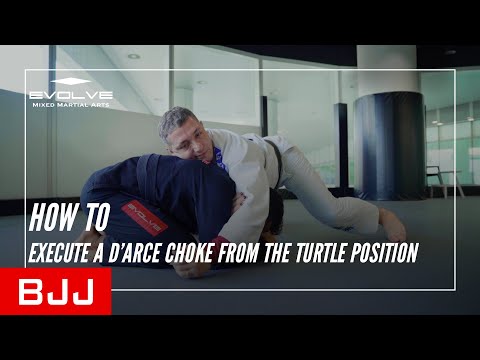
BJJ | How To Execute A D’Arce Choke From The Turtle Position
0
Arm Thread Compressor·Evolve Mixed Martial Arts
In this tutorial, BJJ Champions Robson Indio and Gamal Hassan demonstrate how to execute a D'Arce choke from the turtle …
Translation: Front Headlock Choke (katakana loanword)
The D'Arce choke from turtle is a species where the head-and-arm strangle is applied against an opponent who has assumed the turtle (all-fours) position. [1] The attacker positions to the side of the turtled opponent, slides the near arm under the chin and through the gap between the neck and the far arm, threading until a figure-four or palm-to-palm grip can be locked on the far side. [1],[2] The turtle position exposes the neck-and-arm channel because the opponent's elbows are typically planted on the mat, creating a natural gap for the D'Arce thread. [2] Once the grip is secured, the attacker rolls the opponent to their side or sprawls heavy to complete the compression. [2],[3] This entry is particularly common in wrestling-heavy grappling where opponents frequently turtle to avoid guard passes. [3]
Attacking the turtle with D'Arce chokes developed as a competitive counter to opponents who turtled defensively rather than conceding guard passes or back takes. [1],[2] In wrestling-heavy MMA and no-gi grappling, the turtle became a common defensive posture, and the D'Arce emerged as one of the most effective submissions against it. [1] This entry point was refined through competition in the late 2000s and early 2010s as front headlock attacks from turtle became increasingly systematized. [1],[2]
Arm-thread compressor techniques (D'Arce, anaconda) are among the most effective front headlock submissions — they use the opponent's own shoulder as a compression surface, requiring less strength than direct forearm chokes. [1]
The arm-threading principle appears in catch wrestling (arm-in headlocks) and was systematised in BJJ by Milton Vieira (anaconda) and Joe D'Arce (D'Arce choke). Danaher's front headlock system further organised the subfamily. [1]
Arm-thread compressors dominate front headlock submission statistics at ADCC and no-gi competition. The D'Arce and anaconda together account for a significant percentage of front headlock finishes. [1]
No images yet for this technique.
Sign in to suggest an image.
In this tutorial, BJJ Champions Robson Indio and Gamal Hassan demonstrate how to execute a D'Arce choke from the turtle …
No instructional courses yet for this technique.
Sign in to suggest a course.
Risk of injury to the person this technique is applied to
Arm-thread chokes (D'Arce/Brabo) compress the neck using the arm threaded under the opponent's armpit
Skill level needed to execute this technique reliably
Whether this technique is allowed under major competition rule sets
Wikipedia ja (フロントチョーク); Japanese BJJ community
Japanese Wikipedia — martial arts technique articles
Standard katakana transliteration of Western martial arts terminology (外来語) — used in Japanese MMA, boxing, and BJJ communities
Japanese terminology sourced from Wikipedia ja (フロントチョーク); Japanese BJJ community
long arms for threading under armpit and around neck
longer limbs, lean build
biceps, deltoids, forearm flexors, core (for sprawl pressure)
Every move, in any martial art, shares a few universal traits. Mix and match below to pinpoint the right tool — or compare equivalents across styles.
The D'Arce choke from turtle is a species where the head-and-arm strangle is applied against an opponent who has assumed the turtle (all-fours) position. The attacker positions to the side of the turtled opponent, slides the near arm under the chin and through the gap between the neck and the far arm, threading until a figure-four or palm-to-palm grip can be locked on the far side.
Attacking the turtle with D'Arce chokes developed as a competitive counter to opponents who turtled defensively rather than conceding guard passes or back takes. In wrestling-heavy MMA and no-gi grappling, the turtle became a common defensive posture, and the D'Arce emerged as one of the most effective submissions against it.
IBJJF: legal — Legal at all belt levels, gi and no-gi — chokes are the safest submission cat…; IJF: legal — Legal (shime-waza) — strangulation techniques are one of three permitted subm…; ADCC: legal — Legal; Unified MMA: legal — Legal — choke submissions are among the most common finishes in MMA; FIAS Sport Sambo: banned — All chokes prohibited in Sport Sambo; FIAS Combat Sambo: legal — Legal
Danger rating 9/10. Arm-thread chokes (D'Arce/Brabo) compress the neck using the arm threaded under the opponent's armpit
The standard setup chain: Achieve Controlling Position → Isolate the Neck → Set the Grip → Apply Pressure.
Standard counters include: Tuck Chin — protect the neck by lowering the chin to prevent the choke from sinking / Two-on-One Grip Fight — use both hands to strip the choking grip before it locks / Turn Into — rotate toward the choking arm to relieve carotid pressure / Posture Up — straighten the spine and create distance to break the choking angle.
Common variants: Standard D'Arce (arm threaded under the far armpit and around the neck fro…); Marce (short choke) (tighter, shorter threading for compact body types); Standing D'Arce (applied during a scramble without going to the ground); D'Arce from turtle (threaded as the opponent attempts to re-guard from turtle…).
Arm-thread compressors dominate front headlock submission statistics at ADCC and no-gi competition. The D'Arce and anaconda together account for a significant percentage of front headlock finishes.
Top errors to watch for: Threading without first controlling the opponent's head — head control (front headlock, crossface) must be establishe… / Not trapping the near arm inside the loop — the shoulder compression requires the arm inside; threading around the ne… / Threading too shallow — depth is critical; the arm must pass far enough to connect the hands (figure-four or gable grip) / Not understanding the two threading directions — under-neck-over-arm (D'Arce) and over-neck-under-arm (anaconda) crea….
The Arm Thread Compressor is also known as Furonto Heddorokku Chōku, Arm-In Head-and-Arm Chokes, Threading Chokes.