How to HOOK KICK - Kicking tutorial
0
Hook Kick·Bruce Willow
Follow my Training Program! Be stronger, faster and more flexible for your martial arts: https://marketplace.trainheroic…
Translation: hook kick
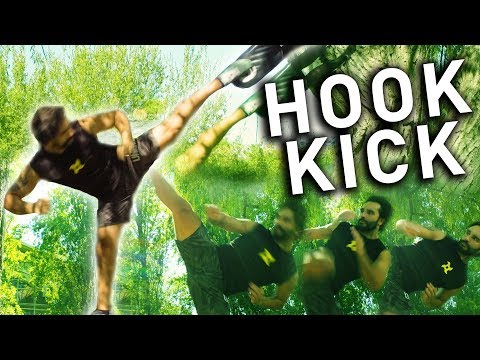
The Hook Kick family groups kicking techniques where the leg extends past the target and then hooks back inward, striking with the heel or sole of the foot as the leg retracts in a hooking arc. [1] The hook kick's deceptive trajectory — extending as if for a side kick before curving back to strike from an unexpected angle — makes it one of the most difficult kicks to defend against, as the impact comes from behind the opponent's guard. [1],[2] Hook kicks are prominent in taekwondo (huryeo chagi), karate (ura mawashi geri), and kickboxing, where they are used to attack the opponent's head from an angle that bypasses conventional blocking. [2],[3]
Hook kicks developed within Korean and Japanese martial arts, with taekwondo refining the technique into a competition staple for head scoring. [1] The hook kick's ability to circumvent straight-line defences made it a valuable addition to competitive kicking arsenals in the 1970s and 1980s. [1],[2] The technique gained recognition in MMA and kickboxing through fighters like Mirko Cro Cop and Edson Barboza, who used hook kick variations to produce knockouts. [2],[3]
The hook kick swings the leg in a hooking arc to strike with the heel. [1]
The hook kick is prominent in TKD and karate. [1]
Used in TKD and MMA competition. [1]
No images yet for this technique.
Sign in to suggest an image.
Follow my Training Program! Be stronger, faster and more flexible for your martial arts: https://marketplace.trainheroic…
Another tip of an iceberg resting on a mountain top alongside a sliver of a canyon at the top of a hidden rainforest's h…
No instructional courses yet for this technique.
Sign in to suggest a course.
Risk of injury to the person this technique is applied to
Whipping heel strike; high KO potential to temple
Skill level needed to execute this technique reliably
Whether this technique is allowed under major competition rule sets
Karate-Do Kyohan: The Master Text (Gichin Funakoshi, 1935)
Alias sources — [1] Dynamic Karate (Nakayama, 1966) [2] Kukkiwon Textbook (2006) [3] Dynamic Karate (Nakayama, 1966)
Effectiveness sources — [1] Comprehensive Asian Fighting Arts (Draeger & Smith, 1969)
Official karate technique names (和語/漢語)
Established Japanese martial arts naming convention — native Japanese term (和語/漢語)
Alias sources — [1] Dynamic Karate (Nakayama, 1966) [2] Kukkiwon Textbook (2006) [3] Dynamic Karate (Nakayama, 1966)
Effectiveness sources — [1] Comprehensive Asian Fighting Arts (Draeger & Smith, 1969)
hip rotation, horizontal arm acceleration, tight elbow angle
compact build for short-range hooks, strong core
obliques, hip rotators, pectorals, biceps, forearms
Every move, in any martial art, shares a few universal traits. Mix and match below to pinpoint the right tool — or compare equivalents across styles.
The Bent-Body Hook Kick uses lateral body lean to extend the reach of the hook kick significantly beyond standard range. [1] The lean creates a counterbalance that allows the kicking leg to travel further through its arc. [1]
The Bent-Body Spin-Back Hook Kick combines the spinning hook kick with lateral body lean, creating an extended-range spinning hook attack. [1] The lean compensates for the body's natural tendency to stay upright during the spin, allowing the foot to reach further. [1]
The Downward Hook Kick adds a descending arc to the hook trajectory, targeting the collarbone, shoulder, or top of the head from above. [1] The downward component increases the impact by adding gravity to the hooking force. [1]
The Drop Hook Kick delivers a hook kick while dropping the body, creating a sweeping low-level attack. [1] The drop changes the plane of the attack, making the hook trajectory come from an unexpected low angle. [1]
This is the most complex kick variant: a spinning, dropping, downward-arcing high hook kick that combines multiple directional changes in a single technique. [1] It requires elite-level body control and is used primarily as a highlight technique in demonstration and competition. [1]
The Drop Spin-Back Hook Kick combines a spin, drop, and hook kick into a single complex technique. [1] The dropping spin generates significant rotational force at ground level. [1]
The Front Leg Hook Kick uses a skip-step to deliver the hook kick from the lead leg, sacrificing some power for significantly faster delivery. [1] The lead-leg version arrives much sooner than the rear-leg version, making it effective as a counter or surprise attack. [1]
The Half-Pivot Hook Kick uses only a 90-degree pivot rather than the standard hook kick's full 180-degree turn, enabling significantly faster delivery at closer range at the cost of reduced power. [1] In the standard hook kick, the practitioner pivots 180° (turning the back to the opponent) before chambering and hooking the heel back into the target — a process that requires approximately 0.6-0.8 seconds and medium-to-long range. [1] The Half-Pivot variant cuts this rotation in half: the practitioner pivots only 90° (turning the body sideways rather than fully away), then hooks the heel across the target in a tighter arc — the entire sequence takes approximately 0.3-0.4 seconds, roughly half the time of the full hook kick. [1] This speed advantage makes the Half-Pivot Hook effective at ranges where the standard hook kick cannot be executed (too close) and at timings where the standard hook would arrive too late (the opponent is already moving or counter-attacking). [1] The trade-off is power: the half rotation generates approximately 50-60% of the angular momentum of a full-rotation hook kick, because the body rotates through only half the arc before the kick fires. [1] De Bremaeker and Faige document the Half-Pivot Hook as one of the hook kick variants, noting its tactical value as a 'quick hook' that bridges the gap between straight-line punches (fast but predictable) and full hook kicks (powerful but slow) — the Half-Pivot occupies a middle ground that catches opponents who are calibrated to defend either the fast-straight or the slow-circular attack, but not the medium-speed, medium-arc attack. [1] The technique is particularly effective in combination with boxing: after a jab-cross that occupies the opponent's frontal defence, the Half-Pivot Hook arrives from a 90° angle in approximately 0.3 seconds — faster than the opponent can adjust from defending straight punches to defending a hook kick from the side. [1]
The Hand-on-the-Floor Hook Kick uses one hand on the ground for support and balance while delivering a hook kick. [1] The hand support allows the practitioner to kick from an extremely low position with maximum reach. [1]
This advanced technique combines a spinning back hook kick with hand-on-the-floor support, creating a ground-level spinning attack with maximum reach. [1] It draws from capoeira's ground-level spinning attacks and traditional martial arts sacrifice techniques. [1]
The Hooked Hook Kick features an exaggerated hooking motion at the end of the arc, wrapping around the opponent's guard to strike the back of the head or neck. [1] The deep hook action pulls the foot further around the target than a standard hook kick. [1]
The Oblique Hook Kick is delivered at a non-standard angle, typically with a downward or upward component added to the standard horizontal arc. [1] The angled trajectory targets unusual areas and bypasses defences calibrated for horizontal hooks. [1]
The Oblique Spin-Back Hook Kick adds an angular component to the spinning hook kick, creating a non-standard trajectory that bypasses conventional defences. [1] The oblique angle can target the back of the head or the side of the neck. [1]
The Small Heel Back Hook Kick is a short-range hook kick striking with the heel in a tight arc, optimised for close-quarters fighting. [1] The compact motion and hard heel striking surface make it effective at ranges where a full hook kick cannot develop. [1]
The Standard Hook Kick subfamily covers the basic hook kick where the kicker extends the leg as if throwing a side kick, then hooks the foot back to strike the target with the heel as the leg retracts. [1] The deceptive two-phase motion — extension followed by retraction — makes the kick difficult to read and time, as defenders initially react to what appears to be a side kick. [1,2] The standard hook kick primarily targets the head, particularly the temple and jaw, and is most effective when preceded by techniques that condition the opponent to expect linear kicks. [2,3]
The Straight Leg Hook Kick is delivered with the kicking leg kept straight (or nearly straight) throughout the entire hooking arc, creating a wider trajectory and longer reach than the standard bent-knee hook kick while relying entirely on hip rotation for power rather than the typical knee-snap that characterises the standard version. [1] In the standard hook kick (huryeo chagi in taekwondo, ura mawashi geri in karate), the knee chambers first, the leg extends to full length as it passes the target, then the knee bends to 'hook' the heel back into the target from behind — a retraction-based striking mechanism. [1] The Straight Leg variant eliminates the retraction: the entire leg swings through the arc as a single rigid unit, and the hooking action comes from the hip rotation continuing past the target, sweeping the heel across the target surface in a wide arc from outside to inside. [1] This produces a fundamentally different impact: the standard hook kick snaps backward into the target (a whip-like retraction), while the Straight Leg Hook sweeps through the target (a bat-like swing), delivering heavier but slower impact with significantly more follow-through. [1] De Bremaeker and Faige document the Straight Leg Hook Kick as the first variant in the hook kick chapter of their 89-kick compilation, noting that its wider arc and different timing make it effective against opponents who have trained to defend the standard hook kick's retraction-based rhythm. [1] The technique is sometimes called the 'wheel kick' when delivered at head height, referencing the wheel-like circular motion of the fully extended leg. [1] In taekwondo and sport karate competition, the Straight Leg Hook Kick has produced numerous spectacular head-kick knockouts because the wide arc approaches the head from an angle that the standard frontal guard cannot cover — the heel arrives from behind and above the ear, a direction that conventional hand guards do not protect. [2]
The Universal Chamber Hook Kick begins from a neutral chamber that could develop into any kick type, committing to the hook trajectory only at the last moment. [1] This maximises the deceptive potential of the kick. [1]
The hook kick travels in a deceptive arc that bypasses the guard from the outside — the heel swings around the opponent's guard to strike the jaw or temple from the blind side. One of the highest-percentage head kick KOs in TKD competition. (De Bremaeker & Faige, Essential Book of Martial Arts Kicks)
Bruce Willow emphasizes that the hook kick is one of the most important kicks for learning how to properly use your hips and support leg, even though it's not commonly used.
Bruce Willow recommends doing a flexibility routine two or three times a week to get as close as possible to the splits, which allows you to reach higher targets on taller opponents.
The position of your bottom support foot is one of the most critical elements—this applies to the hook kick as well as side kicks, roundhouse kicks, and wheel kicks.
HwarangSam explains that the degree of separation between your planted leg and kicking leg determines your kick's trajectory—a narrow separation allows you to go straight to the target, while a wider separation may require you to curve around a defender's guard.
HwarangSam notes that for a more direct hook kick you can extend the knee later in the motion, while for a wider approach some people release the knee extension early and swing it all the way around, such as when trying to go around an opponent's arm.
The Hook Kick family groups kicking techniques where the leg extends past the target and then hooks back inward, striking with the heel or sole of the foot as the leg retracts in a hooking arc. The hook kick's deceptive trajectory — extending as if for a side kick before curving back to strike from an unexpected angle — makes it one of the most difficult kicks to defend against, as the impact comes from behind the opponent's guard.
Hook kicks developed within Korean and Japanese martial arts, with taekwondo refining the technique into a competition staple for head scoring. The hook kick's ability to circumvent straight-line defences made it a valuable addition to competitive kicking arsenals in the 1970s and 1980s.
Unified MMA: legal — Legal striking technique; WBC/Boxing: banned — All kicks prohibited in boxing; WKF: legal — Legal, chudan (body) kick scores 2 points, jodan (head) kick scores 3 points; Kyokushin: legal — Legal at full power to body and head; WT: legal — Legal, body kick 2 points, head kick 3 points, spinning body 4 points, spinni…; WAKO: legal — Legal in Full Contact and Low Kick formats; K: legal — 1/GLORY — Legal; IFMA: legal — Legal — kicks are a core Muay Thai technique
Danger rating 6/10. High — whipping heel strike; high KO potential to temple
The standard setup chain: Setup with Straight Punch → Pivot the Lead Foot → Arc the Arm → Follow Through.
Standard counters include: Check (Shin Block) — raise the shin to intercept the kick before it lands / Catch and Sweep — catch the kicking leg and sweep the standing leg / Step Inside — close distance inside the kick's effective range to smother it.
Common variants: Standard hook (horizontal-arc punch targeting the jaw or temple); Tight hook (compact, short-range hook for close-quarters fighting); Body hook (targeting the ribs or liver with a downward-angled hook); Check hook (pivoting on the lead foot while throwing the hook as a co…).
Used in TKD and MMA competition.
Top errors to watch for: Not extending past the target first — the hooking motion only works if the leg travels beyond the target before hooki… / Hooking with the toes instead of the heel — the heel is the hard, safe contact surface / Not whipping the heel back with enough force — the hook must be a sharp retraction, not a gentle pull / Throwing the hook kick from too close, where there is no room for the leg to extend and hook.
The Hook Kick is also known as Kagi-geri, Ura Mawashi Geri, Huryeo Chagi, Heel Kick.