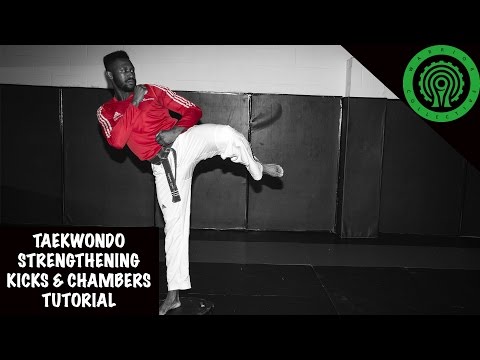
Taekwondo Strengthening your Kicks and Chambers Tutorial
0
Universal Chamber Hook Kick·Stuart Tomlinson
Andrew Deer, former member of Team GB Taekwondo, Commonwealth Champion and TKD black belt is here filmed by the Warrior …
Translation: Universal chamber hook kick
Offers specific tactical advantages over the standard hook kick in appropriate situations. [1]
Cross-style martial arts kicking tradition; documented in kick compendiums. [1]
Commonly used in WT Taekwondo Olympic competition and ITF tournament sparring. Also appears in WKF karate kumite and kickboxing. [1]
No images yet for this technique.
Sign in to suggest an image.
Andrew Deer, former member of Team GB Taekwondo, Commonwealth Champion and TKD black belt is here filmed by the Warrior …
#Hookkick #Hapkidokick #taekwondokick #SelfDefenceClasses #MartialArts #MasterSung #Hapkido https://self-defence-classes…
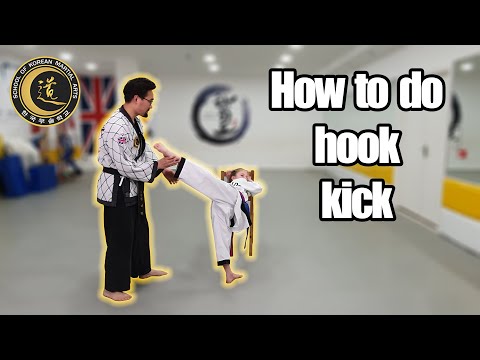
The Universal Chamber Hook Kick is executed by lifting the knee to approximately 45 degrees forward (not laterally) and then sweeping the leg in a circular arc while striking with the sole of the foot, typically targeting the side of the neck or head. SKMA Hapkido emphasizes that the technique, known in Korean Hapkido as mukamachagi or 'neck binding kick,' requires exceptional balance and flexibility, with the foot positioned sole-downward and the kick extending past the centerline to at least head height. The instructor stresses maintaining a straight body alignment throughout and moving the entire leg rather than merely flexing at the knee. The technique can be practiced progressively using a chair for postural support, then without equipment, and finally with a pad as a target. Stuart Tomlinson's contribution focuses on strengthening the chambering position itself—the critical knee-up posture—through proprioceptive exercises on stable and unstable surfaces (BOSU balls), addressing ankle joint stability as foundational to safe and powerful execution. While SKMA Hapkido provides detailed movement mechanics and progression methodology, Tomlinson addresses the physical conditioning and neuromuscular stability required to maintain proper chamber position under fatigue, emphasizing that ankle, knee, hip, and core engagement are simultaneously activated during quality performance.
Synthesized from 2 instructors
No instructional courses yet for this technique.
Sign in to suggest a course.
Risk of injury to the person this technique is applied to
Hook Kick variant with standard striking power
Skill level needed to execute this technique reliably
Whether this technique is allowed under major competition rule sets
Essential Book of Martial Arts Kicks (De Bremaeker & Faige, 2010)
[1] De Bremaeker & Faige, Essential Book of Martial Arts Kicks (2010)
Requires solid hook kick foundation
Good balance and coordination
Documented in De Bremaeker & Faige, Section 5.16. Uses a neutral chamber position that can transition into multiple kick types — the opponent cannot read whether a front kick, side kick, or hook kick will follow. (De Bremaeker & Faige, Essential Book of Martial Arts Kicks, 2010)
Balance and flexibility are the two most important things in kicking, especially for the hook kick. SKMA Hapkido emphasizes that developing these fundamentals is essential before progressing to the full technique.
Bring your knee up at a 45-degree angle, then kick and hold for about two seconds while maintaining a straight body line from top to bottom before folding it back down. SKMA Hapkido stresses that keeping your body in a straight line at the moment of impact is critical for proper execution.
Using a chair allows you to practice the kick step by step, which helps you focus on proper form and body alignment before performing the full technique in open space.
The Universal Chamber Hook Kick begins from a neutral chamber that could develop into any kick type, committing to the hook trajectory only at the last moment. This maximises the deceptive potential of the kick.
The Universal Chamber Hook Kick is a specialised variant documented in cross-style kicking methodology. It represents an advanced development of the standard hook kick.
Unified MMA: legal — Legal striking technique; WBC/Boxing: banned — All kicks prohibited in boxing; WKF: legal — Legal, chudan (body) kick scores 2 points, jodan (head) kick scores 3 points; Kyokushin: legal — Legal at full power to body and head; WT: legal — Legal, body kick 2 points, head kick 3 points, spinning body 4 points, spinni…; WAKO: legal — Legal in Full Contact and Low Kick formats; K: legal — 1/GLORY — Legal; IFMA: legal — Legal — kicks are a core Muay Thai technique
Danger rating 6/10. Hook Kick variant with standard striking power
The standard setup chain: Feint → Universal Chamber Hook Kick → Follow-up combination.
Standard counters include: Step inside range / Block and counter / Low kick to support leg.
Common variants: High variant; Mid variant; Low variant.
Commonly used in WT Taekwondo Olympic competition and ITF tournament sparring. Also appears in WKF karate kumite and kickboxing.
Top errors to watch for: Attempting without solid hook kick foundation / Poor balance / Insufficient power generation.
The Universal Chamber Hook Kick is also known as Yunibāsaru Chanbā Fukku Kikku, Generic Chamber Hook Kick.