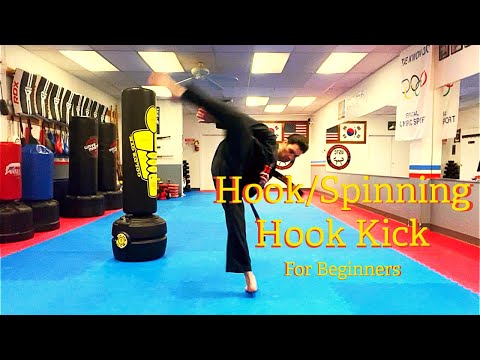
Spinning Hook Kick Tutorial
0
Standard Hook Kick·Technical Taekwondo
Master Messmer's Back Spinning Hook Kick Tutorial. for Dunes Camp Registration, go to www.risingstartaekwondo.com/dune…
Translation: standard hook kick
The Standard Hook Kick subfamily covers the basic hook kick where the kicker extends the leg as if throwing a side kick, then hooks the foot back to strike the target with the heel as the leg retracts. [1] The deceptive two-phase motion — extension followed by retraction — makes the kick difficult to read and time, as defenders initially react to what appears to be a side kick. [1],[2] The standard hook kick primarily targets the head, particularly the temple and jaw, and is most effective when preceded by techniques that condition the opponent to expect linear kicks. [2],[3]
Standard hook kick. [1]
From TKD/karate. [1]
Used in competition. [1]
No images yet for this technique.
Sign in to suggest an image.
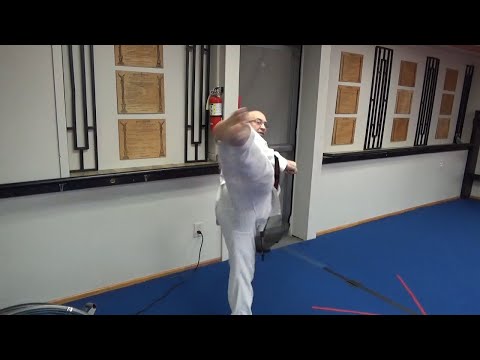
Master Messmer's Back Spinning Hook Kick Tutorial. for Dunes Camp Registration, go to www.risingstartaekwondo.com/dune…
In this video, we discuss what a hook kick is and not only how to execute it properly, but also how to train ourselves t…
No instructional courses yet for this technique.
Sign in to suggest a course.
Risk of injury to the person this technique is applied to
Whipping heel strike; high KO potential to temple
Skill level needed to execute this technique reliably
Whether this technique is allowed under major competition rule sets
Karate-Do Kyohan: The Master Text (Gichin Funakoshi, 1935)
Alias sources — [1] Dynamic Karate (Nakayama, 1966) [2] Kukkiwon Taekwondo Textbook (Kukkiwon, 2006) [3] Best Karate Vol. 5 (Nakayama, 1979)
Effectiveness sources — [1] Comprehensive Asian Fighting Arts (Draeger & Smith, 1969)
Mixed Japanese-Western terminology — combines traditional Japanese terms with katakana loanwords
Alias sources — [1] Dynamic Karate (Nakayama, 1966) [2] Kukkiwon Taekwondo Textbook (Kukkiwon, 2006) [3] Best Karate Vol. 5 (Nakayama, 1979)
Effectiveness sources — [1] Comprehensive Asian Fighting Arts (Draeger & Smith, 1969)
hip rotation, horizontal arm acceleration, tight elbow angle
compact build for short-range hooks, strong core
obliques, hip rotators, pectorals, biceps, forearms
Every move, in any martial art, shares a few universal traits. Mix and match below to pinpoint the right tool — or compare equivalents across styles.
Hook kick is a full body effort—your whole body, not just your leg, has to work together to make the kick work. Your body torques while your leg kicks through, so focus on coordinating your entire body movement rather than relying only on leg strength.
Keep your feet on the same line when in fighting stance. If your feet are crossed or your lead foot is even three or four inches off, you'll lose balance during the pivot and won't be able to complete the kick properly.
Keep your heel off the floor and swing your arms close to your body. If you spin on your heel or with your foot flat, you won't make the full rotation, but keeping your heel up and using your arms will allow you to complete the spin and land properly.
Spin on your toes, not your heels. Spinning on your heels will prevent you from making a full rotation and cause you to lose balance.
The Standard Hook Kick subfamily covers the basic hook kick where the kicker extends the leg as if throwing a side kick, then hooks the foot back to strike the target with the heel as the leg retracts. The deceptive two-phase motion — extension followed by retraction — makes the kick difficult to read and time, as defenders initially react to what appears to be a side kick.
The standard hook kick is a fundamental technique in taekwondo (huryeo chagi) and karate (ura mawashi geri), taught as part of the standard kicking curriculum in both arts. It has been a regular scoring technique in World Taekwondo competition since the sport's early competitive era.
Unified MMA: legal — Legal striking technique; WBC/Boxing: banned — All kicks prohibited in boxing; WKF: legal — Legal, chudan (body) kick scores 2 points, jodan (head) kick scores 3 points; Kyokushin: legal — Legal at full power to body and head; WT: legal — Legal, body kick 2 points, head kick 3 points, spinning body 4 points, spinni…; WAKO: legal — Legal in Full Contact and Low Kick formats; K: legal — 1/GLORY — Legal; IFMA: legal — Legal — kicks are a core Muay Thai technique
Danger rating 6/10. High — whipping heel strike; high KO potential to temple
The standard setup chain: Setup with Straight Punch → Pivot the Lead Foot → Arc the Arm → Follow Through.
Standard counters include: Check (Shin Block) — raise the shin to intercept the kick before it lands / Catch and Sweep — catch the kicking leg and sweep the standing leg / Step Inside — close distance inside the kick's effective range to smother it.
Common variants: Standard hook (horizontal-arc punch targeting the jaw or temple); Tight hook (compact, short-range hook for close-quarters fighting); Body hook (targeting the ribs or liver with a downward-angled hook); Check hook (pivoting on the lead foot while throwing the hook as a co…).
Used in competition.
Top errors to watch for: Trying to hook without first extending past the target — the kick must go beyond and then come back / Hooking too wide and missing the back of the head entirely — the arc must be tight and targeted / Not pivoting the support foot, which restricts the hip rotation needed for the full extension and hook / Using the ball of the foot instead of the heel for the hooking contact.
The Standard Hook Kick is also known as Sutandādo Kagi-geri, Ura Mawashi Geri, Huryeo Chagi, Reverse Roundhouse Kick.