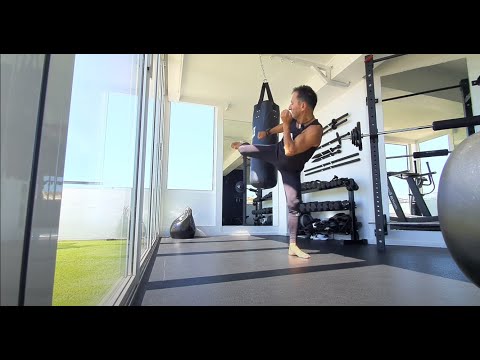
Darebee:- How to Execute a Martial Arts Reverse or Spinning Hook Kick
0
Half-Pivot Hook Kick·DAREBEE
The fitness benefits from learning how to execute a reverse of spinning hook kick include physical, mental, neurological…
Translation: Half-pivot hook kick — a hook kick with only a 90-degree pivot (half of the standard 180° turn), allowing faster delivery at closer range
The Half-Pivot Hook Kick uses only a 90-degree pivot rather than the standard hook kick's full 180-degree turn, enabling significantly faster delivery at closer range at the cost of reduced power. [1] In the standard hook kick, the practitioner pivots 180° (turning the back to the opponent) before chambering and hooking the heel back into the target — a process that requires approximately 0.6-0.8 seconds and medium-to-long range. [1] The Half-Pivot variant cuts this rotation in half: the practitioner pivots only 90° (turning the body sideways rather than fully away), then hooks the heel across the target in a tighter arc — the entire sequence takes approximately 0.3-0.4 seconds, roughly half the time of the full hook kick. [1] This speed advantage makes the Half-Pivot Hook effective at ranges where the standard hook kick cannot be executed (too close) and at timings where the standard hook would arrive too late (the opponent is already moving or counter-attacking). [1] The trade-off is power: the half rotation generates approximately 50-60% of the angular momentum of a full-rotation hook kick, because the body rotates through only half the arc before the kick fires. [1] De Bremaeker and Faige document the Half-Pivot Hook as one of the hook kick variants, noting its tactical value as a 'quick hook' that bridges the gap between straight-line punches (fast but predictable) and full hook kicks (powerful but slow) — the Half-Pivot occupies a middle ground that catches opponents who are calibrated to defend either the fast-straight or the slow-circular attack, but not the medium-speed, medium-arc attack. [1] The technique is particularly effective in combination with boxing: after a jab-cross that occupies the opponent's frontal defence, the Half-Pivot Hook arrives from a 90° angle in approximately 0.3 seconds — faster than the opponent can adjust from defending straight punches to defending a hook kick from the side. [1]
The Half-Pivot Hook Kick developed in competitive martial arts as fighters sought to deliver hook kicks at ranges and speeds that the standard full-rotation hook kick could not achieve. [1] In sport karate and taekwondo, where point-scoring speed is critical, the abbreviated pivot allows the hook kick to function as a combination finisher rather than a standalone technique — fast enough to follow a boxing combination without the time gap that a full 180° pivot would create. [1] De Bremaeker and Faige documented the technique as Section 5.7 in their 2010 compilation, noting its tactical position between the fast-but-predictable front kick and the powerful-but-slow standard hook kick. [1] The technique has gained importance in MMA where combinations mixing boxing and kicks have become standard, and where a hook kick that integrates seamlessly into a boxing sequence (via the abbreviated pivot) has significant tactical value. [2]
The Half-Pivot Hook's effectiveness comes from its tactical position in the speed-power spectrum: it is faster than a full hook kick (catching opponents before their defence adjusts) while delivering more angular-attack capability than straight punches (reaching targets that the frontal guard protects from straight-line attacks). [1] Its primary value is as a COMBINATION technique: following straight punches with a suddenly angular hook from 90° creates a multi-vector attack sequence that is extremely difficult to defend completely. [1] The technique is most effective against opponents who have calibrated their defence to the practitioner's jab-cross rhythm — the sudden angle change to the hook catches the defence in transition. [1]
Standard hook kick → abbreviated pivot variant developed for competitive speed → documented by De Bremaeker & Faige (2010) → adopted in MMA as a combination-compatible hook kick. [1]
The Half-Pivot Hook Kick is used in point karate and taekwondo competition as a fast scoring technique that integrates with hand combinations. In MMA, the abbreviated hook kick following boxing combinations has been used by fighters with karate backgrounds (Lyoto Machida, Stephen Thompson) to create multi-angle attack sequences.
No images yet for this technique.
Sign in to suggest an image.
The fitness benefits from learning how to execute a reverse of spinning hook kick include physical, mental, neurological…
No instructional courses yet for this technique.
Sign in to suggest a course.
Risk of injury to the person this technique is applied to
The Half-Pivot Hook delivers less raw power than the full hook kick due to the reduced rotation, but it compensates with speed and surprise. The heel impact to the temple from a 90° angle produces concussive force that is difficult to defend because the attack arrives from the peripheral visual field. The technique's primary danger is tactical: its speed catches opponents between defensive adjustments.
Skill level needed to execute this technique reliably
Whether this technique is allowed under major competition rule sets
Essential Book of Martial Arts Kicks (De Bremaeker & Faige, 2010)
description: [1] De Bremaeker 2010 pp.194-195
Standard katakana transliteration of Western martial arts terminology (外来語) — used in Japanese MMA, boxing, and BJJ communities
description: [1] De Bremaeker 2010 pp.194-195
Requires good hip flexibility for the hook kick's retraction arc
Balance on the standing leg during the 90° pivot
Adequate hamstring flexibility for head-height delivery
Speed-focused fast-twitch muscles for the quick pivot-and-kick
Less demanding than the full hook kick because the rotation is halved
Accessible to practitioners who find the full 180° hook kick too slow or off-balance
According to Darebee, the three most important components are: turning your lead foot around and planting it, tucking your arms in close to your body, and spinning your head around quickly through a 180-degree circle before executing the kick.
Darebee recommends ensuring you have plenty of clear space around you and removing obstacles like lamp shades and lamps that could be within reach, since spinning kicks can cause you to lose awareness of your body's direction in 3D space.
Darebee suggests leaning forward to touch the target, then leaning back to establish your proper distance, which helps you gauge how far away you need to be before executing the technique.
The Half-Pivot Hook Kick uses only a 90-degree pivot rather than the standard hook kick's full 180-degree turn, enabling significantly faster delivery at closer range at the cost of reduced power. In the standard hook kick, the practitioner pivots 180° (turning the back to the opponent) before chambering and hooking the heel back into the target — a process that requires approximately 0.
The Half-Pivot Hook Kick developed in competitive martial arts as fighters sought to deliver hook kicks at ranges and speeds that the standard full-rotation hook kick could not achieve. In sport karate and taekwondo, where point-scoring speed is critical, the abbreviated pivot allows the hook kick to function as a combination finisher rather than a standalone technique — fast enough to follow a boxing combination without the time gap that a full 180° pivot would create.
Unified MMA: legal — Legal striking technique; WBC/Boxing: banned — All kicks prohibited in boxing; WKF: legal — Legal, chudan (body) kick scores 2 points, jodan (head) kick scores 3 points; Kyokushin: legal — Legal at full power to body and head; WT: legal — Legal, body kick 2 points, head kick 3 points, spinning body 4 points, spinni…; WAKO: legal — Legal in Full Contact and Low Kick formats; K: legal — 1/GLORY — Legal; IFMA: legal — Legal — kicks are a core Muay Thai technique
Danger rating 6/10. The Half-Pivot Hook delivers less raw power than the full hook kick due to the reduced rotation, but it compensates with speed and surprise. The heel impact to the temple from a 90° angle produces concussive force that is difficult to defend because the attack arrives from the peripheral visual field. The technique's primary danger is tactical: its speed catches opponents between defensive adjustments.
The standard setup chain: Establish the jab-cross rhythm (2-3 jab-cross combinations) → Opponent calibrates defence to defend straight-line attacks from the front → On the next combination: jab-cross → continue rotation past the cross to 90° (pivoting to sideways position) → IMMEDIATELY fire the Half-Pivot Hook from the 90° angle → Heel sweeps across the opponent's temple from the side → The opponent's frontal defence, calibrated for straight punches, cannot protect against the 90° angle attack → Retract and follow up or reset.
Standard counters include: Straight counter down the centre — the 90° pivot creates a momentary gap in the kicker's frontal defence; a fast jab … / Side step away from the hook — moving away from the hooking direction (away from the heel's arc) avoids the kick / Duck — the Half-Pivot Hook at head height can be ducked under / Check with the hand — raising the rear hand behind the ear to intercept the incoming heel.
Common variants: Lead leg Half-Pivot Hook (fastest version, using the front leg for jab-like speed); Rear leg Half-Pivot Hook (more powerful, using the rear leg with hip rotation); Half-Pivot Hook to the body (targeting the ribs or liver from the side angle); Half-Pivot to Roundhouse (feinting the hook and converting to a roundhouse (or vice…); Half-Pivot to spinning hook (initiating with a half-pivot but continuing into a full 1…); Jumping Half-Pivot Hook (adding a small jump during the pivot for additional height).
The Half-Pivot Hook Kick is used in point karate and taekwondo competition as a fast scoring technique that integrates with hand combinations. In MMA, the abbreviated hook kick following boxing combinations has been used by fighters with karate backgrounds (Lyoto Machida, Stephen Thompson) to create multi-angle attack sequences.
Top errors to watch for: Over-rotating to 180° — the most common error: the practitioner pivots too far, converting the Half-Pivot into a stan… / Under-rotating — pivoting less than 90° produces a kick that is too frontal (approaching a roundhouse trajectory) and… / Pausing at the 90° position — stopping the body's rotation and then kicking separately telegraphs the hook. The pivot… / Insufficient knee snap — the Half-Pivot Hook's reduced rotation means less angular momentum from the hip; the knee sn….
The Half-Pivot Hook Kick is also known as Hāfu Pibotto Fukku Kikku, Short Pivot Hook Kick, Quick Hook Kick, Quarter Turn Hook, Abbreviated Hook Kick.