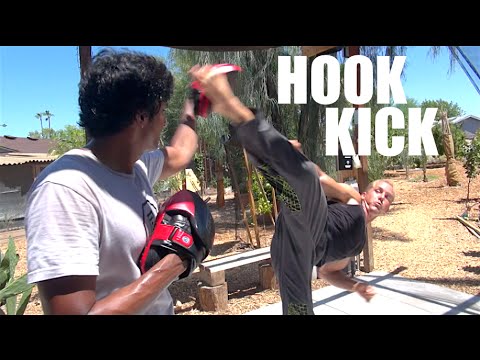
How to HOOK KICK - Amazing Martial Arts Kicking
0
Straight Leg Hook Kick·Kung Fu & Tai Chi Center w/ Jake Mace
How to HOOK KICK - Amazing Martial Arts Kicking. Here's my short tutorial on how all Martial Artists, especially Kung F…
Translation: Chokkyaku (直脚) = straight leg, Kagi (鉤) = hook, Geri (蹴り) = kick — a hook kick delivered with the leg kept straight throughout, creating a wider arc and longer reach than the standard bent-knee hook kick
The Straight Leg Hook Kick is delivered with the kicking leg kept straight (or nearly straight) throughout the entire hooking arc, creating a wider trajectory and longer reach than the standard bent-knee hook kick while relying entirely on hip rotation for power rather than the typical knee-snap that characterises the standard version. [1] In the standard hook kick (huryeo chagi in taekwondo, ura mawashi geri in karate), the knee chambers first, the leg extends to full length as it passes the target, then the knee bends to 'hook' the heel back into the target from behind — a retraction-based striking mechanism. [1] The Straight Leg variant eliminates the retraction: the entire leg swings through the arc as a single rigid unit, and the hooking action comes from the hip rotation continuing past the target, sweeping the heel across the target surface in a wide arc from outside to inside. [1] This produces a fundamentally different impact: the standard hook kick snaps backward into the target (a whip-like retraction), while the Straight Leg Hook sweeps through the target (a bat-like swing), delivering heavier but slower impact with significantly more follow-through. [1] De Bremaeker and Faige document the Straight Leg Hook Kick as the first variant in the hook kick chapter of their 89-kick compilation, noting that its wider arc and different timing make it effective against opponents who have trained to defend the standard hook kick's retraction-based rhythm. [1] The technique is sometimes called the 'wheel kick' when delivered at head height, referencing the wheel-like circular motion of the fully extended leg. [1] In taekwondo and sport karate competition, the Straight Leg Hook Kick has produced numerous spectacular head-kick knockouts because the wide arc approaches the head from an angle that the standard frontal guard cannot cover — the heel arrives from behind and above the ear, a direction that conventional hand guards do not protect. [2]
The Straight Leg Hook Kick appears across multiple martial arts traditions that favour wide, sweeping circular leg movements. [1] In taekwondo, both ITF and WT systems include straight-leg hooking variations as standard competition techniques. [2] In capoeira, the armada and meia lua de compasso use similar fully-extended circular leg sweeps as core techniques. [1] In Northern Chinese kung fu and wushu, sweeping hook kicks with straight legs are common in both forms and combat applications. [1] De Bremaeker and Faige documented the technique as Section 5.1 in their 2010 compilation, placing it as the first variant in the hook kick family. [1] The technique has gained prominence in modern competition through highlight-reel head-kick knockouts, particularly in taekwondo where the heel sweeping around the opponent's guard produces some of the sport's most dramatic finishes. [2]
The Straight Leg Hook Kick is one of the most effective head-targeting techniques in martial arts because the heel approaches from a direction that the standard frontal guard cannot protect: from behind and above the ear. [1] The wide arc means the kick bypasses the guard entirely rather than impacting against it. [1] The full-length lever arm produces angular momentum sufficient for immediate knockout when the heel contacts the temple or jaw. [2] The technique is most effective as a surprise weapon — its wider arc is visible if the opponent is watching for it, so it works best when disguised by combinations, feints, or after the opponent's attention has been drawn in another direction. [1] In WT taekwondo competition, hook kicks (including the straight-leg variant) are among the highest-scoring single techniques due to the bonus points awarded for head contact. [2]
Traditional circular kicking techniques (capoeira armada, Northern kung fu sweeping kicks, TKD hook kicks) → straight-leg variant developed for competition reach and timing advantages → documented by De Bremaeker & Faige (2010). [1]
The Straight Leg Hook Kick (and its spinning variant) has produced numerous highlight-reel head-kick knockouts in WT and ITF taekwondo World Championships and Olympic Games. In kickboxing, the 'wheel kick' variant is responsible for several career-defining knockouts. In MMA, the spinning heel kick (a close relative) has produced memorable UFC finishes by fighters including Edson Barboza (spinning heel kick KO of Terry Etim, UFC 142).
No images yet for this technique.
Sign in to suggest an image.
How to HOOK KICK - Amazing Martial Arts Kicking. Here's my short tutorial on how all Martial Artists, especially Kung F…
No instructional courses yet for this technique.
Sign in to suggest a course.
Risk of injury to the person this technique is applied to
The Straight Leg Hook Kick to the head produces devastating knockouts because the heel arrives from behind and above the ear — a direction the standard frontal guard cannot protect. The full-length lever arm generates enormous angular momentum, and the heel's concentrated surface delivers high-pressure impact. Tournament knockouts from the straight-leg hook kick are among the most spectacular in martial arts competition. [1,2]
Skill level needed to execute this technique reliably
Whether this technique is allowed under major competition rule sets
Essential Book of Martial Arts Kicks (De Bremaeker & Faige, 2010)
description: [1] De Bremaeker 2010 pp.177-180, [2] Pieter 1997
Mixed Japanese-Western terminology — combines traditional Japanese terms with katakana loanwords
description: [1] De Bremaeker 2010 pp.177-180, [2] Pieter 1997
Requires excellent hamstring flexibility for the straight leg at head height
Strong hip rotators for the sole power source
Good balance on the standing leg during the wide arc
Proprioception for the follow-through (the body continues rotating after the kick)
Above-average cardiovascular fitness (the wide arc is physically demanding)
Tall practitioners with long legs gain the most absolute reach advantage
Jake Mace teaches two methods: first, hanging the leg out in a big circle while keeping it as straight as possible with a wide arc, and second, a snapped version from a chambered knee position similar to a punching snap, which is the version recommended for actual fighting.
Start with your back pocket and butt cheek facing the target, then snap the kick with a pop, flicking your leg so your heel nearly touches your own butt—this snapped version has better accuracy and speed than the wide-arc training method.
Have your partner hold targets at three different levels—high, medium, and low—and practice multiple repetitions of the snapped hook kick at each height to build consistency and accuracy.
The Straight Leg Hook Kick is delivered with the kicking leg kept straight (or nearly straight) throughout the entire hooking arc, creating a wider trajectory and longer reach than the standard bent-knee hook kick while relying entirely on hip rotation for power rather than the typical knee-snap that characterises the standard version. In the standard hook kick (huryeo chagi in taekwondo, ura mawashi geri in karate), the knee chambers first, the leg extends to full length as it passes the target, then the knee bends to 'hook' the heel back into the target from behind — a retraction-based striking mechanism.
The Straight Leg Hook Kick appears across multiple martial arts traditions that favour wide, sweeping circular leg movements. In taekwondo, both ITF and WT systems include straight-leg hooking variations as standard competition techniques.
Unified MMA: legal — Legal striking technique; WBC/Boxing: banned — All kicks prohibited in boxing; WKF: legal — Legal, chudan (body) kick scores 2 points, jodan (head) kick scores 3 points; Kyokushin: legal — Legal at full power to body and head; WT: legal — Legal, body kick 2 points, head kick 3 points, spinning body 4 points, spinni…; WAKO: legal — Legal in Full Contact and Low Kick formats; K: legal — 1/GLORY — Legal; IFMA: legal — Legal — kicks are a core Muay Thai technique
Danger rating 8/10. The Straight Leg Hook Kick to the head produces devastating knockouts because the heel arrives from behind and above the ear — a direction the standard frontal guard cannot protect. The full-length lever arm generates enormous angular momentum, and the heel's concentrated surface delivers high-pressure impact. Tournament knockouts from the straight-leg hook kick are among the most spectacular in martial arts competition.
The standard setup chain: Establish jab-cross combinations to draw the opponent's guard high and central → Opponent focuses on defending straight-line attacks from the front → Initiate the Straight Leg Hook with explosive hip rotation → Extended leg sweeps in a wide arc from outside → Heel travels around the opponent's guard, approaching from behind and above the ear → Heel impacts the temple or jaw from the unguarded direction → The wide arc's follow-through carries the heel THROUGH the target → Knockout or severe stunning → If missed: recover to fighting stance quickly or flow into a follow-up technique.
Standard counters include: Duck under the arc — the straight-leg hook travels at head height; ducking below the arc avoids it entirely / Step inside — closing distance before the wide arc develops jams the kick at short range where it cannot generate power / Lean back — pulling the head back as the heel approaches causes it to sweep through empty space / Straight counter — the wide arc exposes the kicker's back during the middle of the rotation; a fast straight counter ….
Common variants: Standard Straight Leg Hook (rear leg) (the full-power version using the rear leg with complete h…); Lead Leg Straight Hook (faster delivery from the front leg for surprise scoring); Spinning Straight Leg Hook (adding a 180° spin before the hook for additional rotatio…); Low Straight Leg Hook (targeting the body or legs with the sweeping arc); Jumping Straight Leg Hook (adding a jump for height and spectacle); 360° Straight Leg Hook (full rotation before the hook (approaching the 360 Spin C…).
The Straight Leg Hook Kick (and its spinning variant) has produced numerous highlight-reel head-kick knockouts in WT and ITF taekwondo World Championships and Olympic Games. In kickboxing, the 'wheel kick' variant is responsible for several career-defining knockouts.
Top errors to watch for: Bending the knee during the arc — the defining error: if the knee bends and then snaps, the technique becomes a stand… / Insufficient hip rotation — without the knee snap, incomplete hip rotation produces a weak, short-arc kick. The hip m… / Targeting with the ball of the foot — the HEEL must be the contact surface (dorsiflexion presenting the calcaneus). T… / Over-committing the body — the wider arc and follow-through make the Straight Leg Hook difficult to abort mid-motion.….
The Straight Leg Hook Kick is also known as Chokkyaku Kagi Geri, Extended Hook Kick, Stiff-Leg Hook Kick, Full-Arc Hook Kick, Wheel Kick (when targeting the head).