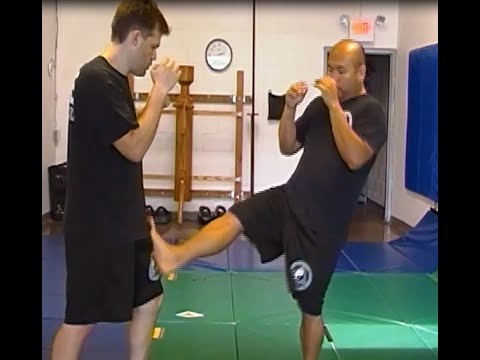
JKD - Basics of the Stomp Kick (Dum Tek) - Jon Jone's Oblique Kick
0
Oblique Hook Kick·Elite Academy of Martial Arts, GA
A demonstration of the stomp kick or dum tek from Jun Fan Jeet Kune Do. The basic stomp kick is demonstrated, and then …
Translation: Oblique hook kick
The Oblique Hook Kick is delivered at a non-standard angle, typically with a downward or upward component added to the standard horizontal arc. [1] The angled trajectory targets unusual areas and bypasses defences calibrated for horizontal hooks. [1]
Offers specific tactical advantages over the standard hook kick in appropriate situations. [1]
Cross-style martial arts kicking tradition; documented in kick compendiums. [1]
Primarily a training, demonstration, and point-fighting technique. Rarely seen in full-contact MMA or kickboxing due to acrobatic risk and telegraphing. Appears occasionally in TKD and point-fighting karate tournaments. [1]
No images yet for this technique.
Sign in to suggest an image.
A demonstration of the stomp kick or dum tek from Jun Fan Jeet Kune Do. The basic stomp kick is demonstrated, and then …
No instructional courses yet for this technique.
Sign in to suggest a course.
Risk of injury to the person this technique is applied to
Hook Kick variant with standard striking power
Skill level needed to execute this technique reliably
Whether this technique is allowed under major competition rule sets
Essential Book of Martial Arts Kicks (De Bremaeker & Faige, 2010)
[1] De Bremaeker & Faige, Essential Book of Martial Arts Kicks (2010)
Requires solid hook kick foundation
Good balance and coordination
Documented in De Bremaeker & Faige, Section 5.6. A hook kick delivered at a diagonal angle — the hooking arc comes from an oblique trajectory rather than horizontal. (De Bremaeker & Faige, Essential Book of Martial Arts Kicks, 2010)
You want to hit right above the knee with the heel; if you're wearing a shoe, you can aim right for the knee itself, but without shoes aim slightly above it to avoid injuring your foot.
Take your front foot and turn it slightly to the outside as you begin the kick, then return it to neutral and repeat. This turning motion is the key to generating the stomp kick properly.
You can use it after punching combinations (e.g., one-two-three then kick), use feints to create openings (throwing fake strikes before committing to the kick), or apply it at close range while trapping by stomping on the side of the knee.
The Oblique Hook Kick is delivered at a non-standard angle, typically with a downward or upward component added to the standard horizontal arc. The angled trajectory targets unusual areas and bypasses defences calibrated for horizontal hooks.
The Oblique Hook Kick is a specialised variant documented in cross-style kicking methodology. It represents an advanced development of the standard hook kick.
Unified MMA: legal — Legal striking technique; WBC/Boxing: banned — All kicks prohibited in boxing; WKF: legal — Legal, chudan (body) kick scores 2 points, jodan (head) kick scores 3 points; Kyokushin: legal — Legal at full power to body and head; WT: legal — Legal, body kick 2 points, head kick 3 points, spinning body 4 points, spinni…; WAKO: legal — Legal in Full Contact and Low Kick formats; K: legal — 1/GLORY — Legal; IFMA: legal — Legal — kicks are a core Muay Thai technique
Danger rating 6/10. Hook Kick variant with standard striking power
The standard setup chain: Feint → Oblique Hook Kick → Follow-up combination.
Standard counters include: Step inside range / Block and counter / Low kick to support leg.
Common variants: High variant; Mid variant; Low variant.
Primarily a training, demonstration, and point-fighting technique. Rarely seen in full-contact MMA or kickboxing due to acrobatic risk and telegraphing.
Top errors to watch for: Attempting without solid hook kick foundation / Poor balance / Insufficient power generation.
The Oblique Hook Kick is also known as Oburīku Fukku Kikku, Angled Hook Kick, Diagonal Hook Kick.