Foot Distance Measurement
The horse stance requires consistent foot spacing, with a five-step distance serving as an accessible starting point for most practitioners. Distance can be measured using either single-foot progression (heel-toe alternating) or double-foot progression (both heels, then both toes). The choice of method affects the resulting width, so practitioners should select one approach and maintain consistency during development.
Foot Position and Knee Alignment
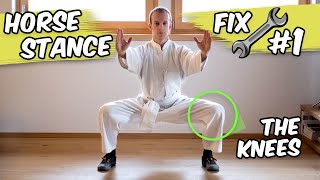
Feet may be positioned either forward-facing or slightly outward depending on individual biomechanics and comfort. Forward-facing foot position is recommended for practitioners without knee pain, while a slight outward angle can alleviate knee discomfort during prolonged holds. Both positions are mechanically valid when executed correctly.
Hip and Pelvic Positioning
The hip should be held in posterior pelvic tilt, with the buttocks tucked underneath rather than protruding outward. This positioning establishes proper spinal alignment and distributes load effectively through the lower body during the stance.
Arm Position and Upper Body Alignment
Arms extend straight forward at approximately shoulder height, creating a counterbalance that reduces demand on the legs. The shoulders should protract forward while the chest remains relaxed, with bent elbows and wrists. The posture resembles holding a large ball of air, maintaining relaxation in the hands and fingers.
Depth Calibration Using the Stick Method
Proper depth is achieved when hips and knees align horizontally, which can be measured by balancing a stick across the middle of the quadriceps. If the stance is too deep, the stick falls toward the hip; if too shallow, it rolls toward the knee. The stick should remain stationary in the middle of the quadriceps, indicating optimal depth.
Progressive Training Methods
Time-based progression involves increasing hold duration by 10 seconds weekly, while distance-based progression expands foot spacing from five to six, seven, or eight steps to develop middle-split flexibility. When practitioners encounter a time plateau, hand positioning can be shifted to rest behind the thigh, increasing quadriceps demand and breaking through resistance before returning to the standard arm position.
Lactic Acid Management and Breath Control
The burning sensation experienced during extended holds results from lactic acid accumulation when demand exceeds energy utilization. Consistent practice improves lactic acid threshold, which correlates directly with respiratory capacity—breathing control reduces lactic acid onset severity. Maintaining calm, steady breathing throughout the stance significantly reduces perceived pain and extends sustainable hold time.
Training Milestones
A five-minute horse stance represents an intermediate checkpoint rather than a final objective, allowing practitioners to assess foundational strength development. Practitioners may discontinue training at this milestone or continue progressive work depending on their broader martial arts or conditioning goals.
How to HORSE STANCE 马步 | Tutorial
Key Takeaways
- •Foot Distance Measurement
- •Foot Position and Knee Alignment
- •Hip and Pelvic Positioning
- •Arm Position and Upper Body Alignment
Join The Tao Way Tribe! https://www.youtube.com/channel/UCgDhr26GyehuNj6YlCUt53A/join Why the horse stance is important: https://youtu.be/h2Xd8gjTHFw •FOLLOW https://www.instagram.com/torresjr.antonio/ •PATREON https://www.patreon.com/Thetaoway •ONLINE SUPPORT [email protected] •WEBSITE www.taowaymove.com Hello humans and welcome back to another video! In today’s video I show you how to perform the horse stance or in Chinese 马步 (Ma Bu). If you enjoyed this video feel free to share and subscribe for future content!
Frequently Asked Questions
What does this video teach about horse stance?
This video covers foot distance measurement, foot position and knee alignment, hip and pelvic positioning. It provides detailed instruction from The Tao Way 陶道.
How long does it take to learn horse stance?
The basic mechanics can be understood in a single session, but developing reliable execution requires consistent drilling over weeks of practice. This 8-part breakdown helps structure your training by isolating each phase of the technique.
What are the key details for finishing horse stance?
The burning sensation experienced during extended holds results from lactic acid accumulation when demand exceeds energy utilization. Consistent practice improves lactic acid threshold, which correlates directly with respiratory capacity—breathing control reduces lactic acid onset severity. Maintaining calm, steady breathing throughout the stance significantly reduces perceived pain and extends sustainable hold time.