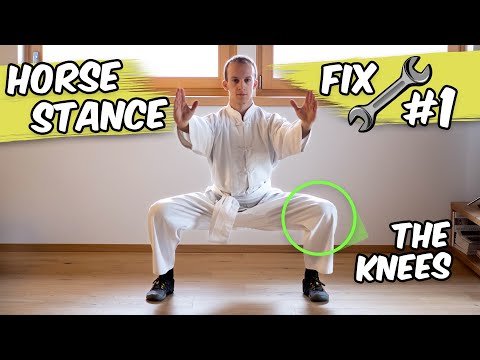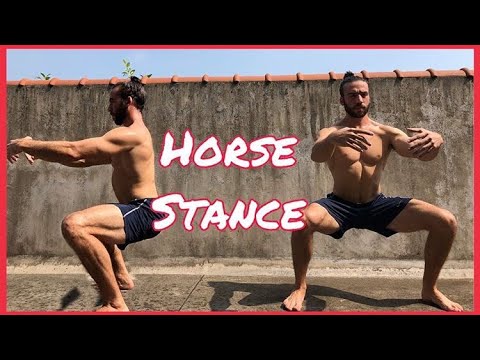
How to HORSE STANCE 马步 | Tutorial
0
Horse Stance·The Tao Way 陶道
Join The Tao Way Tribe! https://www.youtube.com/channel/UCgDhr26GyehuNj6YlCUt53A/join Why the horse stance is important…
Translation: rider's stance / horse-riding stance
The Horse Stance (kiba-dachi in Japanese, ma bu in Chinese) is a wide low-stance position with both feet pointing forward, knees deeply bent, and weight distributed equally between both legs — as if seated on a horse. [1],[2] The torso remains upright and the hips press downward; the depth of the stance directly correlates to the lateral stability and grounding it provides. [1] Used as a static training position to build leg endurance, hip mobility and structural alignment, and as a fighting stance in side-thrust kicks (yoko geri kekomi), middle blocks, and certain hand techniques where lateral force generation matters more than mobility. [1],[3] Horse stance is foundational in karate, kung fu, and Korean traditional martial arts, and is one of the first stances taught after natural stance. [2]
Horse stance is one of the oldest documented martial-arts stances, present in classical Chinese kung fu (where it's known as ma bu and is a foundational training stance in styles like Hung Gar, Wing Chun internal training, and Northern Long Fist) and codified into Japanese karate by Funakoshi as kiba-dachi. [1],[2] The stance was adapted from the bracing posture used by mounted soldiers and farmers — a low wide base for transferring downward force or absorbing lateral impact. [1],[3]
As a fighting stance, horse stance is mostly used in specific scenarios — side thrust kicks (yoko geri kekomi), certain middle-block sequences, and traditional kata/form transitions — rather than as a primary fighting position because it lacks the forward-backward mobility a sparring stance requires. [1],[2] As a training stance, it is universally regarded as foundational for leg conditioning, hip mobility, and lateral stability development across karate, kung fu, and Taekwondo curricula. [1],[2],[3] Modern strength-and-conditioning research validates the stance's training value: extended horse stance hold sessions correlate with measurable improvements in lower-body isometric endurance and ankle dorsiflexion range. [3] Many Shotokan and Kyokushin schools require advanced students to hold the stance for 5-10 minutes as a grading prerequisite. [2],[5]
Classical Chinese kung fu (ma bu) is the historical antecedent — present in Hung Gar, Northern Long Fist, Shaolin, and Wing Chun (in modified internal training forms). [1],[2] The stance was adapted into Okinawan karate as 'kiba-dachi' through cultural exchange between Okinawa and Fujian Province in the 18th-19th centuries. [1] Gichin Funakoshi codified the modern Shotokan version in his 1935 Karate-Do Kyohan and brought it to Japan as part of the karate curriculum, after which Mas Oyama incorporated a deeper, more extended version into Kyokushin. [1],[2],[3] Korean martial arts (Taekwondo, Hapkido) inherited the stance via early 20th-century cultural exchange with Japan. [4]
Used in WKF (World Karate Federation) and ITF (International Taekwon-Do Federation) kata / poomsae / forms competition — appears in nearly every traditional kata, including Shotokan's Tekki series, Heian Sandan, Bassai-Dai, and Kanku-Dai. [1] Not directly judged in isolation but a key transitional stance in every JKA and Kyokushin black-belt grading. [2] In Chinese kung fu wushu competition, ma bu features in Long Fist (changquan) and Southern Style (nanquan) routines. [3] In modern competitive sparring (kumite, kickboxing, MMA), the stance has been largely replaced by mobile fighting stances, though the side-thrust-kick chamber from horse stance continues to feature in TKD and karate kumite.
No images yet for this technique.
Sign in to suggest an image.
Join The Tao Way Tribe! https://www.youtube.com/channel/UCgDhr26GyehuNj6YlCUt53A/join Why the horse stance is important…
The horse stance (馬步 - Mǎ bù in Chinese) forms the foundation of every style of chinese Kung Fu. In this first video of…
No instructional courses yet for this technique.
Sign in to suggest a course.
Risk of injury to the person this technique is applied to
Stance — no inherent danger; risk is to the practitioner's own knees if held with poor alignment for extended training periods
Skill level needed to execute this technique reliably
Whether this technique is allowed under major competition rule sets
Gichin Funakoshi — Karate-Do Kyohan: The Master Text (Kodansha International, 1935; English ed. 1973)
Description sources — [1] Karate-Do Kyohan (Funakoshi); [2] Chinese ma bu pedagogy; [3] Mas Oyama This Is Karate
Standard Japanese martial arts terminology (kanji/hiragana)
Established Japanese martial arts naming convention — native Japanese term (和語/漢語)
Description sources — [1] Funakoshi Karate-Do Kyohan (1935 first edition is the canonical Shotokan reference); [2] Chinese ma bu pedagogy across Hung Gar and Northern Long Fist traditions; [3] Mas Oyama This Is Karate (Kyokushin canon); [4] Hidetaka Nishiyama (Funakoshi student, brought Shotokan to America); [5] modern strength-conditioning research on isometric stance training
Description sources — [1] Funakoshi Karate-Do Kyohan (1935 first edition is the canonical Shotokan reference); [2] Chinese ma bu pedagogy across Hung Gar and Northern Long Fist traditions; [3] Mas Oyama This Is Karate (Kyokushin canon); [4] Hidetaka Nishiyama (Funakoshi student, brought Shotokan to America); [5] modern strength-conditioning research on isometric stance training
hip flexor flexibility, quadriceps endurance, ankle stability
quadriceps (knee flexion holding), gluteus medius (hip stabilization), erector spinae (upright posture), tibialis anterior (foot grip)
Horse stance is the foundational wide-stance position in traditional Asian martial arts. Often the very first stance taught after natural stance. The depth of the stance is style-dependent — Shotokan tends shallower (knees ~100°), Chinese kung fu and Okinawan styles tend deeper (knees ~90° or below). Both ankle and knee alignment are non-negotiable for safety in long holds.
The Tao Way recommends a five-step mabu, which you can measure by starting with feet together and stepping heel-out, toe-out five times in each direction. This distance works well for most practitioners.
The Tao Way suggests that if you have no knee pain, feet facing forward is preferable; however, if you experience knee pain, angling the feet outward is also acceptable.
Keep your arms straight out in front of you with shoulders protracted forward but chest relaxed, elbows and wrists slightly bent, and fingers relaxed—it should look like you're holding a big ball of air with minimal tension.
The Tao Way explains that the burning sensation is caused by lactic acid buildup when holding the position for extended periods; this sensation improves over time with consistent training.
The Horse Stance (kiba-dachi in Japanese, ma bu in Chinese) is a wide low-stance position with both feet pointing forward, knees deeply bent, and weight distributed equally between both legs — as if seated on a horse. The torso remains upright and the hips press downward; the depth of the stance directly correlates to the lateral stability and grounding it provides.
Horse stance is one of the oldest documented martial-arts stances, present in classical Chinese kung fu (where it's known as ma bu and is a foundational training stance in styles like Hung Gar, Wing Chun internal training, and Northern Long Fist) and codified into Japanese karate by Funakoshi as kiba-dachi. The stance was adapted from the bracing posture used by mounted soldiers and farmers — a low wide base for transferring downward force or absorbing lateral impact.
WKF Karate: legal — Legal stance; All competition rule sets: legal — stances are not regulated by competition rules; they are positional foundatio…
Danger rating 1/10. Stance — no inherent danger; risk is to the practitioner's own knees if held with poor alignment for extended training periods
The standard setup chain: Step Out to Shoulder-Width-Plus → Bend Knees to 90° → Square Hips and Tuck Pelvis → Verify Spine Vertical → Hold Position or Transition.
Standard counters include: Mobility — opponent simply moves around the static stance; horse stance is poor for chasing / Sweep attacks against the rear leg — the wide low base is vulnerable to inside reaping / Long-range kicks — the practitioner can't close distance from a deep horse.
Common variants: Standard Kiba-dachi (Shotokan karate) (feet straight forward, knees over toes, hips squared); Ma Bu (Chinese kung fu) (slightly wider, deeper stance, more weight distribution e…); Shiko-dachi (sumo / okinawan karate) (feet turned outward at 45°; sometimes treated as a separa…); Half-horse (shallower depth used during forms transitions).
Used in WKF (World Karate Federation) and ITF (International Taekwon-Do Federation) kata / poomsae / forms competition — appears in nearly every traditional kata, including Shotokan's Tekki series, Heian Sandan, Bassai-Dai, and Kanku-Dai. Not directly judged in isolation but a key transitional stance in every JKA and Kyokushin black-belt grading.
Top errors to watch for: Knees collapsing inward (knee valgus) — long-term knee damage risk / Stance too narrow — loses the lateral stability advantage of the horse stance over natural stance / Heels lifting — converts the stance to a high cat-stance variant; defeats the grounding purpose / Forward lean of the torso — disconnects the legs from the upper body's force generation.
The Horse Stance is also known as Kiba-dachi, Ma Bu, Mǎ Bù, Straddle Stance, Riding Stance.