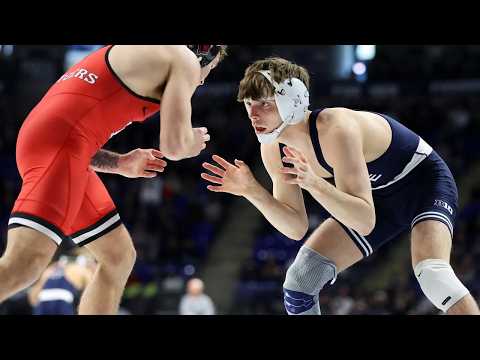
The Secrets to a Great Wrestling Stance
0
Staggered Wrestling Stance·Seth Ciasulli
I got a superchat asking me to detail Marcus Blaze's stance, which leads me to the question: What does it mean to be in …
Translation: staggered wrestling stance
The Staggered Wrestling Stance subfamily covers the low, wide fighting stance used in wrestling, with one foot slightly forward, knees deeply bent, and a low centre of gravity. [1] The wrestling stance is optimised for takedown offence and defence, with the low centre of gravity making it harder for opponents to shoot underneath and the wide base providing stability against throws and trips. [1],[2] The stance keeps the hands low and forward, ready to sprawl, underhook, or shoot for takedowns. [2],[3]
The staggered wrestling stance is the standard wrestling position with one foot forward. [1]
Used in all wrestling competition formats. [1]
No images yet for this technique.
Sign in to suggest an image.
I got a superchat asking me to detail Marcus Blaze's stance, which leads me to the question: What does it mean to be in …
No instructional courses yet for this technique.
Sign in to suggest a course.
Risk of injury to the person this technique is applied to
Standing positions are pre-engagement stances; minimal direct risk
Skill level needed to execute this technique reliably
Whether this technique is allowed under major competition rule sets
Karate-Do Kyohan: The Master Text (Gichin Funakoshi, 1935)
Alias sources — [1] UWW Wrestling Rules [2] UWW Wrestling Rules [3] UWW Wrestling Rules
Effectiveness sources — [1] Kodokan Judo (Kano, 1986)
Mixed Japanese-Western terminology — combines traditional Japanese terms with katakana loanwords
Alias sources — [1] UWW Wrestling Rules [2] UWW Wrestling Rules [3] UWW Wrestling Rules
Effectiveness sources — [1] Kodokan Judo (Kano, 1986)
balance, lower body stability, quick directional change
well-proportioned build with strong base
calves, quadriceps, core, hip stabilisers
Every move, in any martial art, shares a few universal traits. Mix and match below to pinpoint the right tool — or compare equivalents across styles.
According to Seth Ciasulli, a good test is whether you can touch the mat with your hand without lowering your knees any further—if you can't do this comfortably, you're not low enough. Being low to the mat with bent knees gives you better head position and makes it harder for opponents to shoot underneath you.
Your head should be up with your hairline pointed roughly at your opponent's face—this protects your nose while still allowing you to make contact and block shots effectively. A low head position helps you resist snap downs and develops a strong neck, which is crucial for college-level wrestling.
No—while you should be able to touch the mat quickly for down blocks against shots, you shouldn't put weight on your hands as this alters your center of gravity, affects balance, and makes your arms a target for your opponent.
Being on both feet in a low stance maintains your mobility and offensive capability, whereas putting a knee down may help defensively but hampers your ability to attack and leaves you vulnerable to pop-ups or your opponent shooting a double underneath.
The Staggered Wrestling Stance subfamily covers the low, wide fighting stance used in wrestling, with one foot slightly forward, knees deeply bent, and a low centre of gravity. The wrestling stance is optimised for takedown offence and defence, with the low centre of gravity making it harder for opponents to shoot underneath and the wide base providing stability against throws and trips.
The wrestling stance has been developed over thousands of years of wrestling tradition, refined through Olympic wrestling, collegiate wrestling, and folk-style wrestling programmes. It represents the optimal stance for takedown-based combat.
Unified MMA: legal — Legal; IBJJF: legal — Legal; IJF: legal — Legal; WBC/Boxing: legal — Legal — stance and footwork are fundamental; WKF: legal — Legal; UWW: legal — Legal
Danger rating 2/10. Low — standing positions are pre-engagement stances; minimal direct risk
The standard setup chain: Achieve Position → Stabilize → Maintain → Attack.
Standard counters include: Posture Control — maintain strong posture to limit the opponent's offensive options / Escape to Neutral — work back to standing or a neutral position.
Common variants: Standard variation (primary positioning for control and attack); Offensive variation (configured for submission or striking opportunities); Transitional variation (positioned for quick movement to the next position); Defensive variation (prioritising stability and control over attack).
Used in all wrestling competition formats.
Top errors to watch for: Standing too upright in a wrestling stance — the low hips and bent knees are essential for explosive shots / Keeping the hands at face level as in a boxing stance — wrestling hands are lower for tie-ups and shots / Placing the feet too close together — the staggered stance needs adequate front-to-back spacing for stability / Not moving in the wrestling stance — constant motion and level changes make the stance effective.
The Staggered Wrestling Stance is also known as Sutaggādo Resuringu Kamae, Staggered Stance, Split Stance, Wrestling Crouch.